Physics · Ch 4 — Thermodynamics
Heat Added During a Thermodynamic Process
Heat Added During a Thermodynamic Process
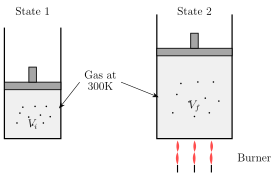
Just as the work done depends on the path taken, so does the heat transferred to a system — even between the same two endpoint states. This is shown using two different routes by which an ideal gas, confined to a cylinder with a movable piston, can be taken from an initial volume to the same final volume .
Route 1 — controlled isothermal expansion. The gas is heated slowly and carefully, in a controlled manner, so that it expands to the final volume while its temperature is held constant throughout (isothermally). Because the change is slow and controlled, the system absorbs a finite, well-defined amount of heat during the expansion, and correspondingly does a finite amount of work on the piston.
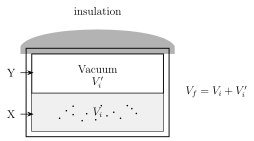
Route 2 — sudden, uncontrolled free expansion. Now imagine the same amount of gas, at the same initial temperature, confined instead to compartment (volume ) of an insulated cylinder that is divided by a thin, breakable partition from an empty (vacuum) compartment (volume , with ). The partition is suddenly broken. The gas rushes to fill the whole combined volume essentially instantaneously. Because the cylinder is insulated, no heat crosses its boundary at all (); and because the gas is not pushing against any piston or other movable surface as it expands into the vacuum, no work is done either (). This uncontrolled process is called free expansion. …
Drawn by us to help you understand the concept clearly, and verified to make sure it's accurate. For exams, practice from your textbook's own diagram.
What this figure shows. A gas at 300 K in a cylinder (State 1) is heated slowly by a burner and expands to State 2 at the same temperature. Because the change is slow and controlled it stays at constant temperature; the system absorbs heat (Q > 0) and does work on the pi …
Drawn by us to help you understand the concept clearly, and verified to make sure it's accurate. For exams, practice from your textbook's own diagram.
What this figure shows. An insulated cylinder divided by a thin partition: compartment X holds gas (volume Vi), compartment Y is a vacuum (volume Vi'). When the partition suddenly breaks the gas expands freely to fill Vf = Vi + Vi'. No heat crosses the insulation (Q = 0) and the gas pushes no piston, so no work is done (W = 0) — a free …