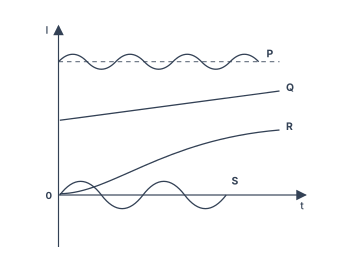
Q.The figure shows variation of current (I) with time (t) in four devices P, Q, R and S. The device in which an alternating current flows is : (A) P (B) Q (C) R (D) S
🔒You're viewing a preview — the full solution, concept, methods & PYQ mapping are locked.
🔒 Start your 14-day free trial to unlock the full solution →Concept understanding — RMS and Peak Value
Why We Need a New Measure
When you push a DC current through a resistor, the power is constant — P=I2R, and the heating is steady. But an AC current keeps changing direction and magnitude. At one instant it's +I0, a moment later it's zero, then −I0. If you simply averaged the current over time, you'd get zero — because the positive and negative halves cancel. That's useless for telling you how much heat the resistor actually feels.
So we need a single number that captures the effective heating power of an alternating current. That number is the RMS value.
The Intuition: Squaring Fixes the Sign Problem
Heat depends on I2, not on I. Squaring the current makes every instant positive — a negative current squared gives the same heat as a positive one of the same magnitude. So instead of averaging the current (which gives zero), we average the square of the current, then take the square root to get back to a current-like number. That's the root-mean-square: Root of the Mean of the Square.
For a sinusoidal current i(t)=I0sin(ωt), the square is I02sin2(ωt). The average of sin2 over a full cycle is exactly 1/2. So:
mean of i2=I02×21
Then:
Irms=2I02=2I0
Irms=2I0andVrms=2V0
The Physical Meaning
If you take a resistor and pass a sinusoidal current of peak value I0 through it, the average power dissipated is exactly the same as if you passed a steady DC current of I0/2 through it. That's why RMS is called the "equivalent DC" value.
When you see "230 V AC" on a household outlet, that 230 V is the RMS voltage. The peak voltage is 230×2≈325 V. The wire insulation has to handle 325 V peaks, but the heating effect is the same as 230 V DC.
Peak Value
The peak value I0 (or V0) is simply the maximum instantaneous value the waveform reaches. For a sine wave, it's the amplitude. The RMS value is always smaller than the peak — by a factor of 2 for a pure sine wave. …
Concept: Alternating current (AC) is defined by periodic reversal of direction — the current must oscillate symmetrically about zero, taking both positive and negative values.
Examine each graph:
-
P oscillates sinusoidally but remains entirely above the time axis (positive offset); the current never reverses direction — this is a pulsating DC with an AC ripple superimposed on a DC level.
-
Q shows a steadily increasing current (linear rise); unidirectional, no reversal. …
Alternating current periodically reverses direction, meaning it must cross zero and take both positive and negative values. Only curve S oscillates symmetrically about the time axis, so the answer is (D).
The defining feature of alternating current is that it changes direction periodically. In a graph of current versus time, this means the current must cross the horizontal axis (where I=0) and spend equal time flowing in both directions—positive and negative values.
Direct current, by contrast, flows in one direction only. It may vary in magnitude (pulsating DC, increasing DC, etc.), but it never reverses sign.
Let's examine each device:
-
Device P: The curve oscillates sinusoidally but remains entirely above the time axis. It never crosses I=0. This is a pulsating unidirectional current—the kind produced by a half-wave rectifier, for instance. The current varies in magnitude but always flows in the same direction.
-
Device Q: The current increases linearly with time, always positive. This is a steadily increasing direct current, perhaps from a charging capacitor or a ramping power supply. Again, unidirectional. …
Showing the 12 most recent of 40 on this concept.
- CBSE 2026Set A1 markMCQQ.The voltage of domestic ac is 220 V. What does this represent? (A) Peak value voltage (B) Mean value voltage (C) Root mean voltage (D) Root mean square voltage
›Reveal solutionSolution
The 220 V of domestic mains is the RMS (root-mean-square) voltage.
An AC voltage varies sinusoidally, so it is specified by an effective value that produces the same heating as an equivalent DC — the root-mean-square (RMS) value. Household ratings such as "220 V" are RMS values. The peak val …
- CBSE 2026Set ANNUAL1 markMCQQ.The ratio of root mean square (rms) value and peak value of an alternating current is(a) 1 : 1(b) 1 : 2(c) √2 : 1(d) 1 : √2
›Reveal solutionSolution
For a sinusoidal alternating current i = i0 sin(omega t), the rms value is i0/root2, so the ratio rms:peak is 1:root2.
RMS (root mean square) value is defined so that it produces the same heating effect as an equivalent DC. For i = i0 sin(omega t), averaging i^2 over a …
- CBSE 2026Set ANNUAL1 markMCQQ.The mean value of an alternating current in a half cycle is(a) I0/sqrt(2)(b) I0/2(c) 2*I0/pi(d) none of these
›Reveal solutionSolution
Averaging I = I0sin(omegat) over one half cycle (0 to pi/omega) gives 2*I0/pi - this is the standard 'mean/average value of AC'.
For a sinusoidal current I = I0sin(omegat), the average over a FULL cycle is zero (positive and negative halves cancel exactly). So the 'mean value' of AC is conventionally defined over just a HALF cycle, where the current keeps one sign throughout. Averaging:
I_mean = (1/T') * integral of I0sin(omegat) dt, over one half period T' = pi/omega
…
- CBSE 2026Set SEM31 markMCQQ.Statement I : Direct current (DC) is less dangerous than alternating current (AC). Statement II : The rms value of the alternating current (AC) is 70·7% of the peak value.(a) Only Statement I is true.(b) Only Statement II is true.(c) Both Statements I and II are true.(d) Both Statements I and II are false.
›Reveal solutionSolution
Statement I is true (AC of equal rated voltage is generally more dangerous than DC), and Statement II is true (rms value = peak/√2 = 70·7% of peak). Hence option (c).
Statement I: For the same magnitude, alternating current is generally considered more dangerous than direct current, largely because AC can cause sustained muscular contraction and its effective (rms) value acts continuously. So DC being 'less dangerous' is accepted as true.
…
- CBSE 2026Set SEM31 markMCQQ.The equation of an alternating electromotive force is E = 220 sin(100πt − π/15) V, here t is in second. Its rms value and frequency are respectively(a) (220/√2) V, 50 Hz(b) 220 V, 50 Hz(c) (220/√2) V, 100 Hz(d) 220√2 V, 50 Hz
›Reveal solutionSolution
Compare E = 220 sin(100πt − π/15) with E = E₀ sin(ωt + φ): E₀ = 220 V and ω = 100π. Then E_rms = E₀/√2 = 220/√2 and f = ω/2π = 50 Hz. Option (a).
Step 1 — peak value: E₀ = 220 V, so the rms value E_rms = E₀/√2 = 220/√2 V.
Step 2 — angular frequency: ω = 100π rad/s.
Step 3 — frequency: f = ω/(2π) = 100π/(2π) = 50 Hz.
…
- CBSE 2026Set SEM31 markMCQQ.The ratio of rms value and average value of current for a half cycle of an AC circuit is(a) √2 : π(b) √2 : 1(c) 2√2 : π(d) π : 2√2
›Reveal solutionSolution
For a sinusoid, I_rms = I₀/√2 and the half-cycle average I_avg = 2I₀/π. Their ratio is (1/√2)/(2/π) = π/(2√2), i.e. π : 2√2. Option (d).
Step 1 — rms value of a sinusoidal current: I_rms = I₀/√2.
Step 2 — average value over a half cycle: I_avg = 2I₀/π (NCERT/CBSE Class 12 Physics, Alternating Current).
Step 3 — form the ratio: …
- CBSE 2025Set 55/4/11 markMCQQ.An ammeter connected in series in an ac circuit reads 10 A. The maximum value of current at any instant in the circuit is: (A) 102 A (B) 210 A (C) π10 A (D) 2π10 A
›Reveal solutionSolution
An AC ammeter reads the RMS (root-mean-square) value of current. For a sinusoidal AC, the peak (maximum) current is 2 times the RMS value. Given RMS = 10 A, the maximum current is 102 A.
The key here is understanding what an AC ammeter actually measures. Unlike a DC ammeter, which reads the average current, an AC ammeter is calibrated to read the RMS value of the current. For a sinusoidal alternating current, the RMS value is the "effective" value — it tells you the equivalent DC current that would produce the same heating effect in a resistor.
The relationship between the RMS value (Irms) and the peak or maximum value (I0) for a pure sine wave is:
Irms=2I0orI0=Irms×2
This comes from averaging the square of the sine function over one cycle. The factor 2 (approximately 1.414) is a fixed mathematical result for sinusoidal waveforms.
Now let's apply this directly to the problem.
-
The ammeter reading is given as 10 A. Since it's an AC ammeter, this is the RMS current: Irms=10 A.
-
We want the maximum instantaneous current, which is the peak value I0. Using the formula above:
I0=Irms×2=10×2 A
- That's it. No further calculation needed. The maximum value is simply 102 amperes. …
-
- CBSE 2025Set D1 markMCQQ.The peak value of an alternating current is 10 A. Its root mean square value will be (A) 5 A (B) 7.07 A (C) 10 A (D) 14.14 A
›Reveal solutionSolution
The rms value of a sinusoidal current is the peak value divided by √2: 10/√2 ≈ 7.07 A.
For a sinusoidal alternating current, the root-mean-square value relates to the peak (amplitude) value by
Irms=2I0
…
- CBSE 2025Set A1 markQ.Write True or False: Average value of alternating current is zero for full cycle.
›Reveal solutionSolution
The statement is True: over a full cycle the positive and negative halves of an AC waveform exactly cancel, giving zero average.
For a sinusoidal alternating current i=I0sinωt, the average value over one complete cycle is found by integrating over a full period T:
Iavg=T1∫0TI0sinωtdt=0
…
- CBSE 2025Set A1 markQ.Write answer in one sentence: Write the root mean square value of alternating current.
›Reveal solutionSolution
The rms value of a sinusoidal AC is I₀/√2, about 70.7% of its peak value.
For an alternating current i=I0sinωt, the root-mean-square (rms) value is obtained by taking the square root of the mean of i2 over one complete cycle:
Irms=T1∫0TI02sin2ωtdt=2I0≈0.707I0
…
- CBSE 2025Set ANNUAL1 markMCQQ.If the peak value of alternating voltage in a circuit is E0, then the root mean square value will be(a) E0/2(b) E0(c) E0/sqrt(2)(d) E0^2/2
›Reveal solutionSolution
For a sinusoidal quantity, the root-mean-square value is obtained by averaging the square of the waveform over a cycle and taking the square root, which gives peak/sqrt(2).
For e(t) = E0 sin(wt), the mean of sin^2(wt) over a full cycle is 1/2. So:
E_rms = sqrt( mean of e^2 ) = sqrt( E0^2 x 1/2 ) = E0 / sqrt(2)
…
- CBSE 2025Set ANNUAL1 markQ.The equation of an alternating current is I = 15 sin 100t. Find its root mean square value.
›Reveal solutionSolution
Comparing I = 15 sin(100t) with the standard form I = I0 sin(wt) gives peak current I0 = 15 A, and the rms value of any sinusoidal current is I0/sqrt(2).
The given alternating current is I = 15 sin(100t) A, matching the standard form I = I0 sin(wt) with:
I0 = 15 A (peak/amplitude), w = 100 rad/s
…
🎓Unlock everything free for 14 days
- ✓Full step-by-step solutions
- ✓Concept-first explanations
- ✓Methods, shortcuts & mistakes
- ✓PYQ mapping + timed mock tests
Full access for 14 days. No credit card required.