Q.Two circular loops A and B, each of radius , are placed coaxially at a distance of . They carry currents of and in opposite directions respectively. Find the net magnetic field at the centre of loop A.
You're viewing a preview — the full solution, concept, methods & PYQ mapping are locked.
Start your 14-day free trial to unlock the full solution →The net magnetic field at the center of loop A is the vector sum of the field produced by loop A itself and the field produced by loop B. Since the currents are in opposite directions, these fields oppose each other. The net magnetic field is directed away from loop B.
The problem asks for the net magnetic field at the center of loop A. This net field is the vector sum of two contributions:
- The magnetic field produced by loop A at its own center.
- The magnetic field produced by loop B at the center of loop A.
Since both loops are circular and coaxial, their magnetic fields at any point on their common axis will also be directed along this axis. Therefore, we need to determine the magnitude and direction of each field component and then perform a vector sum. The key is to correctly identify the direction of each field using the right-hand thumb rule, especially considering the currents are in opposite directions.
Let's assume the common axis of the loops is the x-axis. Let the center of loop A be at and the center of loop B be at .
-
Identify given parameters:
- Radius of each loop, .
- Distance between loops, . This is the distance from the center of loop B to the center of loop A.
- Current in loop A, .
- Current in loop B, .
- Currents are in opposite directions.
-
Magnetic field due to loop A at its own center ():
We use the formula for the magnetic field at the center of a circular current loop.
The magnetic field at the center of a circular loop of radius carrying current is given by:
Let's assume the current in loop A is counter-clockwise when viewed from a point on the positive x-axis. By the right-hand thumb rule, the magnetic field at the center of loop A will point along the positive x-axis (away from loop B).
Substituting the values:
(directed along the positive x-axis).
-
Magnetic field due to loop B at the center of loop A ():
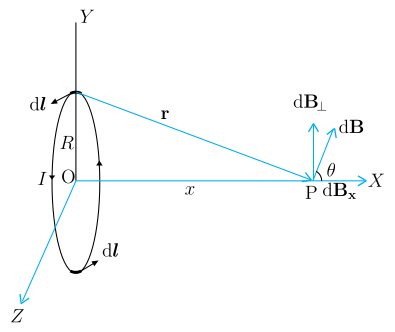
We use the formula for the magnetic field on the axis of a circular current loop. The center of loop A is on the axis of loop B, at a distance from the center of loop B.
The magnetic field on the axis of a circular loop of radius carrying current , at a distance from its center, is given by:
Since the current in loop B is in the opposite direction to loop A, and we assumed loop A's current is counter-clockwise, loop B's current must be clockwise (when viewed from a point on the positive x-axis). By the right-hand thumb rule, the magnetic field produced by loop B at any point on its axis (including the center of loop A) will point along the negative x-axis (towards loop B).
Substituting the values: , , . …
Unlock everything free for 14 days
- Full step-by-step solutions
- Concept-first explanations
- Methods, shortcuts & mistakes
- PYQ mapping + timed mock tests
Full access for 14 days. No credit card required.