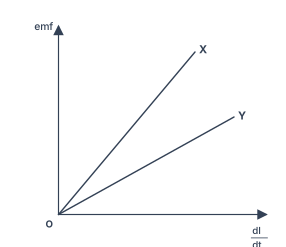
Q.(a) The figure shows the variation of induced emf as a function of the rate of change of current for two identical solenoids X and Y. One is air cored and the other is iron cored. Which one of them is iron cored ? Why ?
You're viewing a preview — the full solution, concept, methods & PYQ mapping are locked.
Start your 14-day free trial to unlock the full solution →The induced emf in a solenoid is , so the slope of the emf vs. graph equals the self-inductance . X is iron-cored because its steeper slope means larger , and an iron core (high permeability) dramatically increases inductance. For part (b), the self-inductance of a long solenoid is .
Part (a): Identifying the iron-cored solenoid
The graph plots induced emf against the rate of change of current. The fundamental relationship governing self-inductance is
where is the self-inductance. Taking magnitudes, . This is a linear relationship: the induced emf is directly proportional to , and the constant of proportionality is precisely the self-inductance.
Both lines pass through the origin and are straight, confirming this linear relationship. The slope of each line therefore equals the self-inductance of that solenoid.
Looking at the graph, line X has a steeper slope than line Y. This means .
Now, what determines the self-inductance of a solenoid? For a solenoid with turns, length , and cross-sectional area , the self-inductance is
where is the permeability of the core material. For air (or vacuum), . For iron, , where the relative permeability can be hundreds or even thousands.
Since the two solenoids are otherwise identical (same , , ), the only difference is the core material. The iron-cored solenoid will have a self-inductance that is times larger than the air-cored one.
A common mistake is to confuse which line corresponds to which solenoid. Remember: steeper slope = larger inductance = iron core. The iron core doesn't reduce inductance; it amplifies it enormously.
Solenoid X is iron-cored because it has the larger self-inductance, evidenced by the steeper slope of its emf vs. line.
Part (b): Self-inductance of a long solenoid
Self-inductance quantifies how much magnetic flux a coil links with itself per unit current. For a solenoid, we build this from first principles.
1. Magnetic field inside a long solenoid
When a current flows through a solenoid of turns uniformly distributed over length , the number of turns per unit length is . The magnetic field inside a long solenoid (far from the ends) is uniform and given by
This field is directed along the axis and is independent of position inside the solenoid.
2. Magnetic flux through one turn
Each turn of the solenoid is a loop of cross-sectional area . The magnetic flux through one turn is
…
Unlock everything free for 14 days
- Full step-by-step solutions
- Concept-first explanations
- Methods, shortcuts & mistakes
- PYQ mapping + timed mock tests
Full access for 14 days. No credit card required.