Q.(a)
🔒You're viewing a preview — the full solution, concept, methods & PYQ mapping are locked.
🔒 Start your 14-day free trial to unlock the full solution →Part (a)Concept understanding — Drift Velocity
Drift Velocity: The Slow March of Electrons
Electrons in a metal are always moving — but randomly. At room temperature they zip around at roughly 106 m/s, colliding with the lattice ions every few trillionths of a second. Without an electric field this motion cancels out: for every electron heading left another heads right, so the net velocity is zero.
Apply a battery and the field gives every electron a tiny, steady push in one direction. Between collisions the electron accelerates only briefly before smashing into an ion and losing its directed motion. What survives is a very small average velocity along the field — the drift velocity.
The random thermal speed is about 105 m/s, but the drift velocity is only about 10−4 m/s — about a billion times slower. An electron drifts slower than a snail, yet a lamp lights instantly, because the electric field (not the electrons) propagates at nearly the speed of light and starts every electron drifting almost at once.
The precise definition
Drift velocity (vd) is the average velocity acquired by the charge carriers in a conductor under an applied electric field:
vd=meEτ
where:
- e = electron charge (1.6×10⁻¹⁹ C)
- E = electric field inside the conductor (V/m)
- τ = average relaxation time — the mean time between collisions (s)
- m = electron mass (9.1×10⁻³¹ kg)
vd=meEτ
Linking to current
Drift velocity connects the microscopic motion of electrons to the current an ammeter reads:
I=neAvd
where n is the free-electron number density and A the cross-sectional area. A larger vd means more current, but vd stays tiny because τ is tiny (about 10−14 s in copper).
For a copper wire carrying 1 A with area 1 mm² and n≈8.5×1028 m−3:
vd=neAI≈(8.5×1028)(1.6×10⁻¹⁹)(10−6)1≈7×10⁻⁵ m/s …
Why this formula?
Drift Velocity: Why the Formula Holds
Let's build this from first principles — understanding why electrons drift the way they do, not just memorizing the formula.
1. The Core Idea: What is Drift Velocity?
In a conductor, free electrons are constantly moving randomly (thermal motion, speeds ~105 m/s). Without an electric field, their net displacement is zero — they're like a swarm of bees buzzing in all directions.
When we apply an electric field E, it gently nudges each electron in the opposite direction (since electrons are negatively charged). This small, steady net velocity superimposed on the random motion is drift velocity (vd).
Key insight: Drift velocity is not the speed of individual electrons — it's the average velocity of the entire electron cloud.
2. The Derivation: Step by Step
Step 1: Force on a single electron
An electron of charge −e in an electric field E experiences:
F=−eE
The magnitude of acceleration (opposite to E) is:
a=mF=meE
where m is the electron's mass.
Step 2: What happens between collisions?
Electrons don't accelerate forever — they keep colliding with atoms/ions in the metal lattice. Let the average time between collisions be τ (relaxation time). Just after a collision an electron's velocity is essentially random (zero average in the field direction); it then accelerates for time τ before the next collision.
Step 3: Drift velocity
Averaging the field-driven velocity over the relaxation time τ gives the net drift:
vd=meEτ
Here τ is the average time since the last collision, so this expression already averages over electrons at every stage between collisions — it is the standard result used in the NCERT treatment.
3. Connecting to Current: The Big Picture
Drift velocity directly gives us current density J:
J=nevd
where n = number of free electrons per unit volume. …
Part (b)Concept understanding — Power Dissipation in Resistors
Power Dissipation in Resistors
Whenever charge is driven through a resistor, electrical energy is converted into heat. The rate of this conversion is the power dissipated.
Why a Resistor Heats Up
Inside a resistor, drifting electrons repeatedly collide with the vibrating lattice ions. Each collision transfers kinetic energy to the lattice, raising its temperature. The source (battery or AC supply) continually does work to keep the current flowing, and that work reappears as heat. This is Joule heating.
The Power Formulas (DC)
The power delivered to any device carrying current I across a potential difference V is
P=VI
For an ohmic resistor V=IR, so this can be written in three equivalent forms:
P=VI=I2R=RV2
The SI unit is the watt (W), where 1 W=1 J s−1.
Which form to use depends on what is fixed:
- Series elements share the same current, so P=I2R shows the larger resistor dissipates more.
- Parallel elements share the same voltage, so P=V2/R shows the smaller resistor dissipates more.
The total heat produced in time t is Q=Pt=I2Rt — Joule's law of heating.
Power Dissipation with AC
With alternating current the instantaneous power p(t)=i2(t)R fluctuates, but a resistor still only dissipates energy (it never returns any). The average power over a cycle is written with root-mean-square values:
Pavg=Irms2R=RVrms2=VrmsIrms
where for a sinusoid Irms=Im/2 and Vrms=Vm/2. This is precisely why rms values are defined: an AC of rms value Irms heats a resistor at the same average rate as a steady DC of value Irms.
A pure resistor has power factor 1 — voltage and current are in phase, so all the power supplied is dissipated. In inductors and capacitors, by contrast, the average dissipated power is zero; energy is only stored and returned.
Worked Example
A 100 Ω resistor carries a current of 0.5 A. …
Why this formula?
Power Dissipation in Resistors — Why the Formula Holds
Let's build this from first principles. The goal is to understand why a resistor dissipates power as heat, and how the formula P=I2R (and its equivalents) arise naturally.
1. What is "Power" in an Electrical Circuit?
Power is the rate of energy transfer — how much energy is converted from one form to another per unit time.
- In a resistor, electrical energy is converted into heat (thermal energy).
- The fundamental definition of electrical power is:
P=V⋅I
where:
- P = power (watts, W)
- V = voltage across the component (volts, V)
- I = current through the component (amperes, A)
Why this definition?
Voltage is energy per unit charge (V=qW), and current is charge per unit time (I=tq). Multiplying them gives energy per unit time — exactly power.
2. How Does a Resistor Behave? — Ohm's Law
A resistor obeys Ohm's Law:
V=I⋅R
where R is resistance (ohms, Ω). This is an empirical law — it describes how real resistors behave: the voltage across them is proportional to the current through them.
3. Deriving the Power Dissipation Formulas
We start with P=VI and substitute Ohm's Law in two ways.
Case A: Express power in terms of I and R
Replace V with IR:
P=(IR)⋅I=I2R
Interpretation:
- For a fixed resistance, power grows with the square of current.
- Doubling current quadruples the heat generated — this is why high currents cause wires to overheat.
Case B: Express power in terms of V and R
Replace I with RV:
P=V⋅(RV)=RV2
Interpretation:
- For a fixed voltage, power is inversely proportional to resistance.
- A low-resistance resistor (like a short circuit) dissipates huge power at a given voltage — that's why short circuits are dangerous.
4. The Physical "Why" — Energy Conversion at the Atomic Level
Why does this energy turn into heat?
- Electrons moving through a resistor collide with the atoms of the material.
- Each collision transfers kinetic energy from the electron to the atom, making the atom vibrate more — i.e., heating up the resistor.
- The rate at which this energy is lost by the electrons (and gained by the lattice) is exactly P=I2R.
Key insight:
The I2 term appears because:
- More current = more electrons per second. …
Current, drift velocity and energy in a circuit
Part (a) — mobility, field/drift along a wire, resistor network
(i) Mobility μ=Evd = drift speed per unit field. SI unit: m2V−1s−1.
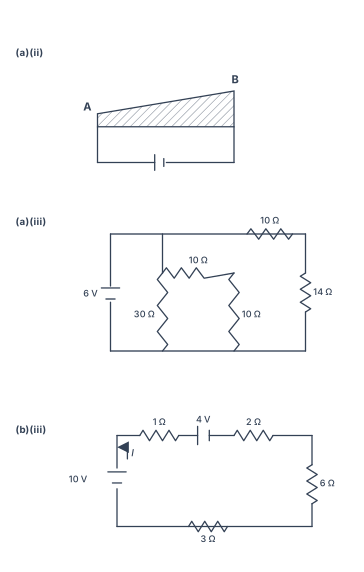
(ii) Steady current is the same everywhere, but the wire AB widens, so J=I/A falls from A to B. Since E=J/σ and vd=J/(ne), both the electric field and the drift velocity decrease from A to B.
(iii) The three parallel branches: 10+14=24 Ω, 10+10=20 Ω, 30 Ω.
Reff1=241+201+301=1205+6+4=12015=81⇒Reff=8 Ω, …
Along a widening wire both E and vd fall (lower current density). Network: Reff=8 Ω, I=0.75 A. Opposing-battery loop: net emf 6 V, I=0.5 A, energy in one minute =180 J.
Part (a) — mobility, conduction along a wire, resistor network
(i) Mobility is the drift velocity acquired per unit applied field, μ=Evd; units V/mm/s=m2V−1s−1.
(ii) In steady state the current I is identical at every cross-section. The wire AB has increasing cross-section, so the current density J=I/A decreases from A to B. Because E=J/σ and vd=J/(ne) with σ,n,e constant, both E and vd decrease from A to B.
Constant current does not mean constant drift velocity — vd depends on current density, which drops as the area grows.
(iii) Three parallel branches across 6 V:
- R1=10+14=24 Ω, R2=10+10=20 Ω, R3=30 Ω. Reff1=241+201+301=1205+6+4=81 ⇒ Reff=8 Ω, …
Showing the 12 most recent of 39 on this concept.
- CBSE 2026Set 55/1/11 markMCQQ.Two heaters rated as (P1,V) and (P2,V) are connected in series across a dc source of 2V volt. The power consumed by the combination will be (A) (P1+P2) (B) 2P1+P2 (C) 2(P1+P2)P1P2 (D) 4(P1+P2)P1P2
›Reveal solutionSolution
Each heater's resistance is found from its rated power and voltage; in series across 2V, the total power dissipated is 4(P1+P2)P1P2.
Why this approach works
When a device is rated at (P,V), it means that at voltage V it consumes power P. This rating tells us the device's resistance through P=RV2, so R=PV2. Once we know the resistances, we can treat the heaters as ordinary resistors in a series circuit and calculate the actual power consumed at the new operating voltage.
The key insight: rated values describe behavior at a specific voltage, but resistance is an intrinsic property that doesn't change. We extract the resistance from the rating, then analyze the actual circuit.
Step-by-step solution
-
Find the resistance of each heater from its rating.
For heater 1 rated at (P1,V):
R1=P1V2
For heater 2 rated at (P2,V):
R2=P2V2
-
Calculate the total resistance in series.
When connected in series, resistances add:
Rtotal=R1+R2=P1V2+P2V2=V2(P11+P21)=V2⋅P1P2P1+P2
-
Apply the actual supply voltage.
The combination is connected across 2V. The power consumed by a resistor is:
P=RtotalVapplied2
Substituting:
P=V2⋅P1P2P1+P2(2V)2=V2⋅P1P2P1+P24V2
- Simplify the expression. …
-
- CBSE 2026Set 55/2/11 markMCQQ.Two statements are given – one labelled Assertion (A) and the other Reason (R). Select the correct answer from the codes below: (A) Both (A) and (R) are true and (R) is the correct explanation of (A). (B) Both (A) and (R) are true, but (R) is not the correct explanation of (A). (C) (A) is true, but (R) is false. (D) (A) is false and (R) is also false. Assertion (A) : Two electric heaters of power P1 and P2(>P1) are joined in series across a dc source of voltage V. The power consumed by the combination will be less than that consumed by P1 when connected across the same source. Reason (R) : The power consumed by an electric device when connected to a dc source of voltage V is proportional to its resistance.
›Reveal solutionSolution
The key idea is that in series, the combined resistance is larger than either heater's resistance, so the total power drawn from the source is smaller. The assertion is true; the reason is false because power is inversely proportional to resistance for a fixed voltage, not proportional.
Concept and intuition
When you connect a device to a fixed DC voltage source V, the power it consumes is given by P=V2/R. For a fixed voltage, power is inversely proportional to resistance — a higher resistance draws less current and therefore consumes less power. The reason statement gets this backwards.
Now, when two heaters are joined in series, their resistances add up. Since each heater's resistance is Ri=V2/Pi (from Pi=V2/Ri), the series combination has a total resistance Rseries=R1+R2, which is larger than either R1 or R2 alone. With a larger resistance, the power drawn from the same voltage source must be smaller than the power drawn by either individual heater. In particular, it will be less than P1 (the smaller power heater, which has the larger resistance). So the assertion is correct, but for a reason opposite to what is stated.
Step-by-step reasoning
- Express each heater's resistance in terms of its rated power. For a heater rated at power P when connected to voltage V, we have P=V2/R, so R=V2/P. Therefore:
R1=P1V2,R2=P2V2.
Since P2>P1, it follows that R2<R1 (higher power means lower resistance).
- Find the total resistance when they are in series.
Rseries=R1+R2=V2(P11+P21).
Clearly Rseries>R1 (and also >R2).
- Compute the power consumed by the series combination. Using P=V2/R again:
Pseries=RseriesV2=V2(P11+P21)V2=P11+P211=P1+P2P1P2.
- Compare Pseries with P1. Since P1>0, we have P1+P2>P2, so Pseries=P1+P2P1P2<P2P1P2=P1. …
- CBSE 2026Set ANNUAL1 markMCQQ.Drift velocity Vd varies with the intensity of electric field E as per the relation(a) Vd is proportional to E^2(b) Vd is proportional to 1/E(c) Vd is proportional to sqrt(E)(d) Vd is proportional to E
›Reveal solutionSolution
Drift velocity is the (small) average velocity electrons gain between collisions due to the electric field, and it comes out directly proportional to E.
When an electric field E is applied to a conductor, each free electron experiences a force F = eE, giving it an acceleration a = eE/m between collisions with the lattice ions. If tau is the average time between collisions (relaxation time), the average extra velocity gained (the drift velocity) is
vd = a * tau = (eE/m) * tau = (e*tau/m) * E
…
- CBSE 2026Set ANNUAL1 markQ.If the current flowing in a copper wire be allowed to flow in another copper wire of same length but of doubled the radius then what will be the effect on the drift velocity of the electron?
›Reveal solutionSolution
For the same current, vd∝1/A, and doubling the radius quadruples the cross-sectional area.
Current is related to drift velocity by I=nAevd, so for the same current I (and the same material, hence the same n), vd=nAeI∝A1. If the radius is doubled, the cross-sectional area A=πr2 becomes 4 times larger. So the drift velocity becomes
…
- CBSE 2026Set ANNUAL1 markQ.State Ohm's law in terms of current density, specific conductance and electric field intensity.
›Reveal solutionSolution
Microscopic Ohm's law: current density J = σE (σ = conductivity, E = field).
The usual Ohm's law is V = IR. In microscopic (vector) form, it relates the current density J (current per unit cross-sectional area) to the electric field E inside the conductor through the material's specific conductance (conductivity) σ:
J = σ E.
…
- CBSE 2026Set SEM31 markMCQQ.Which of the following statement(s) is/are true ? A potential difference of V is applied at the two ends of a conductor of length l and area of cross-section A. Statement I : When potential difference is doubled, current density also gets doubled. Statement II : When potential difference is doubled, drift velocity gets halved. Statement III : When area of cross-section is doubled, current density decreases.(a) I and II are true(b) Only I is true(c) Only III is true(d) II and III are true
›Reveal solutionSolution
Doubling V doubles E, so J = σE and v_d = μE both double — Statement I true, Statement II (drift velocity halved) false. J = V/(ρl) is independent of area, so Statement III (J decreases when A doubles) is also false. Only I is true → option (b).
Statement I: J = σE and E = V/l, so doubling V doubles E and hence doubles the current density J. TRUE.
Statement II: drift velocity v_d = (eE/m)τ ∝ E ∝ V. Doubling V doubles v_d, it does not halve it. FALSE.
…
- CBSE 2025Set D1 markMCQQ.The relation between drift velocity v of free electrons in conductor in electric conduction and potential difference V between ends of conductor is (A) proportional to V (B) inversely proportional to V (C) proportional to V^2 (D) inversely proportional to V^2
›Reveal solutionSolution
Drift velocity is directly proportional to the potential difference V.
In a conductor of length L across which a potential difference V is applied, the electric field is E = V/L. Free electrons acquire a drift velocity
vd=meEτ=mLeVτ …
- CBSE 2025Set D1 markMCQQ.If the length of a conductor is doubled while keeping the potential difference across it constant, then the drift velocity of electron will (A) remain the same (B) be double (C) be halved (D) increase fourfold
›Reveal solutionSolution
Doubling the length at constant V halves the drift velocity.
The drift velocity is
vd=meEτ=mLeVτ …
- CBSE 2025Set ANNUAL1 markMCQQ.If R1 and R2 are respectively the filament resistance of a 200 W bulb and a 100 W bulb designed to operate on the same voltage, then –(a) R1 = 2R2(b) R2 = 2R1(c) R2 = 4R1(d) R1 = 4R2
›Reveal solutionSolution
Since power P=V2/R at fixed voltage, the lower-power bulb has the higher filament resistance.
Both bulbs operate at the same voltage V. Using P=RV2, so R=PV2.
For the 200 W bulb: R1=200V2
For the 100 W bulb: R2=100V2=2002V2=2R1
…
- CBSE 2025Set ANNUAL1 markMCQQ.A thick wire is stretched so that its length becomes two times. What is the ratio of change in resistance of the wire to the initial resistance of the wire?(i) 2 : 1(ii) 4 : 1(iii) 3 : 1(iv) 1 : 4
›Reveal solutionSolution
New resistance is 4 times the old, so the change is 3 times the original: ratio 3 : 1.
Resistance R=ρL/A. Stretching keeps the volume AL constant, so if length doubles (L→2L) the area halves (A→A/2). Then R′=ρ(2L)/(A/2)=4ρL/A=4R. The change in …
- CBSE 2025Set ANNUAL1 markMCQQ.Calculate the amount of charge flowing in 2 minutes in a wire of resistance 10 ohm when a potential difference of 20 volts is applied between its ends.(i) 120 C(ii) 240 C(iii) 20 C(iv) 4 C
›Reveal solutionSolution
Q = It = (V/R) x t = 2 A x 120 s = 240 C.
…
- CBSE 2024Set 55/2/11 markMCQQ.Electrons drift with speed vd in a conductor with potential difference V across its ends. If V is reduced to 2V, their drift speed will become : (A) 2vd (B) vd (C) 2vd (D) 4vd
›Reveal solutionSolution
Drift speed is directly proportional to the applied potential difference for a given conductor, so halving V halves vd. The new drift speed is 2vd, which is option (A).
The key here is understanding what drift speed actually depends on. Many students memorise the formula vd=neAI and then try to relate I to V via Ohm's law — that works, but it's easy to lose track of which quantities stay constant. Let's build it from the physics up.
Drift speed is the average velocity electrons acquire due to an electric field inside the conductor. That field is E=V/L, where L is the length of the conductor. The force on each electron is eE, and in the steady state, this force is balanced by collisions with the lattice, giving a constant drift speed proportional to the field. So the fundamental proportionality is:
vd∝Eand sinceE=LV,we getvd∝V
for a fixed conductor (fixed L, fixed material properties like relaxation time τ, mass m, charge e).
Now let's walk through it step by step.
-
Start with the microscopic relation. The drift speed is given by vd=meEτ, where τ is the average time between collisions (relaxation time). This comes from F=eE=ma, and then vd=aτ. For a given conductor at a fixed temperature, τ, m, and e are constants.
-
Express the electric field in terms of the applied voltage. For a conductor of length L, the uniform electric field inside is E=V/L. So:
vd=me(V/L)τ=(mLeτ)V
The quantity in parentheses is constant for a given conductor. So vd is directly proportional to V.
-
Apply the change. If V becomes V/2, then:
vd′=(mLeτ)⋅2V=21(mLeτ)V=2vd …
-
🎓Unlock everything free for 14 days
- ✓Full step-by-step solutions
- ✓Concept-first explanations
- ✓Methods, shortcuts & mistakes
- ✓PYQ mapping + timed mock tests
Full access for 14 days. No credit card required.