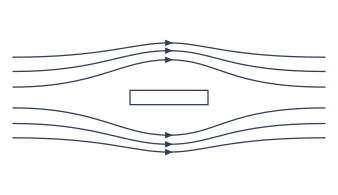
Q.The magnetic field lines near a substance are as shown in the figure. The substance is : (A) Copper (B) Iron (C) Sodium (D) Aluminium
Concept understanding — Diamagnetism
Diamagnetism: The Quiet Repulsion
Imagine you bring a magnet near a piece of copper or water. Nothing dramatic happens — no strong pull like iron, no noticeable push. But if you had a very sensitive scale, you'd detect a tiny repulsion. The material is pushed away, ever so slightly. That's diamagnetism.
Why does this happen? The key is that in a diamagnetic material, every atom has zero net magnetic moment to begin with. All its electrons are paired up — each electron's tiny magnetic field is cancelled by its partner. The atom is magnetically neutral.
Now bring an external magnetic field. Something subtle occurs: the field slightly distorts the motion of the orbiting electrons. According to Lenz's law, the electrons respond by creating a tiny induced magnetic moment that opposes the applied field. This is like a weak electromagnetic shield — the material generates its own field pointing opposite to the external one.
This induced moment is temporary. Remove the external field, and the material returns to being magnetically neutral. No permanent magnetism remains.
The result? The material is weakly repelled. The strength of this repulsion is measured by magnetic susceptibility χ, which for diamagnets is small and negative — typically around −10−5 to −10−6.
The Precise Statement
Diamagnetism is the property of materials whose atoms have no permanent magnetic dipole moment. When placed in an external magnetic field B, the orbital motion of electrons induces a magnetic moment m opposite to B, leading to a negative magnetic susceptibility χ<0.
m=−6mee2⟨r2⟩B
where e is electron charge, me its mass, and ⟨r2⟩ the mean square orbital radius.
The susceptibility is:
- Small in magnitude (∣χ∣∼10−5)
- Negative (repulsion)
- Independent of temperature — because it arises from orbital motion, not from thermal alignment of permanent moments
Unlike paramagnets and ferromagnets, diamagnetism is present in all materials. But it's usually masked by stronger magnetic effects. Only in materials with no unpaired electrons (like copper, bismuth, water, and most organic compounds) does diamagnetism become the dominant response.
Common Examples
| Material | χ (approx.) | Behaviour |
|---|---|---|
| Bismuth | −1.66×10⁻⁴ | Strongest diamagnet among elements |
| Copper | −9.7×10⁻⁶ | Weakly repelled |
| Water | −9.0×10⁻⁶ | Pure water is diamagnetic |
| Graphite | −1.6×10⁻⁴ | Anisotropic — stronger along certain axes |
| A common mistake: thinking diamagnets are "non-magnetic". They are magnetic — just very weakly, and in the opposite direction. A diamagnet in a non-uniform field will move toward the weaker field region, not toward the magnet.
Why Temperature Doesn't Matter
In paramagnetism, thermal energy randomises the alignment of permanent atomic moments, so χ depends on temperature (Curie's law). In diamagnetism, there are no permanent moments to randomise. The induced moment is purely a response to the applied field, arising from the fundamental orbital motion of electrons. Temperature has almost no effect on this — the orbits are fixed by quantum mechanics, not by thermal agitation.
So diamagnetism is universal, weak, temperature-independent, and always repulsive. It's the quiet, ever-present magnetic property that only reveals itself when louder voices are absent.
Diamagnetism is a standard CBSE Class 12 Physics NCERT topic under Magnetism and Matter, frequently searched as diamagnetic materials examples and properties class 12 or why diamagnetism is temperature independent. This concept is regularly paired with paramagnetism and ferromagnetism in comparison-based questions across CBSE boards and JEE Main/NEET physics.
Concept: Diamagnetic materials
The figure shows field lines bowing outward and avoiding the substance—the field is weaker inside the bar than in the surrounding space. This is the hallmark of diamagnetism: materials with relative permeability μr<1 that repel magnetic field lines.
Reasoning:
-
Diamagnetic substances (like copper) have no permanent magnetic moments; an applied field induces tiny opposing dipoles, so μr≈0.99999 and field lines are expelled.
-
Paramagnetic (sodium, aluminium) and ferromagnetic (iron) materials have μr>1; they attract field lines, which would crowd into the bar—opposite to the figure.
-
Among the options, only copper is diamagnetic; the other three would show field-line concentration, not expulsion.
The substance is (A) Copper, which is diamagnetic and repels magnetic field lines.
The field lines bow away from the substance, indicating the material expels the field — the hallmark of a diamagnetic substance. Of the options, only copper is diamagnetic.
Understanding magnetic response: how materials interact with external fields
When you place a material in an external magnetic field, its atoms respond in one of three fundamental ways, depending on their electronic structure:
Diamagnetic materials (like copper, gold, bismuth) have all electrons paired. The external field induces tiny circulating currents in the electron clouds that oppose the applied field (Lenz's law at the atomic scale). The net effect: the material develops a very weak magnetization opposite to the external field, so the field inside the material is slightly weaker than outside. Relative permeability μr<1 (typically 0.99999…). Field lines are repelled or expelled from the substance.
Paramagnetic materials (like aluminium, sodium, platinum) have unpaired electrons with permanent magnetic moments. These moments normally point randomly, but the external field aligns them along the field direction. The material develops a weak magnetization in the same direction as the applied field, so the field inside is slightly stronger. Relative permeability μr>1 (just barely, say 1.00002). Field lines are drawn into the substance.
Ferromagnetic materials (iron, cobalt, nickel) also have unpaired electrons, but with strong exchange coupling between neighbouring atoms. They form magnetic domains and can be permanently magnetized. In an external field, domains align strongly, and the field inside becomes much stronger. Relative permeability μr≫1 (thousands). Field lines crowd into the substance dramatically.
Reading the figure
The diagram shows field lines approaching a rectangular bar from the left. Crucially, the lines bow outward around the bar — they avoid entering it. The density of lines inside the bar is lower than in the surrounding space. This is the signature pattern of field expulsion.
A common mistake is to confuse "lines bending" with "attraction." If lines crowd into a material (higher density inside), the material is para- or ferromagnetic. If lines spread out and avoid the material (lower density inside), it is diamagnetic.
Classifying the options
Let's identify the magnetic character of each substance:
| Substance | Type | Field response |
|---|---|---|
| Copper | Diamagnetic | Expels field lines (as in the figure) |
| Iron | Ferromagnetic | Strongly attracts field lines |
| Sodium | Paramagnetic | Weakly attracts field lines |
| Aluminium | Paramagnetic | Weakly attracts field lines |
The figure shows field expulsion, so we need the diamagnetic substance.
Memorize the common diamagnets for exams: copper, gold, silver, bismuth, water, most organic compounds. Everything else in typical option lists (alkali metals, transition metals, aluminium) is either paramagnetic or ferromagnetic.
Only copper is diamagnetic. Iron would pull the lines in strongly (ferromagnetic); sodium and aluminium would pull them in weakly (paramagnetic). Neither matches the outward-bowing pattern.
The correct option is (A) Copper, the only diamagnetic substance in the list, which expels magnetic field lines as shown.
Showing the 12 most recent of 16 on this concept.
- CBSE 2026Set ANNUAL1 markMCQQ.Super conductor material exhibit perfectly(a) ferromagnetism(b) paramagnetism(c) diamagnetism(d) strong ferromagnetism
›Reveal solutionSolution
Superconductors show the Meissner effect - they expel magnetic field lines completely from their interior, which is the signature of perfect diamagnetism.
Below their critical temperature, superconductors develop surface currents that exactly cancel any external magnetic field inside the material, so B_inside = 0. A material with a magnetic susceptibility of exactly -1 (complete flux expulsion) is called a perfect diamagnet, and this is precisely what a superconductor exhibits.
✓Final answer(c) diamagnetism.
- CBSE 2025Set 55/6/11 markMCQQ.A piece of a diamagnetic material, free to move when placed in a uniform magnetic field: (A) moves along the field (B) moves opposite to the field (C) moves perpendicular to the field (D) does not move at all
›Reveal solutionSolution
A diamagnetic material experiences no net force in a uniform magnetic field because the induced magnetic moment opposes the field but the field gradient is zero — so the material does not move. The correct option is (D).
Why This Works
The key is the word uniform. A uniform magnetic field has the same strength and direction at every point. For any material to experience a net force, the field must be non-uniform — there must be a gradient. Diamagnetism is a weak, induced effect: when placed in a field, the material develops a tiny magnetic moment opposite to the field. But in a uniform field, equal and opposite forces on the north and south poles of this induced dipole cancel out exactly. No net force means no motion.
Watch outA classic mistake is to think diamagnetic materials are "repelled" by magnets — that's true only in a non-uniform field (like near a pole). In a uniform field, repulsion doesn't produce motion because the force is zero everywhere.
Step-by-Step Reasoning
-
Understand the nature of diamagnetism
Diamagnetic materials have no permanent magnetic dipoles. When placed in an external magnetic field B, the orbital motion of electrons changes slightly, inducing a magnetic moment m that is opposite to B. This is a weak effect, present in all materials but usually swamped by paramagnetism or ferromagnetism.
-
Force on a magnetic dipole in a field
The force on a magnetic dipole m in a magnetic field B is given by:
F=∇(m⋅B)
For a diamagnetic material, m is antiparallel to B, so m⋅B=−∣m∣∣B∣. The force becomes:
F=−∇(∣m∣∣B∣)
This force depends on the gradient of the field magnitude.
- Apply to a uniform field In a uniform magnetic field, B is constant in magnitude and direction everywhere. Therefore:
∇∣B∣=0
Consequently, F=0 at all points. The material experiences no net force.
-
What about torque?
A uniform field can exert a torque on a magnetic dipole, tending to align it with the field. But for a diamagnetic material, the induced moment is always opposite to the field — so the torque is zero (the moment is already aligned antiparallel, which is an unstable equilibrium, but no torque acts to rotate it further). Even if a tiny torque existed, the material is "free to move" translationally, not necessarily to rotate; the question asks about motion, implying translation.
-
Contrast with non-uniform fields
If the field were non-uniform (e.g., near a magnet's pole), ∇∣B∣=0, and the diamagnetic material would experience a force away from the stronger field region — the classic "repulsion" of diamagnets. But the problem explicitly states a uniform field.
TipA neat way to remember: In a uniform field, a diamagnetic material is like a neutral object in a uniform gravitational field — no net force, so no motion. The induced dipole is there, but the field doesn't "push" anywhere because it's the same everywhere.
✓Final answerThe correct option is (D): the material does not move at all.
-
- CBSE 2025Set X11 markQ.Water is an example for ________ material.
›Reveal solutionSolution
diamagnetic Water has no permanent atomic magnetic moment and is weakly repelled by a magnetic field (relative permeability slightly less than 1), so it is a diamagnetic material.
✓Final answerdiamagnetic
Water has no permanent atomic magnetic moment and is weakly repelled by a magnetic field (relative permeability slightly less than 1), so it is a diamagnetic material.
- CBSE 2024Set A11 markMCQQ.The universal property among all substances is(a) Diamagnetism(b) Paramagnetism(c) Ferromagnetism(d) Non-magnetism
›Reveal solutionSolution
(a) Diamagnetism
✓Final answer(a) Diamagnetism
Diamagnetism arises from the change in orbital motion of electrons due to an applied field and is present in every material. It is universal, though it is weak and gets masked in para- and ferromagnetic substances.
- CBSE 2024Set IMPROVEMENT1 markQ.If magnetic susceptibility χ of a magnetic material is small and negative then what type of magnetic material is this?
›Reveal solutionSolution
Small, negative susceptibility is the defining signature of a diamagnetic material.
Magnetic susceptibility χ measures how strongly a material responds to an applied magnetic field. Diamagnetic materials have a small, negative χ (typically of order −10−5), meaning they are weakly magnetised opposite to the applied field. (In contrast, paramagnetic materials have small positive χ, and ferromagnetic materials have large positive χ.) Since the given material has small and negative χ, it is diamagnetic.
✓Final answerIt is a diamagnetic material.
- CBSE 2024Set A1 markQ.Fill in the blank with appropriate word: The substances which have negative magnetic tendency are called ______ substances.
›Reveal solutionSolution
A negative magnetic susceptibility (χ < 0) identifies a diamagnetic substance.
Magnetic materials are classified by their magnetic susceptibility χ, defined by M=χH (M = magnetisation, H = magnetising field).
- Diamagnetic substances have a small negative susceptibility — they get weakly magnetised opposite to the applied field and are repelled by it (e.g., bismuth, copper, water).
- Paramagnetic substances have a small positive susceptibility.
- Ferromagnetic substances have a large positive susceptibility.
Since the question specifies a negative magnetic tendency, the answer is diamagnetic.
✓Final answerDiamagnetic substances.
- CBSE 2023Set 55/1/11 markMCQQ.A diamagnetic substance is brought near the north or south pole of a bar magnet. It will be :(a) repelled by both the poles.(b) attracted by both the poles.(c) repelled by the north pole and attracted by the south pole.(d) attracted by the north pole and repelled by the south pole.
›Reveal solutionSolution
Diamagnetic materials develop an induced magnetic moment opposite to the applied field, causing repulsion regardless of which pole approaches them. The answer is (a).
Why diamagnetic materials behave this way
When you place any material in a magnetic field, the field tries to align the tiny atomic current loops inside it. Most materials respond in one of three ways: ferromagnetic (strong attraction), paramagnetic (weak attraction), or diamagnetic (weak repulsion).
Diamagnetic substances have no permanent magnetic moments. Their atoms have paired electrons whose magnetic effects cancel out. But here's the key: when an external magnetic field approaches, it induces tiny currents in the electron orbits through Lenz's law. These induced currents create a magnetic moment that opposes the applied field—nature's way of resisting change.
Think of it this way: if you bring the north pole of a bar magnet close to a diamagnetic material, the material develops a north pole on the side facing the magnet. Two north poles repel. If you bring the south pole close instead, the material develops a south pole facing it. Two south poles also repel.
Step-by-step reasoning
-
The external field induces a moment
When either pole of the bar magnet approaches, the diamagnetic substance experiences a non-uniform magnetic field. This field penetrates the material and alters the electron orbital motion.
-
Lenz's law governs the response
The induced magnetic moment minduced is always antiparallel to the applied field Bext:
minduced=−χBext
where χ>0 is the (positive) diamagnetic susceptibility. The negative sign is the signature of diamagnetism.
- The force is always repulsive A magnetic dipole in a non-uniform field experiences a force:
F=∇(m⋅B)
Since minduced points opposite to B, the dot product m⋅B is negative and decreases as the field strengthens. The gradient points the dipole toward weaker field regions—away from the magnet pole.
- Pole identity doesn't matter Whether you bring the north or south pole close, the diamagnetic material always arranges itself to oppose the field. The repulsion is symmetric with respect to pole choice.
Watch outA common mistake is thinking "opposite poles attract" applies here. That rule works for permanent magnets or paramagnets with pre-existing moments. Diamagnets have induced moments that always oppose the field, so the usual attraction rule doesn't apply.
TipRemember: dia = "opposed to" in Greek. Diamagnetic materials are opposed to magnetic fields and try to move away from them.
Physical examples
Classic diamagnetic materials include bismuth, copper, water, and even the graphite in your pencil. The effect is weak—you need very strong field gradients to see levitation (like the famous levitating frog experiment). But the principle holds: bring any pole of a magnet near them, and they're pushed away.
✓Final answerThe correct option is (a): a diamagnetic substance is repelled by both the north and south poles of a bar magnet.
-
- CBSE 2023Set 55/4/11 markMCQQ.The magnetic field lines near a substance are as shown in the figure. The substance is : (A) Copper (B) Iron (C) Sodium (D) Aluminium
›Reveal solutionSolution
The field lines bow away from the substance, indicating the material expels the field — the hallmark of a diamagnetic substance. Of the options, only copper is diamagnetic.
Understanding magnetic response: how materials interact with external fields
When you place a material in an external magnetic field, its atoms respond in one of three fundamental ways, depending on their electronic structure:
Diamagnetic materials (like copper, gold, bismuth) have all electrons paired. The external field induces tiny circulating currents in the electron clouds that oppose the applied field (Lenz's law at the atomic scale). The net effect: the material develops a very weak magnetization opposite to the external field, so the field inside the material is slightly weaker than outside. Relative permeability μr<1 (typically 0.99999…). Field lines are repelled or expelled from the substance.
Paramagnetic materials (like aluminium, sodium, platinum) have unpaired electrons with permanent magnetic moments. These moments normally point randomly, but the external field aligns them along the field direction. The material develops a weak magnetization in the same direction as the applied field, so the field inside is slightly stronger. Relative permeability μr>1 (just barely, say 1.00002). Field lines are drawn into the substance.
Ferromagnetic materials (iron, cobalt, nickel) also have unpaired electrons, but with strong exchange coupling between neighbouring atoms. They form magnetic domains and can be permanently magnetized. In an external field, domains align strongly, and the field inside becomes much stronger. Relative permeability μr≫1 (thousands). Field lines crowd into the substance dramatically.
Reading the figure
Figure — CBSE 2023 55/4/1 Q3 The diagram shows field lines approaching a rectangular bar from the left. Crucially, the lines bow outward around the bar — they avoid entering it. The density of lines inside the bar is lower than in the surrounding space. This is the signature pattern of field expulsion.
Watch outA common mistake is to confuse "lines bending" with "attraction." If lines crowd into a material (higher density inside), the material is para- or ferromagnetic. If lines spread out and avoid the material (lower density inside), it is diamagnetic.
Classifying the options
Let's identify the magnetic character of each substance:
Substance Type Field response Copper Diamagnetic Expels field lines (as in the figure) Iron Ferromagnetic Strongly attracts field lines Sodium Paramagnetic Weakly attracts field lines Aluminium Paramagnetic Weakly attracts field lines The figure shows field expulsion, so we need the diamagnetic substance.
TipMemorize the common diamagnets for exams: copper, gold, silver, bismuth, water, most organic compounds. Everything else in typical option lists (alkali metals, transition metals, aluminium) is either paramagnetic or ferromagnetic.
Only copper is diamagnetic. Iron would pull the lines in strongly (ferromagnetic); sodium and aluminium would pull them in weakly (paramagnetic). Neither matches the outward-bowing pattern.
✓Final answerThe correct option is (A) Copper, the only diamagnetic substance in the list, which expels magnetic field lines as shown.
- CBSE 2023Set ANNUAL1 markMCQQ.An example of Diamagnetic material is ________.(a) Nickel(b) Water(c) Aluminium(d) Iron
›Reveal solutionSolution
Water is diamagnetic; nickel and iron are ferromagnetic and aluminium is paramagnetic, so water is the correct choice.
Working
Diamagnetic materials have no permanent atomic magnetic dipole moment. When placed in an external magnetic field, they develop a weak induced moment opposite to the applied field and are weakly repelled by it (small negative susceptibility).
- Nickel — ferromagnetic
- Water — diamagnetic
- Aluminium — paramagnetic
- Iron — ferromagnetic
✓Final answerThe correct option is (b): Water
- CBSE 2022Set ANNUAL1 markMCQQ.In terms of susceptibility χ, a material is diamagnetic if(a) χ is negative(b) χ is positive and small(c) χ is large and positive(d) χ is zero
›Reveal solutionSolution
Susceptibility χ=M/H measures how strongly a material magnetises in response to a field H. Diamagnetic substances develop a magnetisation opposite to H, so χ<0.
Definition of susceptibility
For a magnetic material placed in an external field of intensity H, the magnetisation M produced in it is
M=χH
where χ is the magnetic susceptibility, a dimensionless number characterising the material's magnetic response.
Classifying materials by χ
- Diamagnetic: χ is small and negative (typically −10−5 to −10−6). The induced dipole moments oppose H, so the material is feebly repelled by a magnet (e.g. bismuth, copper, water).
- Paramagnetic: χ is small and positive (typically 10−3 to 10−5). The material is feebly attracted (e.g. aluminium, sodium).
- Ferromagnetic: χ is large and positive (order 103–105), showing strong attraction and hysteresis (e.g. iron, cobalt, nickel).
A diamagnetic material's atoms have no net permanent dipole moment; the field they develop (via Lenz's-law-like induced atomic currents) always opposes the applied field — exactly the condition χ<0.
✓Final answer(a) χ is negative
- CBSE 2020Set ANNUAL1 markQ.What is diamagnetic substances?
›Reveal solutionSolution
Diamagnetic substances develop a weak magnetisation opposite to an applied magnetic field and are repelled, however weakly, by magnets.
When certain substances are placed in an external magnetic field B, the field induces a small magnetic moment in the material directed opposite to B. Such substances are called diamagnetic substances.
Key properties:
- Magnetic susceptibility χ is small and negative.
- Relative permeability μr is slightly less than 1.
- They are weakly repelled by a strong magnet (move from stronger to weaker field regions).
- Magnetisation is independent of temperature (mostly) and disappears when the external field is removed.
- This behaviour arises because the applied field induces orbital currents in the atoms that oppose the field (Lenz's law at the atomic level); diamagnetism is present in all materials but is usually masked by stronger para/ferromagnetic effects if present.
Examples: bismuth, copper, silver, gold, water, and most organic compounds.
✓Final answerDiamagnetic substances are those which get feebly magnetised opposite to the applied magnetic field and are weakly repelled by magnets — e.g. bismuth, copper, water.
- CBSE 2019Set ANNUAL1 markQ.What is the value of relative magnetic permeability of perfectly diamagnetic substance?
›Reveal solutionSolution
A perfectly diamagnetic material completely expels magnetic field lines from its interior, so its relative permeability is zero.
For a diamagnetic substance the magnetic susceptibility χ is small and negative. For a perfect diamagnet (the idealised/superconducting limit), χ=−1. Since μr=1+χ, this gives μr=1+(−1)=0 — meaning B=0 inside the material (complete flux exclusion, as seen in the Meissner effect of superconductors).
✓Final answerμr=0.
🎓Unlock everything free for 14 days
- ✓Full step-by-step solutions
- ✓Concept-first explanations
- ✓Methods, shortcuts & mistakes
- ✓PYQ mapping + timed mock tests
Full access for 14 days. No credit card required.