Biology · Ch 3 — Inheritance and Variation
Pleiotropy
Pleiotropy
d. Pleiotropy :
Pleiotropy is the phenomenon in which a single gene influences two or more apparently unrelated traits simultaneously, and the gene responsible is called a pleiotropic gene. The chapter's example is sickle-cell anaemia in humans, caused by the recessive allele HbS against the normal dominant allele HbA. Heterozygous carriers (HbA HbS) show only a mild form of the condition — their red blood cells become sickle- (half-moon-) shaped only under unusually low oxygen concentration — while individuals homozygous for the recessive allele (HbS HbS) suffer full sickle-cell anaemia and, in the chapter's account, do not survive.
Because the homozygous recessive class is lost, a cross between two carriers (HbA HbS × HbA HbS) does not yield the usual 1:2:1 ratio of surviving offspring; instead the affected homozygotes die, leaving carriers and normal individuals among survivors in an altered 2:1 ratio. The gene is therefore pleiotropic in a very concrete sense — the very same allele simultaneously determines both the shape of the red blood cell and, in double dose, the severity and lethality of the resulting anaemia — showing two distinct outcomes from what is, at root, a single genetic change.
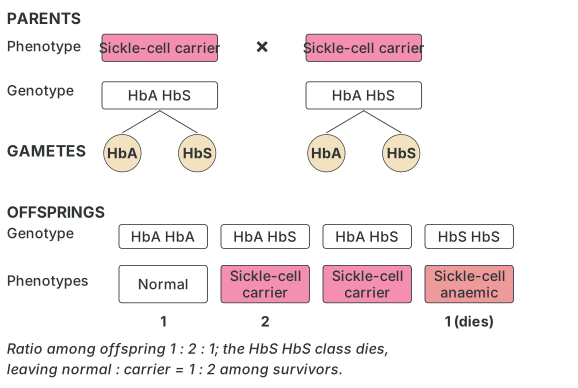
Drawn by us to help you understand the concept clearly, and verified to make sure it's accurate. For exams, practice from your textbook's own diagram.
What this figure shows. Shows a cross between two sickle-cell carriers (HbA HbS x HbA HbS) to illustrate how one gene, HbS, produces more than one distinct effect: heterozygotes only show mild anaemia under low oxygen while homozygous HbS HbS individuals die of severe anaemia, so the recessive homozygote class is lost and the surviving offspring appear in an altered 1 normal : 2 carrier ratio ra …
…