Physics · Ch 12 — Electromagnetic Induction
Motional emf in a Rotating Bar
Motional emf in a Rotating Bar
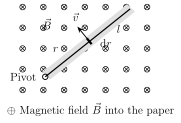
A rotating bar is a genuinely different case from a sliding bar, because different points along its length move at different speeds. Consider a conducting rod pivoted at one end and rotating with angular velocity in a magnetic field perpendicular to the plane of rotation. Take a small element of the rod of length dr, at a distance r from the pivot: this element moves with (tangential) speed , and -- exactly as for a sliding conductor -- has a small motional emf induced in it, .
Since all such elements along the rod's length can be imagined as tiny emf sources connected in SERIES, their individual emfs simply add. Integrating from the pivot (r = 0) to the free end (r = l) gives the total emf induced across the rotating rod: . …
Drawn by us to help you understand the concept clearly, and verified to make sure it's accurate. For exams, practice from your textbook's own diagram.
What this figure shows. Shows a straight conducting rod pivoted at one end (a fixed point), free to rotate about that pivot within a plane, with the uniform magnetic field drawn perpendicular to this plane of rotation (pointing directly out of, or into, the page). A small representative segment of the rod, of length dr, is marked at a distance r from the pivot, with a short tangential velocity arrow drawn at that segment (magnitude , direction perpendicular to the rod at that point, in the sense of rotation). The figure sets up the derivation of the rotating-bar motional emf by imagining every such small segment along the rod's length as its own tiny emf source, all effectively in series, to be integrated from the pivot out to the rod's free end. …