Physics · Ch 2 — Mechanical Properties of Fluids
Absolute Pressure and Gauge Pressure
Absolute Pressure and Gauge Pressure
To find how pressure varies between two different points inside a fluid at rest, consider a tank of water with an imaginary vertical cylinder of horizontal cross-sectional area A marked inside it, with its top surface at height and its bottom surface at height (heights measured from a common reference level, taken as increasing upward, so that and ). Three vertical forces act on this imaginary cylinder of water: a force acting downward on its top surface, due to the weight of the water column above it; a force acting upward on its bottom surface, due to the water pressing up from below; and the cylinder's own weight, , acting downward on the water enclosed inside it. Because the water is in static equilibrium, these forces must balance:
Writing and for the pressures at the top and bottom surfaces respectively, and (--- 2.4), and writing the enclosed water's mass as (--- 2.5), and substituting Eqs. (2.4) and (2.5) into Eq. (2.3):
This general relation can be used to find the pressure inside a liquid as a function of depth below its free surface, and equally to find atmospheric pressure as a function of altitude above sea level.
To find the (absolute) pressure p at a depth h below a liquid's free surface, place the top of the imaginary cylinder exactly at the free surface (so , and the pressure there is the atmospheric pressure ), and its bottom at depth h below the surface (so , and the pressure there is the unknown p, i.e. ). Substituting into Eq. (2.6):
This gives the total, or absolute, pressure p at depth h below a liquid's surface, as the sum of two separate contributions: , the pressure due to the atmosphere pressing down on the liquid's own free surface, and , the additional pressure due to the liquid itself at depth h.
The difference between the absolute pressure and the atmospheric pressure is, quite generally, called the gauge pressure. Using Eq. (2.7), the gauge pressure at depth h below a liquid's surface is simply:
…
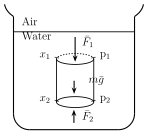
Drawn by us to help you understand the concept clearly, and verified to make sure it's accurate. For exams, practice from your textbook's own diagram.
What this figure shows. A tank filled with water is shown with an imaginary vertical cylinder of horizontal cross-sectional area A marked inside it, its top surface at height x1 and its bottom surface at height x2 (heights measured from a common reference point, increasing upward, so x1 > x2 and h = x1 − x2). Three forces act on this imaginary cylinder: F1 pointing downward on the top surface (due to the weight of water above the cylinder), F2 pointing upward on the bottom surface (due to the water below), and the cylinder's own weight mg acting downward on the enclosed water — the general force-balance geometry (F2 = F1 + mg) from which th …
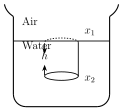
Drawn by us to help you understand the concept clearly, and verified to make sure it's accurate. For exams, practice from your textbook's own diagram.
What this figure shows. A specialisation of the Fig. 2.7 imaginary-cylinder geometry: the top of the imaginary cylinder is now placed exactly at the liquid's free surface (level x1 = 0, where the pressure is the atmospheric pressure p0), and the bottom is placed at a point a depth h below the surface (level x2 = −h, where the total/absolute pressure p is to be found). This figure is the direct picture behind the standard result p = p0 + hρg for the absolute pressure at depth h belo …
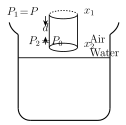
Drawn by us to help you understand the concept clearly, and verified to make sure it's accurate. For exams, practice from your textbook's own diagram.
What this figure shows. A point is shown at a height d above a liquid's free surface, with the medium between that point and the surface now being air (density ρ_air) rather than liquid — the mirror-image case to Fig. 2.8, applying the same general pressure-height relation upward through the atmosphere instead of downward through a liquid, to derive p = p0 − dρ_air·g for how atmospheric pressure decreases with height above a reference surface (assuming the air density …