Physics · Ch 2 — Mechanical Properties of Fluids
Hydrostatic Paradox
Hydrostatic Paradox
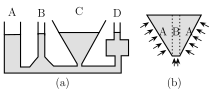
Consider several interconnected vessels of very different shapes — some narrow, some wide, some tapering — all joined together at their base and open at the top. When a liquid is poured into any one of them, it is found that the liquid rises to exactly the same level in every one of the vessels, no matter how different their shapes or widths are. This observation seems puzzling at first: one might expect the liquid pressure at the base of a wider vessel to be greater than at the base of a narrower one, which would seem to make the liquid rise higher in the narrower vessel until the extra pressure from vessel C forced liquid up into a narrower vessel B — yet this is never actually observed. Before the principles of hydrostatics were fully understood, this was called the hydrostatic paradox.
The resolution comes directly from Eq. (2.2), : the pressure at a point inside a liquid depends only on the height h of the liquid column directly above that point — it does not depend at all on the shape of the vessel. Since the height of liquid is the same in every one of the interconnected vessels (they all show the same level), the pressure at the base is also the same in every vessel, and the whole connected system is in equilibrium — the liquid in a wide vessel like C simply does not rise up into a narrower vessel like B, because there is no pressure imbalance driving it to. …
Drawn by us to help you understand the concept clearly, and verified to make sure it's accurate. For exams, practice from your textbook's own diagram.
What this figure shows. Two-part figure: (a) several interconnected vessels of markedly different shapes and widths — including a narrow vessel B and a wider vessel C — all open at the top and joined at a common base reservoir, with liquid poured into any one of them rising to exactly the same level in every vessel regardless of each one's individual shape; (b) a close-up of one of the slanted-walled vessels (like the tapering vessel C), with a series of force arrows drawn perpendicular to the vessel's slanted inner walls at various points, each resolved into a vertical component (pointing upward, into the liquid) and a horizontal component. The figure shows that the liquid in the 'shoulder' region near label B experiences an unbalanced upward-acting vertical wall force that contributes to (rather than reduces) the pressure at the base — which is exactly why the naive expectation of a shape-dependent base pressure is wrong, and …