Physics · Ch 2 — Mechanical Properties of Fluids
Measurement of Pressure
Measurement of Pressure
Instruments used to measure pressure are known generally as pressure meters, pressure gauges, or (for pressures below atmospheric) vacuum gauges. Two of the most commonly used pressure instruments are the mercury barometer and the open tube manometer.
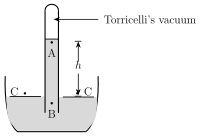
i) Mercury barometer. An instrument that measures atmospheric pressure is called a barometer; one of the first was invented by the Italian scientist Torricelli. A mercury barometer takes the form of a glass tube about 1 metre long and about 1 cm in diameter, filled completely with mercury up to its brim, and then quickly inverted into a small open dish also containing mercury. On inversion, the mercury level inside the tube drops slightly (some mercury spills out into the dish), leaving a gap at the sealed top end of the tube between the closed glass and the mercury surface — this gap contains no air at all (it is called Torricelli's vacuum), although it does contain a small amount of mercury vapour. Because there is essentially nothing pressing down from above inside this gap, the pressure at the very top of the mercury column, at a point such as A, is taken to be zero: .
Consider a point C on the open mercury surface in the dish, and a second point B inside the tube, chosen to be at exactly the same horizontal level as C. Since C is directly exposed to the atmosphere, the pressure there equals atmospheric pressure, ; and since B and C are at the same horizontal level (within the same connected body of mercury), the pressure at B must also equal , i.e. . If B lies a depth h below A, then, from Eq. (2.2),
Since and , this immediately gives , where h is the height of the mercury column standing in the barometer tube and ρ is mercury's density — so the height of this column directly measures atmospheric pressure. In practice, atmospheric pressure is most often simply quoted as the length of this mercury column: cm of Hg mm of Hg Torr. (Using mercury in an open laboratory setting is best avoided where possible, since mercury vapour is hazardous to both human health and the environment.)
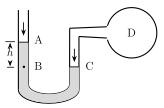
ii) Open tube manometer. A manometer measures the pressure of a gas held in a sealed container. It consists of a U-shaped tube, partly filled with a liquid of deliberately low density, such as water or kerosene — a low-density liquid is chosen specifically because it produces a larger, more easily read level difference between the two arms of the tube for a given pressure difference, than a dense liquid like mercury would. One arm of the manometer is left open to the atmosphere; the other is connected by tubing to the container D whose gas pressure p is to be measured. Consider a point B in the open arm, and a point C at the liquid surface in the connected arm, chosen at the same horizontal level as B, so that
…
Drawn by us to help you understand the concept clearly, and verified to make sure it's accurate. For exams, practice from your textbook's own diagram.
What this figure shows. A glass tube about 1 m long and about 1 cm in diameter, completely filled with mercury, is shown inverted into a small open dish also containing mercury. The mercury level inside the tube has settled somewhat below the closed top, leaving a gap at the sealed end containing essentially no air (Torricelli's vacuum, with only trace mercury vapour) — so the pressure at the very top of the mercury column inside the tube, point A, is taken as zero. A point B inside the tube is marked at the same horizontal level as a point C on the open mercury surface in the dish outside; since C is exposed to the atmosphere, pC = p0, and since B and C are at the same level, pB = p0 too. With B a depth h below A, pB = pA + hρg gives p0 = hρg — the equation used to read …
Drawn by us to help you understand the concept clearly, and verified to make sure it's accurate. For exams, practice from your textbook's own diagram.
What this figure shows. A U-shaped glass tube, partly filled with a low-density liquid such as water or kerosene (deliberately chosen over a dense liquid like mercury so that a given pressure difference produces a larger, more easily read level difference between the tube's two arms), is shown with one arm left open to the atmosphere and the other arm connected by tubing to a sealed container D whose internal gas pressure p is to be measured. A point B is marked in the open arm at the same horizontal level as a point C on the liquid surface in the connected arm, with pB = pC since they are level; pB is also equal to p0 + hρg (from the atmosphere plus the height h of liquid above B in the open arm), and by Pascal's principle the pressure at C equals the pressure inside the container D — together …