Physics · Ch 2 — Mechanical Properties of Fluids
Pressure Due to a Liquid Column
Pressure Due to a Liquid Column
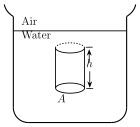
To find the pressure due to a liquid at some depth below its free surface, imagine a vertical cylinder of the liquid, of cross-sectional area A, extending down to a depth h inside a vessel filled with the liquid of density ρ. The weight of the liquid making up this imaginary column is , and this weight acts straight down on the cylinder's base. By the definition of pressure, the pressure exerted by this liquid column on the base of the cylinder is:
Now the mass of the liquid filling the imaginary cylinder is simply its volume times the liquid's density, . Substituting this in,
So the pressure due to a liquid of density ρ, at rest, at a depth h below its free surface, is simply . It is worth stressing explicitly that this result does not depend at all on the cross-sectional area A of the imaginary cylinder used to derive it — A cancels out of the formula completely, so the same pressure holds at depth h no matter how wide or narrow an imaginary column one imagines there. …
Drawn by us to help you understand the concept clearly, and verified to make sure it's accurate. For exams, practice from your textbook's own diagram.
What this figure shows. A container filled with liquid of density ρ is shown with an imaginary vertical cylinder of cross-sectional area A marked inside it, extending down from the free surface to a depth h. The weight of the liquid filling this imaginary cylinder, F = mg, is shown acting downward on the cylinder's base — this is the exact geometry used to derive p = hρg by dividing this weight by the base area A, and the figure makes visually clear why the derived pressure formula cannot depend on the (arbitrarily chosen) cross-sectional area A of the imag …