Physics · Ch 5 — Oscillations
Explanation of Periodic Motion
Explanation of Periodic Motion
Periodic motion is defined as any motion that repeats itself, in exactly the same way, after a fixed interval of time. The object performing periodic motion keeps re-tracing the same set of movements over and over; the time taken to complete one such set is called the period (or periodic time) of the motion. At the end of each set of movements, the state of the body (its position, velocity, and so on) is identical to what it was at the start of that set. The motion of the moon around the earth, of the planets around the sun, and (as you already know from the circular-motion chapter) uniform circular motion of any object, are all examples of periodic motion.
A more restricted kind of periodic motion is oscillatory motion (also called vibratory motion), in which a particle moves repeatedly to and fro along the SAME path. It is important to notice that this is a one-way relationship: every oscillatory motion is periodic, but not every periodic motion is oscillatory. Uniform circular motion is the clearest counter-example -- it is periodic (the particle returns to the same position after each revolution) but it is not oscillatory, because the particle never reverses direction and retraces its path; it simply keeps going around in the same sense. …
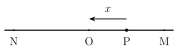
Drawn by us to help you understand the concept clearly, and verified to make sure it's accurate. For exams, practice from your textbook's own diagram.
What this figure shows. A particle P performing S.H.M. along the straight line MN, with O the mean (equilibrium) position at the centre. M and N are the extreme positions. The displacement x is measured from O; the particle oscillates …