Physics · Ch 5 — Oscillations
Graphical Representation of S.H.M.
Graphical Representation of S.H.M.
It is often clearer to SEE the periodic nature of displacement, velocity and acceleration than to read it off the equations, so this section plots all three against phase angle (equivalently, against time measured in fractions of the period T) for the two starting conditions worked out in section 5.5.
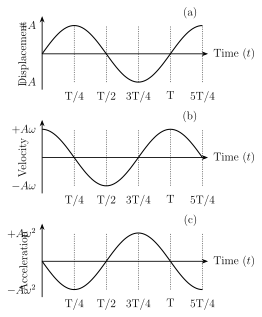
(a) Starting from the mean position, moving towards positive (, Fig. 5.6): the three expressions are , , . Plotted against time (marked off in units of T/4), the displacement curve is a pure sine shape -- starting at 0, rising to +A at t = T/4, back to 0 at t = T/2, down to -A at t = 3T/4, and back to 0 at t = T. The velocity curve is a pure cosine shape, starting at its maximum , and the acceleration curve is an inverted (negative) sine shape, starting at 0 and mirroring the displacement curve with the opposite sign throughout.
Drawn by us to help you understand the concept clearly, and verified to make sure it's accurate. For exams, practice from your textbook's own diagram.
What this figure shows. Three stacked graphs against time for a particle starting S.H.M. from the mean position (φ = 0): (a) displacement x = A sin ωt (a sine curve, ±A); (b) velocity v = Aω cos ωt (a cosine curve, ±Aω); (c) acceleration a = -Aω² sin ωt (a negative sine curve, ±Aω²). All are periodic with period T; velocity leads displacement …
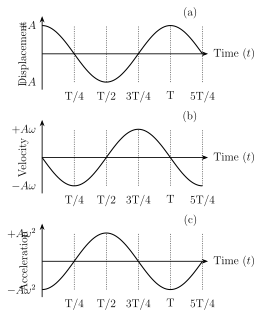
(b) Starting from the positive extreme position (, Fig. 5.7): the three expressions become , , -- essentially the same three curve SHAPES as in case (a), just each shifted along the time axis by a quarter period, since starting at an extreme is itself a quarter-cycle "ahead of" starting at the mean position.
Drawn by us to help you understand the concept clearly, and verified to make sure it's accurate. For exams, practice from your textbook's own diagram.
What this figure shows. The same three quantities for a particle starting S.H.M. from the positive extreme position (φ = π/2): (a) displacement x = A cos ωt; (b) velocity v = -Aω sin ωt; (c) acceleration a = -Aω² cos ωt. The shapes are the same sinusoids as from the mean position but shifted by a quarter period, since the …
Comparing the two sets of graphs (and, more generally, the algebraic forms of x, v and a for ANY starting phase) lets us draw five standing conclusions, used repeatedly in the rest of the chapter:
-
Displacement, velocity and acceleration of a particle in S.H.M. are all periodic functions of time, each completing one full cycle in exactly the period T of the motion.
-
The displacement-time and acceleration-time curves are always sine-type curves, while the velocity-time curve is always a cosine-type curve (or, depending on the chosen starting phase, the roles of "sine-type" and "cosine-type" can swap between the two, but displacement and acceleration always share the SAME curve type as each other, distinct from velocity).
-
There is a phase difference of radian between displacement and velocity -- velocity is always a "quarter cycle ahead of" displacement.
-
There is a phase difference of radian between velocity and acceleration -- for the same reason, acceleration is a quarter cycle ahead of velocity. …