Physics · Ch 5 — Oscillations
Free Oscillations, Forced Oscillations and Resonance
Free Oscillations, Forced Oscillations and Resonance
If an object is simply allowed to oscillate or vibrate entirely on its own -- displaced once and then left alone, with no ongoing external driving -- it does so at its own NATURAL frequency (or, for more complex systems, one of several possible natural frequencies). For example, a simple pendulum of length l, displaced and released, oscillates ONLY at the frequency (from Eq. 5.29) -- this is called its natural frequency, and oscillations at this frequency, with no external driving, are called FREE oscillations. However, the SAME pendulum can be made to oscillate at a DIFFERENT frequency if a periodic external force is applied to it; the resulting motion is then called FORCED oscillation, and the frequency at which it occurs -- fixed by whatever is doing the driving, not by the pendulum's own length -- is called the driver frequency or forced frequency.
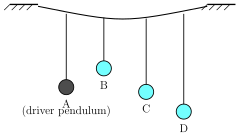
This distinction, and the special phenomenon that arises from it, can be demonstrated with a simple classroom set-up (Fig. 5.15): four pendula, A, B, C and D, are all tied to a single common string, itself stretched taut between two fixed supports. Pendulum A, with a SOLID rubber ball as its bob, acts as the driver (or source) pendulum. Pendula B, C and D, each with a HOLLOW rubber ball as its bob, act as the driven pendula. Pendula A and C are made of EQUAL length (so they share the same natural frequency); pendulum B is made SHORTER than A (giving it a HIGHER natural frequency than A); and pendulum D is made LONGER than A (giving it a LOWER natural frequency than A).
Drawn by us to help you understand the concept clearly, and verified to make sure it's accurate. For exams, practice from your textbook's own diagram.
What this figure shows. Four pendula hang from a common horizontal string: A (the driver, with a solid bob), B (shorter), C (same length as A) and D (longer). When A is set oscillating, it forces the others through the string; they all take up A's frequency (forced oscillations), but C — having the same natural frequency as A — absorbs the most …
When pendulum A alone is set oscillating, in a plane perpendicular to the plane containing all four supports, it is observed -- after a little time -- that the other three pendula ALSO begin oscillating, in that same plane. This happens because vibrational energy is transferred from A to the others through the shared string. A's own oscillations are free oscillations (nothing is driving A); the oscillations of B, C and D are forced oscillations, all occurring at the SAME frequency as A's (the driving frequency), regardless of each pendulum's own natural frequency.
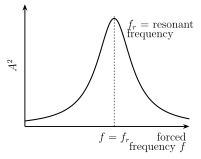
Crucially, though, not all three driven pendula respond equally. Among B, C and D, pendulum C -- whose natural frequency happens to EXACTLY match A's driving frequency -- is observed to oscillate with by far the LARGEST amplitude, while B and D (whose natural frequencies differ from A's, one higher and one lower) oscillate with noticeably SMALLER amplitudes. Since the energy absorbed by a driven oscillator is directly tied to its (amplitude), this shows that C has absorbed the MOST energy from the source pendulum A, while B and D have absorbed less. This condition -- an object being driven at a forcing frequency that exactly equals its OWN natural frequency, resulting in maximum energy absorption and maximum amplitude -- is called RESONANCE, and the object (here, pendulum C) is said to be "in resonance with" the source. …
Drawn by us to help you understand the concept clearly, and verified to make sure it's accurate. For exams, practice from your textbook's own diagram.
What this figure shows. A plot of amplitude² (proportional to the energy absorbed) against the forced (driving) frequency f. The curve peaks sharply at f = fr, the resonant frequency, where the forced frequency matches the system's natural frequency and the energy absorbed is maximum. Away from fr on either …
Internet my friend — links the textbook itself suggests: