Physics · Ch 5 — Oscillations
Damped Oscillations
Damped Oscillations
Every real oscillator, left to itself, eventually stops. This happens because some resistive influence -- air resistance, friction at a support, viscous drag in a fluid, or (as in an electrical LC circuit) resistive losses -- steadily removes mechanical energy from the oscillating system, converting it to heat. When the AMPLITUDE of oscillation is progressively reduced this way by an external (resistive) force, the oscillator and its motion are said to be DAMPED. Periodic oscillations of gradually decreasing amplitude are accordingly called damped harmonic oscillations, and the oscillator performing them a damped harmonic oscillator. The everyday example already mentioned in section 5.1 -- a simple pendulum's motion eventually dying out, owing to the viscous drag of air on the bob and string, plus a little friction at the support -- is a case of damping.
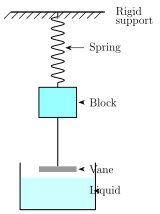
To make this quantitative, consider a block of mass m that can oscillate vertically on a spring, with a rigid rod extending down from the block to a flat vane submerged in a liquid (Fig. 5.13). As the block-spring system oscillates, the attached vane is dragged up and down through the liquid, and the liquid's viscous resistance opposes this motion; energy is thereby continuously transferred out of the mechanical block-spring system and into thermal energy of the liquid and vane, so the system's total mechanical energy steadily decreases with time.
Drawn by us to help you understand the concept clearly, and verified to make sure it's accurate. For exams, practice from your textbook's own diagram.
What this figure shows. A block hanging from a spring (rigid support above) oscillates vertically; a rod from the block carries a vane submerged in a liquid. As the vane moves up and down the liquid exerts a drag force on it, so the mechanical energy of the block-spring system is gradually transferred to the liq …
The damping force exerted by the liquid on the vane (and, through the rigid rod, on the whole system) depends on the properties of the surrounding medium, and -- for the range of speeds typical of such an oscillator -- is well modelled as being directly proportional to the instantaneous speed v of the vane/block:
where b, the damping constant, depends on the medium's viscosity and the vane's shape/size, and the minus sign records that always opposes (is directed against) the velocity. Meanwhile the spring continues to exert its usual restoring force . Assuming the block's own weight can be neglected compared to and (a reasonable approximation for a horizontal, or a carefully-zeroed vertical, arrangement), Newton's second law applied to the total force gives
This is the differential equation governing DAMPED oscillation -- notice it differs from the plain S.H.M. equation (Eq. 5.4) by the addition of the middle, velocity-proportional damping term. Its solution (obtained by standard methods for linear differential equations, not derived in full here) is
…
Drawn by us to help you understand the concept clearly, and verified to make sure it's accurate. For exams, practice from your textbook's own diagram.
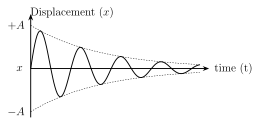
What this figure shows. The displacement-time graph of a damped harmonic oscillator: the oscillation is still sinusoidal (the cos(ω′t + φ) factor), but its amplitude decays exponentially, bounded by the envelope ±A e^(-bt/2m). Damping both reduces the amplitude and slightly increases …