Physics · Ch 5 — Oscillations
Simple Pendulum
Simple Pendulum
An IDEAL simple pendulum is defined as a heavy particle, suspended by a massless, inextensible, perfectly flexible string, from a rigid support. In practice, of course, we cannot build a truly point-mass, truly massless-string pendulum, so a PRACTICAL simple pendulum is instead a small, dense (heavy) sphere -- called the bob -- suspended by a light and inextensible string from a rigid support; provided the string's mass is negligible compared to the bob's, and the bob is small compared to the string's length, the practical pendulum behaves, to excellent approximation, like the ideal one.
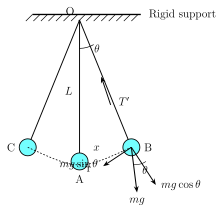
Consider the pendulum displaced to one side, at angular amplitude from the vertical equilibrium position OA (Fig. 5.10). Two forces act on the bob at this displaced position: the tension in the string, directed along the string towards the support, and the weight mg, directed vertically downward. Since (for a string performing circular arcs) there is no net force ALONG the string's own direction at any point of a swing where the bob's speed is instantaneously constant along that direction, the tension must exactly balance the COMPONENT of the weight along the string. Resolving mg into two perpendicular components: , directed along the string (balanced by ), and , directed perpendicular to the string -- i.e. tangent to the bob's circular arc -- which is precisely the RESTORING force, pulling the bob back towards the equilibrium position:
Drawn by us to help you understand the concept clearly, and verified to make sure it's accurate. For exams, practice from your textbook's own diagram.
What this figure shows. A simple pendulum of length L with its bob displaced through a small angle θ from the mean position A. Two forces act on the bob: the tension T′ along the string toward the support, and the weight mg vertically down. The weight is resolved into mg cos θ (along the string, balanced by T′) and mg sin θ (perpendicular to the string), which is the resto …
For SMALL angular amplitudes (as a working rule, less than about ), the small-angle approximation (with measured in radians) is very accurate. Additionally, for small , the angular displacement relates to the ARC-LENGTH (linear) displacement x of the bob from equilibrium via , where L is the string's length. Substituting both approximations into Eq. (5.26),
Since m, g and L are all constants for a given pendulum, this says -- the restoring force is directly proportional to the displacement and opposite in direction to it, which is EXACTLY the defining condition for linear S.H.M. (section 5.3). We conclude: the bob of a simple pendulum performs linear S.H.M., for sufficiently small angular amplitudes.
To find the period, we use the general template from section 5.6.2, . From Eq. (5.27), , so , and hence the acceleration per unit displacement (in magnitude) is . Substituting,
This is the standard period formula for a simple pendulum. It was derived under three explicitly stated assumptions, worth keeping in mind whenever applying it: (i) the amplitude of oscillation is very small -- as a rule of thumb, the amplitude should be at least about 20 times smaller than the pendulum's length; (ii) the string is long (so that the bob can genuinely be treated as a point mass at its end); and (iii) throughout the motion, the bob stays confined to a single vertical plane (it does not, for instance, trace out a conical or elliptical path).
Correspondingly, the frequency of oscillation is
…