Physics · Ch 5 — Oscillations
Energy of a Particle Performing S.H.M.
Energy of a Particle Performing S.H.M.
A particle performing S.H.M. possesses kinetic energy at every point of its path EXCEPT the two extreme positions (where its speed, momentarily, is zero). Yet, despite there being a restoring force acting on it at every position other than the mean position, the particle continues to occupy a whole range of different positions -- which can only mean that work is being done, and that the system also stores potential energy at those positions (elastic potential energy for a stretched/compressed spring, gravitational potential energy for a raised pendulum bob, magnetic potential energy for a displaced magnet, and so on, depending on what physically provides the restoring force). The TOTAL energy of a particle performing S.H.M. is, at every instant, the sum of these two: kinetic plus potential.
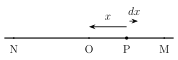
Kinetic energy: consider a particle of mass m performing linear S.H.M. along path MN about mean position O (Fig. 5.8), currently at a point P a distance x from O. Its speed there is given by Eq. (5.10), , so
Drawn by us to help you understand the concept clearly, and verified to make sure it's accurate. For exams, practice from your textbook's own diagram.
What this figure shows. A particle performing S.H.M. along the path MN about the mean position O, at a distance x from O. To find the potential energy, the particle is imagined displaced by a further infinitesimal distance dx against the restoring force f = -kx; the work done k x dx, integrated from O t …
(using , i.e. , from section 5.4). This is the kinetic energy at a given DISPLACEMENT x. Written instead as a function of TIME t (substituting the general velocity expression from section 5.5), it becomes
so kinetic energy varies with time as of the phase.
Potential energy: at a general point P, the restoring force is (Eq. 5.1). If the particle is displaced by a further infinitesimal amount dx AGAINST this restoring force, the (external) work done is (the minus sign flips because we are now computing the work done by an external agent pushing AGAINST the restoring force, not the work done BY the restoring force itself). Integrating this from the mean position (x=0) out to the general position x gives the total work done in reaching P, which equals the potential energy stored there:
Written as a function of time instead,
so potential energy varies with time as of the phase -- exactly out of step with the kinetic energy's variation, in a way that (as we are about to see) makes their sum constant.
Total energy: adding Eqs. (5.21) and (5.23) (the x-dependent forms),
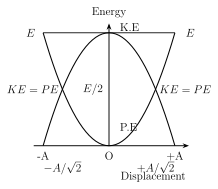
Notice that x has cancelled out COMPLETELY -- the total energy does not depend on the particle's instantaneous position at all (nor, by the same cancellation applied to Eqs. 5.22/5.23a using , does it depend on time). Since m, and A are all fixed constants of a given oscillation, the total energy is therefore CONSTANT -- i.e. conserved -- throughout the motion, continuously exchanged between kinetic and potential forms but never lost or created. Rewriting Eq. (5.24) using (n = frequency) gives an equivalent, often-quoted form:
…
Drawn by us to help you understand the concept clearly, and verified to make sure it's accurate. For exams, practice from your textbook's own diagram.
What this figure shows. Energy plotted against displacement for S.H.M.: the kinetic energy KE = ½k(A² - x²) is a downward parabola, maximum at the mean position O and zero at the extremes ±A; the potential energy PE = ½kx² is an upward parabola, zero at O and maximum at ±A. Their sum, the total energy E, is constant (a horizontal line). KE = PE = E/ …