Physics · Ch 5 — Oscillations
Acceleration (a), Velocity (v) and Displacement (x) of S.H.M.
Acceleration (a), Velocity (v) and Displacement (x) of S.H.M.
Section 5.4 obtained the velocity-displacement relation (Eq. 5.10) by integrating the S.H.M. differential equation once. Integrating a second time gives us x directly as a function of time. Separating variables,
and integrating both sides using the standard result ,
where is (once again) a constant of integration, this time fixed by the value of x at whatever instant we choose to call t = 0. This gives the general expression for the displacement of a particle performing linear S.H.M. at any time t:
The quantity is called the initial phase (or epoch); notice, as the book stresses, that it is NOT that the particle itself "starts" its S.H.M. at t = 0 -- the particle has, in general, already been oscillating for a while. Rather, t = 0 is simply the moment WE (the observer) choose to start our stopwatch, and records where in the cycle the particle happened to be at that chosen moment. Two particular choices of starting instant come up constantly enough to be worth working out explicitly.
Case (i): the particle starts (i.e. we start our stopwatch) exactly at the mean position, so x = 0 at t = 0. Substituting into Eq. (5.11), , so (or, more precisely, a multiple of , with the sign of the subsequent motion fixing which). Then Eq. (5.12) reduces to
with the plus sign chosen if the particle initially moves towards positive x, and the minus sign if it initially moves towards negative x.
Case (ii): the particle starts at an extreme position, so x = at t = 0. Working through the algebra (using ) gives , and Eq. (5.12) becomes
with the plus sign for starting at the positive extreme and the minus sign for starting at the negative extreme.
Differentiating the general expression (Eq. 5.12) with respect to time gives the general velocity and acceleration expressions at any instant t:
These reduce to the familiar forms of Eqs. (5.13)/(5.14) for the two special starting cases above simply by substituting or respectively. …
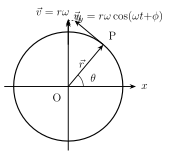
Drawn by us to help you understand the concept clearly, and verified to make sure it's accurate. For exams, practice from your textbook's own diagram.
What this figure shows. The particle P in uniform circular motion has tangential velocity of magnitude v = rω. Its projection on the reference diameter (y-axis) is v_y = rω cos(ωt + φ) — the velocity of the corresponding linear S.H.M. Just as the position projects to the S.H.M. displac …