Physics · Ch 5 — Oscillations
Linear Simple Harmonic Motion (S.H.M.)
Linear Simple Harmonic Motion (S.H.M.)
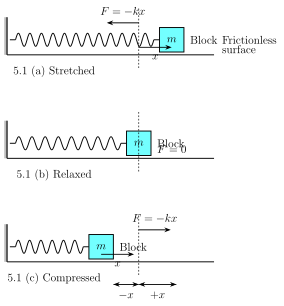
To build up the idea of linear S.H.M. concretely, picture a block of mass m resting on a smooth (frictionless) horizontal surface, with one end of a spring fixed to a rigid wall and the other end attached to the block (Fig. 5.1). If you pull the block towards the right and let go, it does not simply stay put or run away -- it begins a to-and-fro motion on either side of its equilibrium (mean) position, and this to-and-fro motion is precisely what we call linear S.H.M.
Drawn by us to help you understand the concept clearly, and verified to make sure it's accurate. For exams, practice from your textbook's own diagram.
What this figure shows. A block of mass m on a frictionless surface, attached by a spring to a rigid wall, in three states: (a) stretched — the spring pulls the block back with F = -kx toward the mean position; (b) relaxed — the equilibrium position where F = 0; (c) compressed — the spring pushes the block out, again F = -kx. The displacement x is measured from the mean position, with +x to the right and -x to the left. This restori …
At equilibrium (Fig. 5.1(b)), the spring is at its natural length and exerts no force on the block at all. If the block is displaced towards the right (Fig. 5.1(a)), the stretched spring, trying to regain its natural length because of its elastic properties, pulls the block back towards the left -- exerting what is called a restoring force, because its job is to restore the block to the equilibrium position. This restoring force is proportional in magnitude to the displacement, but opposite in direction to it. Writing x for the displacement, the restoring force f obeys
Here k is a constant, called the force constant of the spring, that depends on the spring's own elastic properties; the negative sign is what encodes the fact that force and displacement always point in opposite directions. If instead the block is pushed towards the left of equilibrium (Fig. 5.1(c)), the (now compressed) spring pushes it back towards the right -- again a restoring force proportional to, and opposite to, the displacement, so the SAME equation f = -kx applies regardless of which side the block is displaced to. Because the entire motion happens along one straight line, we do not need to use full vector notation for it; a plus or minus sign is enough to record the direction, and by convention we always measure the displacement x from the mean position.
It is worth following the motion through a full cycle to see why it keeps going rather than settling down. Suppose the block is released from its rightmost position. The restoring force accelerates it back towards the mean position; as it approaches the mean position its speed keeps increasing (because the force, though shrinking, is still pushing it that way) even as its displacement keeps decreasing. Exactly at the mean position, the displacement -- and therefore the force and the acceleration -- all become zero, while the speed (and hence the kinetic energy) reaches its maximum value there. Because of this maximum speed, the block does NOT stop at the mean position; it overshoots and continues moving towards the left. As it does so, the spring is now compressed, and it exerts a restoring force back towards the right, opposing the leftward motion and slowing it down, until the block's speed drops all the way to zero at the leftmost extreme -- the mirror image of where it started. There, the displacement and the restoring force are both at their maximum (in the opposite sense), so the block is once again accelerated back towards the right, and the whole process repeats indefinitely (in the absence of friction or other resistive forces). …
Drawn by us to help you understand the concept clearly, and verified to make sure it's accurate. For exams, practice from your textbook's own diagram.
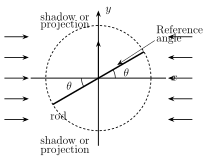
What this figure shows. A rod rotates along a vertical circle in the x-y plane. When illuminated by a parallel beam along the x-axis, its shadow (projection) falls on the y-axis, and the tip of this shadow oscillates about the origin along the y-axis — tracing S.H.M. The reference angle θ is the angle the rod makes with the x-axis. This is the reference-circle method: t …