Physics · Ch 5 — Oscillations
Angular S.H.M. and its Differential Equation
Angular S.H.M. and its Differential Equation
So far this chapter has dealt exclusively with LINEAR S.H.M. -- oscillation along a straight-line path. We now extend the same machinery to ANGULAR (also called torsional) oscillations, where the oscillating "displacement" is an ANGLE rather than a distance.
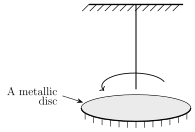
Picture a metallic disc, attached CENTRALLY to the lower end of a thin wire (nylon or metallic), which hangs vertically from a rigid support (Fig. 5.11). If the disc is twisted slightly, about the vertical axis defined by the wire, and then released, it performs a rotational to-and-fro motion -- partly clockwise, partly anticlockwise -- about its rest orientation. This motion is governed by a RESTORING TORQUE set up in the twisted wire, which (exactly analogous to the restoring force of linear S.H.M.) always acts to oppose the current angular displacement.
Drawn by us to help you understand the concept clearly, and verified to make sure it's accurate. For exams, practice from your textbook's own diagram.
What this figure shows. A metallic disc hangs centrally from a thin wire attached to a rigid support. When the disc is twisted about the axis of the wire and released, the wire's restoring torque (always opposite to the angular displacement) makes it oscillate clockwise and anticlockwise — angul …
If the magnitude of this restoring torque happens to be directly proportional to the angular displacement , the resulting motion is called ANGULAR S.H.M. Formally: angular S.H.M. is the oscillatory motion of a body in which the torque producing its angular acceleration is directly proportional to the angular displacement, and directed opposite to it:
where c is a constant -- the restoring torque per unit angular displacement -- playing exactly the role that the force constant k played for linear S.H.M. Now, if I is the moment of inertia of the oscillating body about the axis of rotation, the relationship between torque and angular acceleration is (the rotational analogue of , from the rotational-dynamics chapter). Substituting into Eq. (5.31),
…