Physics · Ch 5 — Oscillations
Differential Equation of S.H.M.
Differential Equation of S.H.M.
Having established, in section 5.3, that the restoring force in linear S.H.M. is f = -kx (Eq. 5.1), we can now combine this with Newton's second law of motion, f = ma, to get
Since velocity is v = dx/dt, acceleration is a = dv/dt = d^2x/dt^2, so substituting into Eq. (5.3) and dividing through by m gives
At this point it is conventional (and, as we will see throughout the rest of the chapter, extremely useful) to define a new constant , called the angular frequency, via . Substituting this in gives the standard, must-know form of the differential equation of linear S.H.M.:
This single equation -- Eq. (5.5) -- IS the differential equation of linear S.H.M.; every result derived later in the chapter (displacement, velocity, acceleration, period, energy) ultimately traces back to solving this equation for a specific system. Rearranging it slightly gives the acceleration directly in terms of displacement:
Equation (5.7) is worth remembering as an equivalent, purely algebraic way to define S.H.M.: it is motion in which acceleration is always directly proportional to displacement from a fixed point, and always directed opposite to that displacement (hence the minus sign) -- this is exactly the condition (proportional to and opposite to the displacement) that section 5.3 described in words for the restoring force, now written for the acceleration instead.
We can integrate the differential equation once to get a relation between velocity and displacement (rather than between acceleration and displacement). The standard trick is to write a = dv/dt = (dv/dx)(dx/dt) = v(dv/dx), so that Eq. (5.6) becomes
Integrating both sides,
where C is a constant of integration, fixed by a boundary condition. Let A be the maximum possible displacement of the particle (its amplitude, to be formally defined in section 5.6.1); at this extreme position the particle is momentarily at rest, so v = 0 when x = A. Substituting into Eq. (5.8),
Using this value of C back in Eq. (5.8) and simplifying, …
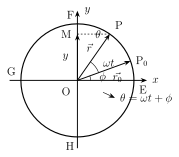
Drawn by us to help you understand the concept clearly, and verified to make sure it's accurate. For exams, practice from your textbook's own diagram.
What this figure shows. A particle P moves anticlockwise with uniform circular motion on a circle of radius r centred at O. At t = 0 it is at P₀ with reference angle φ; at time t the angle is θ = ωt + φ. Its projection M on the y-axis (the reference diameter FH) has displacement OM = y = r sin(ωt + φ) — the equation of linear S.H.M. of am …