Q.Describe the biprism experiment to find the wavelength of the monochromatic light. Draw the necessary ray diagram. The width of plane incident wavefront is found to be doubled on refraction in denser medium. If it makes an angle of 65° with the normal, calculate the refractive index for the denser medium. OR Draw a neat, labelled energy level diagram for H atom showing the transitions. Explain the series of spectral lines for H atom, whose fixed inner orbit numbers are 3 and 4 respectively. The work functions for potassium and caesium are 2.25 eV and 2.14 eV respectively. Is the photoelectric effect possible for either of them if the incident wavelength is 5180 Å? [Given: Planck's constant = J.s.; Velocity of light = m/s; 1 eV = J]
You're viewing a preview — the full solution, concept, methods & PYQ mapping are locked.
Start your 14-day free trial to unlock the full solution →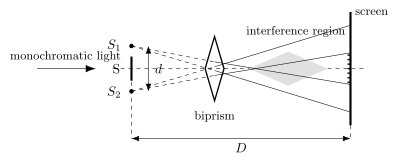
Fresnel's biprism gives two coherent virtual sources for interference and lets be measured; separately, the Bohr atom's energy-level transitions give the H-spectrum series, and the photoelectric effect depends on whether photon energy exceeds the work function.
Option — Part (i): Biprism experiment
A Fresnel biprism is a thin prism with a very obtuse angle (~179°), effectively two thin prisms joined base-to-base. Monochromatic light from a narrow slit falls on the biprism. Refraction through the upper half deviates the light slightly downward (as if coming from a virtual source ), and through the lower half slightly upward (virtual source ). and act as two coherent virtual sources, separated by a small distance , since both derive from the same original slit .
Beyond the biprism, the two overlapping beams from produce interference fringes on a screen placed at distance from the sources, exactly as in Young's double-slit experiment: bright and dark fringes of width .
Ray diagram (description): slit → biprism (drawn as two thin prisms base-to-base) → two diverging virtual rays traced backward to (above the axis) and (below the axis) → overlapping cones of light beyond the biprism → interference fringes on the screen in the overlap region.
Finding : (separation of virtual sources) is found using a convex lens in two positions (displacement method), is measured directly, and the fringe width is measured with a micrometer eyepiece; then .
Option — Part (ii): Numerical
A plane wavefront of width is incident at and its width becomes on refraction into a denser medium.
For a beam of footprint length along the interface, and (where is the angle of refraction), so
Refractive index of the denser medium (relative to the first):
— OR (alternative full question) —
Part (i): Energy level diagram for hydrogen
Diagram description: a set of horizontal lines at heights corresponding to eV for up to (ionisation level) — e.g. : , : , : , : , converging towards as . Downward arrows are drawn between levels to represent transitions (photon emission), grouped into series ending on a common lower level: transitions ending on (Lyman, UV), on (Balmer, visible), on (Paschen, IR), on (Brackett, IR), on (Pfund, IR).
Part (ii): Spectral series with fixed inner orbit 3 and 4
…
Unlock everything free for 14 days
- Full step-by-step solutions
- Concept-first explanations
- Methods, shortcuts & mistakes
- PYQ mapping + timed mock tests
Full access for 14 days. No credit card required.