Question 42 of 83
Q.Write an account on the structure of DNA.
Tamil Nadu DgeTamil Nadu HSC (DGE) Board 2016Subjective· 10mImportance★★★★★
51% · 42/83 Questions
You're viewing a preview — the full solution, concept, methods & PYQ mapping are locked.
Start your 14-day free trial to unlock the full solution →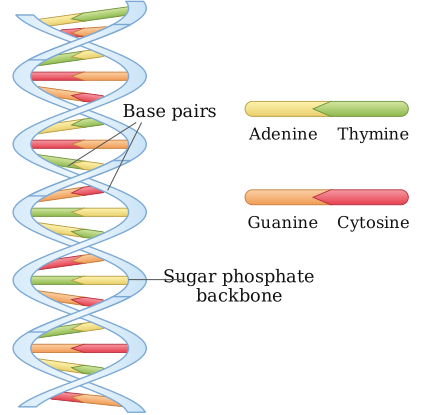
DNA is a right-handed double helix of two antiparallel strands held together by A-T and G-C base pairing.
- DNA is built of nucleotides, each with a nitrogenous base (purines adenine A and guanine G; pyrimidines cytosine C and thymine T), a deoxyribose sugar (lacking the 2'-OH present in RNA's ribose), and a phosphate group.
- Successive nucleotides are joined by 3'-5' phosphodiester bonds, forming a directional (5' to 3') sugar-phosphate backbone -- a polynucleotide strand.
- The Watson-Crick model (1953) describes DNA as TWO such polynucleotide strands wound around a common axis as a right-handed double helix; the two strands run antiparallel (opposite 5'->3' directions).
- The sugar-phosphate backbones form the outside of the helix; the nitrogenous bases project inward and pair between the two strands via hydrogen bonds following strict complementarity (Chargaff's rule): adenine pairs with thymine (2 hydrogen bonds) and guanine pairs with cytosine (3 hydrogen bonds), so A=T and G=C.
- One complete turn of the helix spans 3.4 nm (34 Angstrom) and contains about 10 base pairs, giving a rise of 0.34 nm per base pair; the helix diameter is about 2 nm (20 Angstrom). …
Unlock everything free for 14 days
- Full step-by-step solutions
- Concept-first explanations
- Methods, shortcuts & mistakes
- PYQ mapping + timed mock tests
Full access for 14 days. No credit card required.