Q...................................................... takes place when one male gamete and the egg fuse together. The fertilised egg grows into seed from which the new plants can grow.
Concept understanding — Double Fertilization
The full pollen-pistil interaction runs from a compatible pollen grain hydrating and germinating on the receptive stigma (recognised via recognition-rejection proteins that police interspecific and intraspecific/self- incompatibility), through growth of the resulting pollen tube down the style - hollow/open in monocots (grown over glandular, mucilage-secreting transmitting-tissue cells lining a canal) or solid/closed in dicots (grown through the intercellular spaces of a central transmitting-tissue core), with a semi-solid form intermediate between the two - to entry into the ovule by porogamy (through the micropyle, commonest), chalazogamy (through the chalaza) or mesogamy (through the integument), guided the whole way by chemotropic substances and, within the ovary, by an obturator. The tube always enters the embryo sac at the micropylar end, directly into one of the two synergids, where a terminal pore releases its two male gametes, vegetative nucleus and cytoplasm (the tube itself grows no further and its tube nucleus disorganises). Double fertilization - discovered independently by S.G. Nawaschin and L. Guignard in Lilium and Fritillaria (1898-99) and unique to angiosperms - is the resulting event in which both released male gametes are used: one fuses with the egg nucleus (syngamy) to form the diploid (2n) zygote, and the other migrates to the central cell and fuses with the two polar nuclei/secondary nucleus (triple fusion, since three nuclei combine) to form the triploid (3n) primary endosperm nucleus (PEN), which divides immediately - before the zygote itself starts dividing - to build the nutritive endosperm.
Fertilization (syngamy) is the fusion of one male gamete with the egg, producing the zygote that grows into the seed.
Fertilization (syngamy)
Fertilization (syngamy) is the fusion of one male gamete with the egg, producing the zygote that grows into the seed.
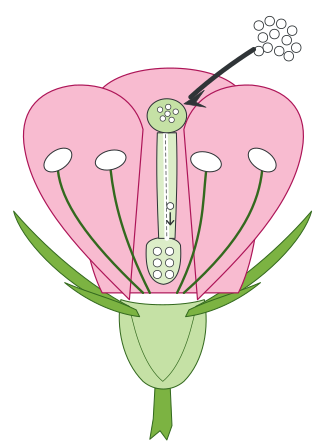
The blank is filled by fertilization (specifically, syngamy): it takes place when one male gamete and the egg fuse together to form the zygote. The fertilised egg (zygote) subsequently develops into the embryo, and the whole ovule matures into the seed from which a new plant can grow.
This is a typical Maharashtra HSC Biology question; the underlying idea appears word-for-word in NCERT Class 12 Biology, so CBSE students can use the same reasoning.
Fertilization (syngamy)
Identify the event defined by 'male gamete + egg fuse together'.
- Writing 'pollination' instead of 'fertilization'; pollination is the earlier transfer step, not the fusion event itself.
- CBSE 2026Set ANNUAL1 markMCQQ.The correct order of haploid, diploid and triploid structure in fertilized embryo sac is :(a) Antipodal, Synergid and PEN(b) Synergid, Zygote and PEN(c) Synergid, Polar nuclei and Zygote(d) Synergid, Antipodal and Polar nuclei
›Reveal solutionSolution
The correct haploid, diploid, triploid sequence in the fertilised embryo sac is Synergid (n), Zygote (2n), and PEN (3n).
Working
In a mature angiosperm embryo sac (typically the Polygonum-type, 7-celled/8-nucleate), the structures present, before and after double fertilisation, have different ploidy levels:
- Synergids (2 of them, forming the egg apparatus along with the egg cell) remain haploid (n) throughout -- they are never fertilised and eventually degenerate after pollen tube entry.
- Antipodal cells (3, at the chalazal end) are also haploid (n) and are not involved in fertilisation.
- Egg cell, on fusion with one male gamete (n + n), becomes the zygote, which is diploid (2n).
- Polar nuclei (2, in the central cell) are each individually haploid (n); when they fuse with each other they form the diploid secondary nucleus, and when this secondary nucleus then fuses with the second male gamete (n) during double fertilisation, it forms the Primary Endosperm Nucleus (PEN), which is triploid (3n).
The question asks for one haploid, one diploid, and one triploid structure, in that order. Checking each option: (a) Antipodal, Synergid, PEN gives haploid, haploid, triploid -- two haploid structures, no diploid one, so it is wrong. (b) Synergid, Zygote, PEN gives haploid (n), diploid (2n), triploid (3n) -- exactly the required sequence. (c) Synergid, Polar nuclei, Zygote gives haploid, haploid (before fusion), diploid -- no triploid structure, so wrong. (d) Synergid, Antipodal, Polar nuclei gives haploid, haploid, haploid -- no diploid or triploid structure at all, so wrong. Only option (b) correctly matches haploid, diploid and triploid structures in order.
✓Final answerThe correct option is (b): Synergid, Zygote and PEN
- CBSE 2022Set ANNUAL1 markMCQQ.In double fertilization of an angiospermic plant,(a) one male gamete fuses with egg and the other one with one of the synergids(b) one male gamete fuses with egg and the other with secondary nucleus(c) one male gamete fuses with synergid and the other with any one of the antipodal nuclei(d) none of these
›Reveal solutionSolution
Double fertilisation in angiosperms = syngamy (male gamete + egg gives zygote) plus triple fusion (male gamete + secondary/polar nuclei gives endosperm).
In angiosperms, the pollen tube delivers two non-motile male gametes into the embryo sac. Double fertilisation involves two simultaneous fusion events:
- Syngamy: One male gamete fuses with the egg cell (n) to form the diploid (2n) zygote.
- Triple fusion: The other male gamete fuses with the diploid secondary nucleus (formed by the fusion of the two polar nuclei) to form the triploid (3n) primary endosperm nucleus, which develops into the nutritive endosperm tissue.
This process, unique to flowering plants, is called double fertilisation because it involves two distinct fusion events using both male gametes delivered by the pollen tube. Options (a) and (c) are incorrect because a male gamete never fuses with a synergid or antipodal cell during normal fertilisation — synergids merely receive the pollen tube, and antipodals eventually degenerate.
✓Final answer(b) — one male gamete fuses with the egg (syngamy giving the zygote) and the other with the secondary nucleus (triple fusion giving the endosperm).
- CBSE 2022Set TERM11 markMCQQ.An event of 'Double fertilization' is unique to(a) Bryophyta(b) Pteridophyta(c) Gymnosperm(d) Angiosperm
›Reveal solutionSolution
Double fertilization -- fusion events forming both the zygote and the nutritive endosperm -- occurs exclusively in angiosperms.
In angiosperms, the pollen tube delivers two non-motile male gametes into the embryo sac. One male gamete fuses with the egg cell (syngamy) to form the diploid zygote, which develops into the embryo. Simultaneously, the second male gamete fuses with the two polar nuclei (or the secondary nucleus formed by their fusion) to form the triploid primary endosperm nucleus (triple fusion), which develops into the endosperm -- the nutritive tissue for the developing embryo. Because BOTH of these fusion events occur together within the same fertilization process, it is called 'double fertilization'. This phenomenon, discovered by Nawaschin, is unique to flowering plants and is absent in bryophytes, pteridophytes, and gymnosperms (which lack the second, triple-fusion event forming a true triploid endosperm).
✓Final answer(d) Angiosperm.
- CBSE 2019Set ANNUAL1 markMCQQ.During double fertilization second male gamete fuses with ______.(a) antipodal cell(b) egg cell(c) secondary nucleus(d) synergids
›Reveal solutionSolution
Double fertilization: gamete 1 + egg = zygote; gamete 2 + secondary nucleus = endosperm.
Double fertilization, unique to angiosperms, involves the pollen tube delivering two non-motile male gametes into the embryo sac. One male gamete fuses with the haploid egg cell (syngamy), forming the diploid zygote, which develops into the embryo. The second male gamete fuses with the diploid secondary (polar) nucleus located in the central cell of the embryo sac — since this involves three haploid nuclei (the second male gamete plus the two polar nuclei that formed the secondary nucleus), it is called triple fusion, producing the triploid primary endosperm nucleus, which develops into the nutritive endosperm tissue that nourishes the developing embryo.
The same concept is examined in the NCERT Class 12 Biology chapter on sexual reproduction in flowering plants, which the Maharashtra (MSBSHSE) syllabus is aligned with, so this answer serves CBSE and NEET revision too.
✓Final answer(c) secondary nucleus.
🎓Unlock everything free for 14 days
- ✓Full step-by-step solutions
- ✓Concept-first explanations
- ✓Methods, shortcuts & mistakes
- ✓PYQ mapping + timed mock tests
Full access for 14 days. No credit card required.