Q.Once the pollen reaches the stigma, pollen tube traverses down the ................... to the ovary where fertilisation occurs.
🔒You're viewing a preview — the full solution, concept, methods & PYQ mapping are locked.
🔒 Start your 14-day free trial to unlock the full solution →Concept understanding — Pollen-Pistil Interaction and Artificial Hybridization
Pollen-pistil interaction covers every event from a pollen grain landing on the stigma to the pollen tube's entry into the embryo sac. Because pollination is not selective, the pistil relies on recognition proteins on the pollen and stigma surfaces to test compatibility, promoting germination of compatible, same-species pollen while rejecting incompatible pollen (including, in self-incompatible species, the flower's own pollen). Once accepted, the pollen tube grows down through the style, guided by specific chemical cues, competing against the tubes of other simultaneously germinating pollen grains to reach the ovule first. This natural screening system is deliberately overridden in artificial hyb …
After landing on the stigma, the pollen tube grows down through the style to reach the ovary, wher …
After landing on the stigma, the pollen tube grows down through the style to reach the ovary, where fertilisation occurs.
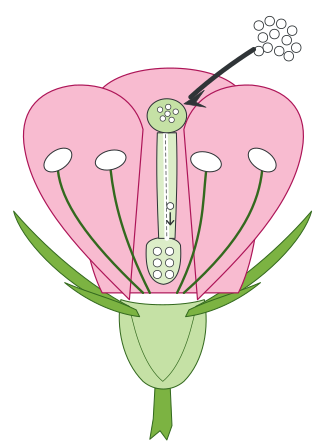
Recall which part of the pistil physically connects stigma to ovary …
- Writing 'ovary' instead of 'style'; the ovary is the destination, not the …
Showing the 12 most recent of 14 on this concept.
- CBSE 2026Set 57/1/11 markMCQQ.Identify the plant in which emasculation is not required for artificial hybridization. (A) Rice (B) Wheat (C) Pea (D) Papaya
›Reveal solutionSolution
Emasculation is not required in papaya because it is a dioecious plant, where male and female flowers occur on separate plants, making the removal of anthers unnecessary.
In artificial hybridization, the goal is to cross two genetically different plants to combine desirable traits. The process usually involves removing the anthers from the flower of the female parent before they release pollen — this step is called emasculation. It prevents self-pollination and ensures that only the desired pollen from the male parent fertilises the flower.
But emasculation is only needed when the flower you are working with is bisexual (hermaphrodite), meaning it contains both male and female reproductive organs in the same flower. In such cases, you must remove the stamens (male parts) to avoid selfing. However, if the plant is unisexual — with male and female flowers on separate plants — emasculation becomes unnecessary. Why? Because the female flower has no anthers to remove in the first place.
Now, look at the options given: rice, wheat, pea, and papaya. Rice and wheat produce bisexual flowers — each flower has both stamens and a pistil. Pea is also a bisexual flower, and in fact, it is naturally self-pollinating, so emasculation is routinely done in hybridisation experiments (as Mendel did, carefully removing anthers from pea flowers). So all three require emasculation. …
- CBSE 2026Set V11 markMCQQ.In artificial hybridisation approach, if the female parent produces unisexual flowers, there is no need for(a) Bagging(b) Tagging(c) Rebagging(d) Emasculation
›Reveal solutionSolution
A unisexual female flower has no anthers, so emasculation is not required.
Emasculation is the removal of anthers from a bisexual flower bud (before the anthers dehisce) to prevent self-pollination during artificial hybridisation. If the female parent already produces unisexual (pistillate) flowers, there are no stamens/anthers present, so there is nothing to remove. Bagging (cove …
- CBSE 2025Set ANNUAL1 markMCQQ.The part of the gynoecium that determines the compatible nature of pollen is(a) Stigma(b) Style(c) Ovary(d) Synergids
›Reveal solutionSolution
The stigma, the terminal, receptive part of the pistil, is where pollen lands and where the plant's self-incompatibility recognition system operates.
When a pollen grain lands on the stigma, proteins on the pollen exine interact with proteins on the stigma surface. If the pollen is compatible (from the same species, and in self-incompatible species, genetically distinct enough from the plant's own pollen), it is allowed to germinate - producing a pollen tube that grows down through the style to the ovary. If incompatible, the stigma prevents germination or arrests pollen tube growth, so it is the …
- CBSE 2024Set ANNUAL1 markQ.What is emasculation?
›Reveal solutionSolution
Emasculation removes a flower's own anthers before they mature, ensuring that only pollen chosen by the plant breeder can fertilize it.
Emasculation is a technique used in plant breeding/hybridization experiments, in which the anthers of a bisexual flower bud are carefully removed with the help of forceps before the anthers dehisce (release pollen), so that the flower cannot self-pollinate. This is an essential step before artificially cross-pollinating the flower with pollen from a chosen, desired male paren …
- CBSE 2024Set ANNUAL1 markMCQQ.Entry of pollen tube through micropyle is called –(a) Mesogamy(b) Pseudogamy(c) Chalazogamy(d) Porogamy
›Reveal solutionSolution
The pollen tube enters the ovule through the micropyle in a process called porogamy, the most common mode of fertilisation in angiosperms.
In angiosperms, the pollen tube grows through the style towards the ovule and enters it by one of three routes, named according to the point of entry:
- Porogamy: pollen tube enters through the micropyle (opening in the integuments) — the most common mode, seen in the majority of flowering plants (e.g., Hibiscus).
- Chalazogamy: pollen tube enters through the chalaza (base of the ovule), e.g., in Casuarina.
- Mesogamy: pollen tube enters through the integuments or funicle (a middle region), rather than through the micropyle or chalaza, e.g., in Cucurbita. …
- CBSE 2023Set BOTANY1 markMCQQ.Fill in the blank selecting the appropriate term given under the bit: Entry of pollen tube through micropyle during fertilization is called _____.(a) mesogamy(b) porogamy(c) chasmogamy(d) chalazogamy
›Reveal solutionSolution
Porogamy is entry of the pollen tube into the ovule through the micropyle - the commonest route of fertilization in flowering plants.
After a pollen grain germinates on the stigma, the pollen tube grows down through the style towards the ovule, guided chemotropically by substances secreted by the synergids. Depending on where the tube enters the ovule, three modes are recognized:
- Porogamy - entry through the micropyle. This is the most common mode, seen in the vast majority of angiosperms (e.g., Hibiscus, Lilium).
- Chalazogamy - entry through the chalaza, at the base of the ovule opposite the micropyle (e.g., Casuarina).
- Mesogamy - entry through the integuments, bypassing both micropyle and chalaza (e.g., some Cucurbitaceae). …
- CBSE 2023Set ANNUAL1 markQ.What is Emasculation?
›Reveal solutionSolution
Emasculation is a technique used in artificial hybridisation to remove a bisexual flower's own anthers before they mature, preventing self-pollination.
In crop-breeding programmes, plant breeders often want to cross-pollinate a bisexual flower with pollen from a different, desired plant.
- Because a bisexual flower has both anthers and a stigma, if left untouched it could self-pollinate before the desired cross can be made.
- Emasculation is the process of carefully removing the anthers of the bisexual flower bud using a pair of forceps, before the anthers in the flower dehisce (burst open to release pollen), so that the flower's own pollen cannot fertilise its own stigma. …
- CBSE 2023Set ANNUAL1 markMCQQ.The removal of anthers from the flower bud before the anther dehisces by using a pair of forceps is called(a) bagging(b) emasculation(c) hybridisation(d) apomixis
›Reveal solutionSolution
Emasculation is anther removal before dehiscence, done to prevent self-pollination during artificial hybridization.
Emasculation is the removal of the anthers from a bisexual flower bud, using a pair of forceps, before the anthers dehisce (release pollen). This is a key step of artificial hybridization, done to prevent the flower's own pollen from fertilizing its own stigma (self-pollination), so that later only the desired foreign pollen can effect fertilization. After emasculation, the flower is usually covered with a bag to prevent contamination fro …
- CBSE 2022Set ANNUAL1 markQ.Name the part of gynoecium that determines the compatibility of pollen grains.
›Reveal solutionSolution
The stigma, the receptive tip of the gynoecium, screens pollen grains for compatibility before allowing germination.
The gynoecium (female reproductive part of the flower) consists of the stigma, style and ovary. Of these, the stigma is the uppermost, receptive surface on which pollen grains land during pollination; it bears secretions and surface proteins that interact biochemically with proteins present in the pollen coat. This pollen-stigma interaction (part of a broader pollen-pistil interaction) allows the plant to recognise whether the pollen is compatible (genetically appropriate, able to germinate and grow a pollen tube down the style to reach the ovule) or incompatible (rejected, e.g. in self-incompatibility …
- CBSE 2021Set ANNUAL1 markMCQQ.The common technique used in artificial hybridization is(a) double fertilization(b) syncarpous(c) apocarpous(d) emasculation
›Reveal solutionSolution
Emasculation (anther removal) followed by bagging is the standard technique for artificial hybridization.
In artificial hybridization, a plant breeder wants to cross two selected parent plants and must ensure the pollen that fertilizes the female parent is only from the desired male parent. Since most crop plants bear bisexual flowers, the flower bud selected as the female parent must first be emasculated — its anthers are carefully removed with a pair of forceps before they dehisce, so the flower cannot self-pollinate. The emasculated flower is then covered with a bag (bagging) to prevent contamination by unwanted p …
- CBSE 2019Set ANNUAL1 markMCQQ.Removal of anther to prevent self-pollination is called.(a) Anthesis(b) Emasculation(c) Fermentation(d) none of these
›Reveal solutionSolution
Emasculation is the removal of anthers from a bud to prevent self-pollination.
In a bisexual flower used for controlled/artificial hybridisation (plant breeding), if the anthers were left in place, the flower's own pollen could pollinate its own stigma. To prevent this, plant breeders remove the anthers from the flower bud before they dehisce (before they mature and open) — this process is called emasculation. The emasculated flower is later covered (bagging) and pollinated with the desired pollen (c …
- CBSE 2019Set BOTANY1 markMCQQ.Emasculation is the process of removal of(a) stigma(b) stamen(c) carpel(d) petals
›Reveal solutionSolution
Emasculation is a plant-breeding technique in which the pollen-producing stamens of a bisexual flower are removed before they mature, so that the flower cannot self-pollinate and can only be fertilised by pollen deliberately applied by the breeder.
Reasoning
In controlled crossing/hybridisation experiments (as performed classically by Mendel), a plant breeder must ensure that the female (mother) plant used in a cross is not fertilised by its own pollen. Since many flowers are bisexual (contain both stamens and carpels), the anthers/stamens are surgically removed from the flower bud before the anthers mature and dehisce (release pollen) — this process is called emasculation. The e …
🎓Unlock everything free for 14 days
- ✓Full step-by-step solutions
- ✓Concept-first explanations
- ✓Methods, shortcuts & mistakes
- ✓PYQ mapping + timed mock tests
Full access for 14 days. No credit card required.