Chemistry · Ch 10 — Halogen Derivatives
Elimination reaction: Dehydrohalogenation
Elimination reaction: Dehydrohalogenation
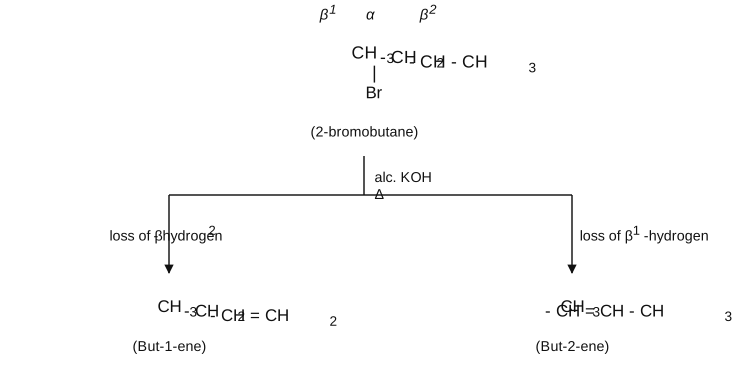
When an alkyl halide that has at least one beta-hydrogen is boiled with an alcoholic solution of potassium hydroxide, it undergoes elimination of a hydrogen atom from the beta-carbon together with the halogen atom from the alpha-carbon, forming an alkene; because both a hydrogen and a halogen are removed together, this is called a dehydrohalogenation reaction, and because it removes two atoms from two adjacent carbons it is also called a beta-elimination (or 1,2-elimination) reaction. (By the naming convention used throughout this section, the carbon bearing the halogen is the alpha-carbon, and any carbon directly attached to the alpha-carbon is a beta-carbon, with hydrogens on that beta-carbon called beta-hydrogens.) The general reaction is written C(beta)H-C(alpha)X + base(B:) (heat, alcoholic KOH) -> C=C + B-H+ + X-. If an alkyl halide has two or more non-equivalent beta-hydrogens available, elimination gives a mixture of alkene products rather than a single one -- for example 2-bromobutane heated with alcoholic KOH gives a mixture of but-1-ene (from loss of a beta2-hydrogen on the terminal methyl) and but-2-ene (from loss of a beta1-hydrogen on the other side). These different products do not form in equal proportion: Saytzeff's rule (an empirical rule formulated after studying many elimination reactions) states that the preferred product is the alkene with the greater number of alkyl groups on its doubly-bonded carbons -- so but-2-ene, being more highly substituted (and correspondingly more stable, following the general alkene stability order R2C=CR2 > R2C=CHR > R2C=CH2), is the major product from 2-bromobutane, with but-1-ene as the minor product. Because alkyl halides can undergo substitution as well as elimination when treated with a basic reagent, the two reactions are always in competition, and which one actually predominates depends on the nature of the alkyl halide (tertiary favours eliminat …
Drawn by us to help you understand the concept clearly, and verified to make sure it's accurate. For exams, practice from your textbook's own diagram.
Worked out. When a dehydrohalogenation reaction can eliminate more than one non-equivalent beta-hydrogen, the different possible alkene products do not form in equal amounts. Russian chemist Saytzeff formulated the empirical rule that the preferred (major) product is the alkene with the greater number of alkyl groups attached to its doubly-bonded carbon atoms -- the more highly substituted alkene. This holds because more highly alkyl-substituted alkenes are also inherently more stable alkenes, with the overall stability order R2C=CR2 > R2C=CHR > R2C=CH2 and RCH=CHR > RCH=CH2. For example, 2-bromobutane heated with alcoholic KOH can lose a beta1-hydrogen to give but-1-ene, or a beta2-hydrogen to give but-2-ene; since but-2-ene is the more highly substituted (and hence more stable) alkene, it forms …
Worked out. Alkyl halides can undergo both substitution and elimination when treated with a basic reagent, so the two reactions are always in competition; which one actually predominates in a given case depends on three factors. (a) Nature of the alkyl halide: tertiary alkyl halides prefer to undergo elimination, while primary alkyl halides prefer to undergo substitution. (b) Strength and size of the nucleophile/base: a bulkier, more electron-rich species prefers to act as a base (abstracting a proton), which favours elimination, whereas a comparatively weaker base prefers to act as a nucleophile instead, which favours substitution. (c) Reaction conditions: a less polar solvent and high temperature favour elimination, while …