Chemistry · Ch 10 — Halogen Derivatives
Reaction of haloarenes
Reaction of haloarenes
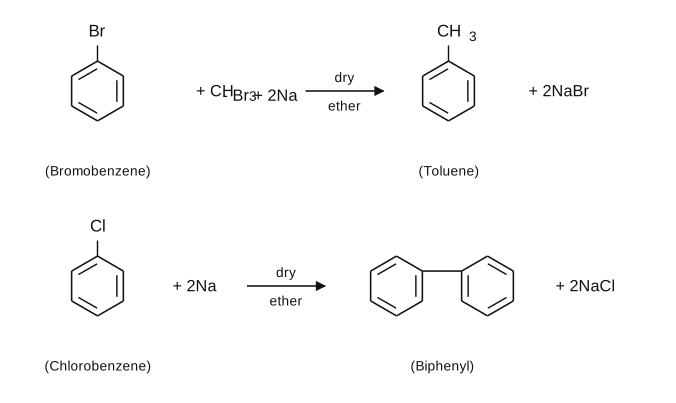
Haloarenes react differently from haloalkanes in three distinct ways, covered here in turn. (a) Reaction with active metals: an aryl halide reacted together with an alkyl halide and sodium metal in dry ether couples the two to give a substituted aromatic compound -- the Wurtz-Fittig reaction, an extension of the ordinary Wurtz reaction (section 10.6.6) that Fittig applied to a mixed aryl-plus-alkyl pair, used to alkylate an aryl halide; when only the aryl halide is present (no alkyl halide), two molecules of it couple to each other instead, giving a biphenyl -- the Fittig reaction proper. (b) Nucleophilic substitution (SN) of haloarenes: aryl halides show low reactivity towards SN, for two combined reasons -- resonance donation of a halogen lone pair into the ring gives the C-X bond partial double-bond character (making it shorter and stronger than in an alkyl halide, ruling out easy heterolysis for SN1), and the sp2 hybridisation and flat geometry of the ring blocks the backside approach an SN2 mechanism would need. Despite this general resistance, an electron-withdrawing group placed at the ortho and/or para position markedly activates the halogen towards substitution (more such groups increase the effect further; the same group at meta has essentially no effect), because it resonance-stabilises the anionic intermediate the substitution passes through -- illustrated by p-nitrochlorobenzene reacting comparatively easily with hydroxide (roughly 433 K) to give p-nitrophenol, versus plain chlorobenzene needing roughly 623 K and 300 atmospheres for the same conversion, with each further nitro group (2,4-dinitro-, then 2,4,6-trinitro-chlorobenzene) lowering the required temperature still more. (c) Electrophilic substitution (SE) of haloarenes: haloarenes undergo electrophilic aromatic substitution more slowly than benzene, because the halogen's strong -I effect deactivates the ring overall even as its +R effect still directs the incoming electrophile to the ortho/para positions, with the para product usually predominating because of steric hindrance at …
Drawn by us to help you understand the concept clearly, and verified to make sure it's accurate. For exams, practice from your textbook's own diagram.
Worked out. When an aryl halide is reacted together with an alkyl halide and sodium metal in dry ether, the two couple to give a substituted aromatic compound; this reaction, an extension of the ordinary Wurtz reaction carried out on a mixed aryl+alkyl pair by the chemist Fittig, is called the Wurtz-Fittig reaction, and it is a way of alkylating an aryl halide -- for example bromobenzene + methyl bromide + 2 Na (dry ether) -> toluene + 2 NaBr. If only the aryl halide takes part (no alkyl halide present), two aryl halide molecules couple to each other instead, giving a biphenyl; this aryl-only variant is called the Fittig reaction on its own - …
Drawn by us to help you understand the concept clearly, and verified to make sure it's accurate. For exams, practice from your textbook's own diagram.
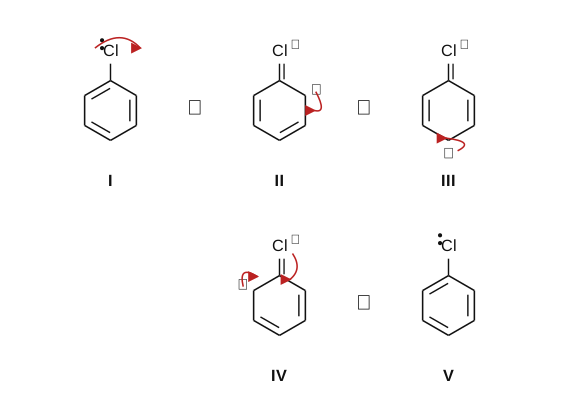
Worked out. Aryl halides show low reactivity towards nucleophilic substitution for two combined reasons. First, resonance: one of the lone pairs of electrons on the halogen atom conjugates with the ring's pi-electron system, so chlorobenzene, for example, can be drawn as a set of resonance structures (I through V) in which structures II, III and IV place double-bond character directly on the carbon-chlorine bond; as a result the C-Cl bond in chlorobenzene is measurably stronger and shorter (169 pm) than the C-Cl bond in an alkyl chloride (178 pm), making it correspondingly harder to break. Second, hybridisation: the ring carbon carrying the halogen is sp2, not sp3. Together these rule out both possible substitution mechanisms -- a phenyl cation formed by self-ionisation of the haloarene would not be resonance-stabilised (unlike an alkyl carbocation), which rules out SN1, and backside attack of an incoming nucleophile is sterically blocked by the flat aromatic ring itself, which rules out SN2. Certain groups, however, placed at certain ring positions, can markedly activate the halogen towards substitution despite this general resistance: an electron-withdrawing group at the ortho and/or para position greatly increases reactivity (more such groups increase it further), while the same group at the meta position has practically no activating effect at all. The -I (inductive, electron-withdrawing) effect of the halogen itself is stronger than its own +R (resonance, …
Drawn by us to help you understand the concept clearly, and verified to make sure it's accurate. For exams, practice from your textbook's own diagram.
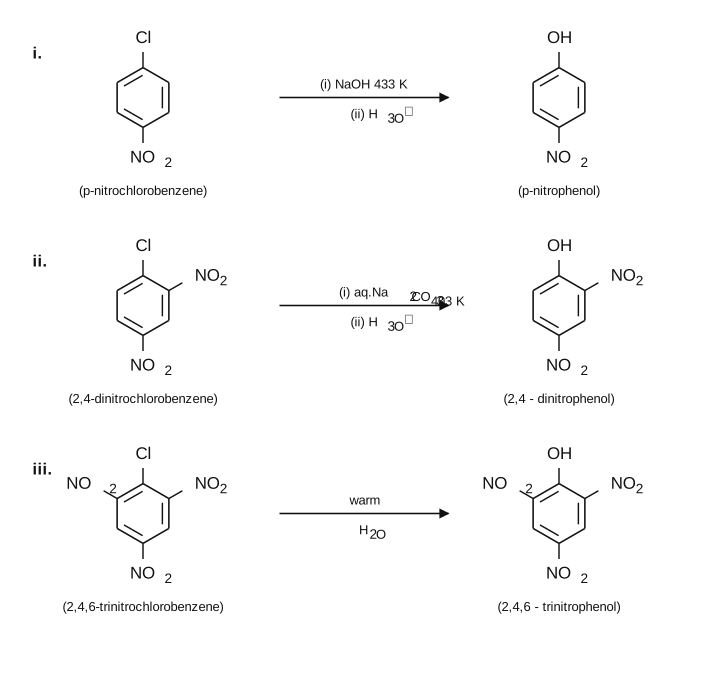
Worked out. Nucleophilic substitution CAN occur at a reasonable rate when the ring carries a strong electron-withdrawing group at the ortho or para position, and this is explained by resonance stabilisation of the reaction's intermediate. For p-nitrochlorobenzene reacting with hydroxide, the incoming OH- first adds to the ring carbon bearing the chlorine, forming a negatively charged (carbanion) intermediate that can be drawn as several resonance structures; crucially, one of these resonance structures places the negative charge directly on the oxygen of the para-nitro group, extending the conjugation of the electron-withdrawing group all the way into where the new bond formed -- this delocalisation makes the intermediate markedly more stable and lowers the energy barrier of the (slow) addition step enough for the reaction to proceed; in the fast step that follows, chloride ion then leaves, restoring aromaticity and giving p-nitrophenol. Correspondingly, converting plain chlorobenzene (no activating group) to phenol by aqueous NaOH requires much harsher conditions -- roughly 623 K and 300 atmospheres of pressure; with one nitro group at the para position (p-nitrochlorobenzene) the same kind of substitution needs only about 433 K, with two nitro groups (2,4-dinitrochlorobenzene) only about 403 K, and with three (2,4,6-trinitrochlorobenzene) the substitution proceeds merely on warming with water -- eac …
Drawn by us to help you understand the concept clearly, and verified to make sure it's accurate. For exams, practice from your textbook's own diagram.
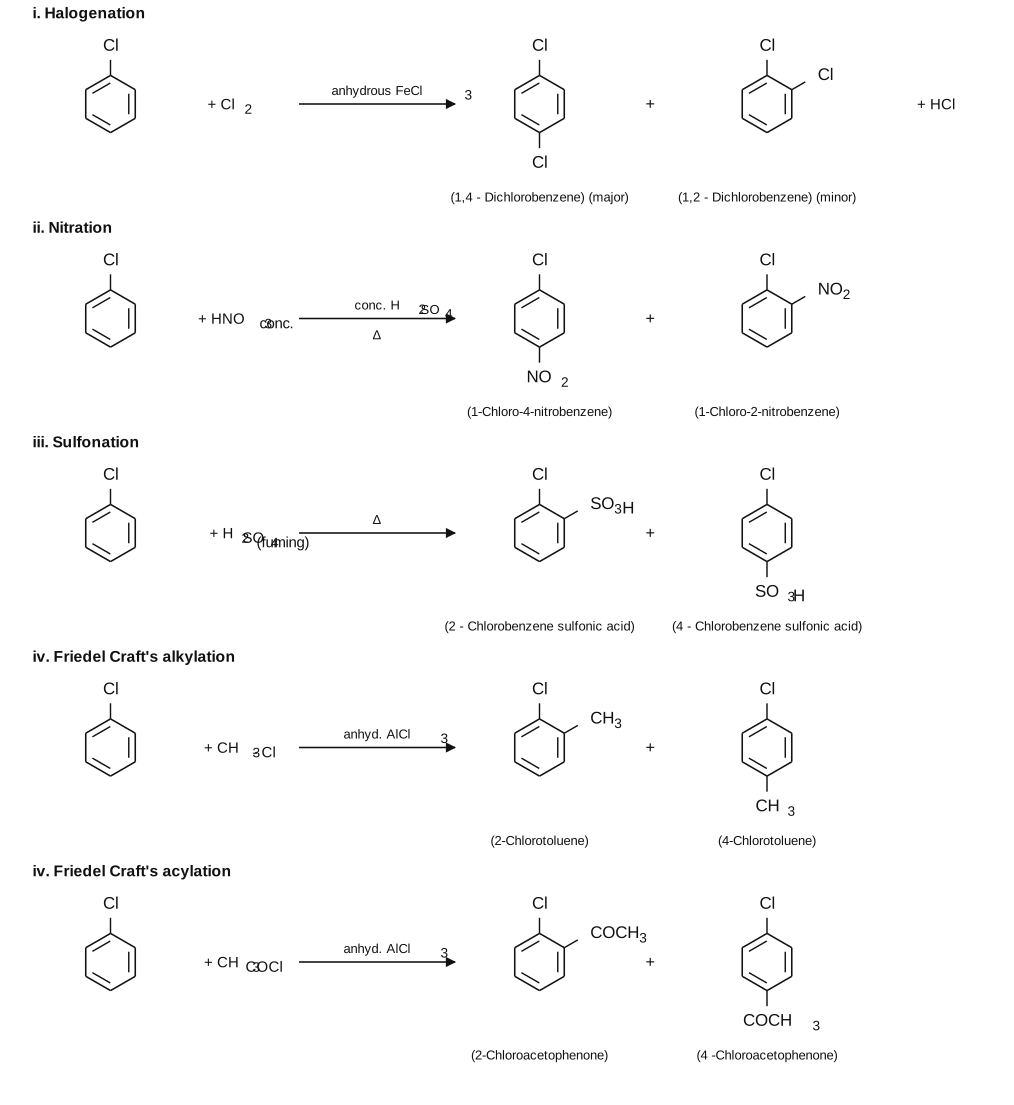
Worked out. Aryl halides undergo electrophilic aromatic substitution reactions more slowly than benzene itself, because the halogen's strong electron-withdrawing inductive effect (-I) deactivates the ring even while its resonance donation (+R) directs the incoming electrophile to the ortho and para positions; in practice the para product usually predominates over the ortho product because of steric hindrance near the halogen at the ortho position. Four such reactions are covered by name: (i) halogenation, reacting the haloarene with a further equivalent of halogen in the presence of a ferric-salt Lewis-acid catalyst -- e.g. chlorobenzene + Cl2 (anhydrous FeCl3) gives mainly 1,4-dichlorobenzene plus a minor amount of 1,2-dichlorobenzene, plus HCl; (ii) nitration, heating the haloarene with concentrated HNO3 in the presence of concentrated H2SO4 -- e.g. chlorobenzene gives mainly 1-chloro-4-nitrobenzene plus a minor amount of 1-chloro-2-nitrobenzene; (iii) sulfonation, heating the haloarene with fuming sulphuric acid -- e.g. chlorobenzene gives a mixture of 2-chlorobenzenesulfonic acid and 4-chlorobenzenesulfonic acid; and (iv) Friedel-Crafts reaction, treating the haloarene with an alkyl chloride or an acyl chloride in the presence of anhydrous AlCl3 as catalyst -- e.g. chlorobenzene with methyl chloride (anhydrous AlCl …
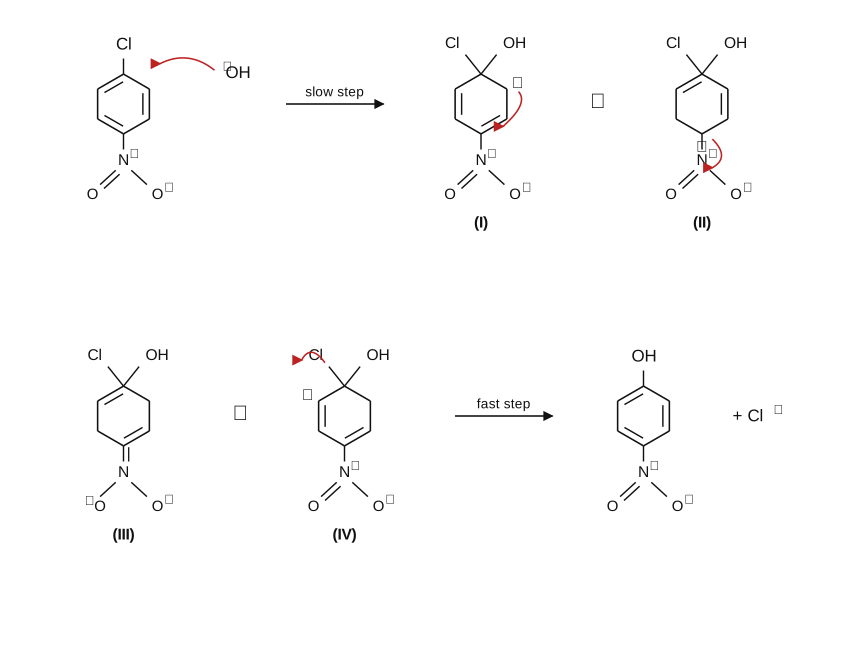
Drawn by us to help you understand the concept clearly, and verified to make sure it's accurate. For exams, practice from your textbook's own diagram.
Why the p-nitro group helps. The slow step adds OH⁻ to the carbon bearing chlorine, giving an sp3 intermediate whose negative charge spreads over the ring — and, in structure (III), right into the electron-withdrawing nitro group. That extra delocalization stabilizes the intermediate, so substitution that plain chlorobenzene resists becomes feas …