Chemistry · Ch 10 — Halogen Derivatives
Nucleophilic substitution reactions of haloalkanes
Nucleophilic substitution reactions of haloalkanes
When one group bonded to a carbon in a substrate is replaced by another group, with no change in the hybridisation state of that carbon, the reaction is called a substitution reaction. The C-X bond in an alkyl halide is a polar covalent bond in which the carbon is positively polarised -- in other words, the carbon of the C-X bond is an electrophilic centre, and it therefore has a natural tendency to react with a nucleophile (Class 11 Chemistry, Chapter 14). Alkyl halides react with a wide variety of nucleophiles to give nucleophilic substitution reactions (SN), represented in general as Nu(-) + C-X -> Nu-C + X(-). A substrate that reacts fast is described as reactive, and the reactivity of an alkyl halide in an SN reaction depends on two independent factors: the substitution state of the carbon carrying the halogen (primary, secondary or tertiary) and the identity of the halogen itself, with the overall order tertiary > secondary > primary for substitution state and R-I > R-Br > R-Cl for the halogen (because a weaker, more polarisable C-X bond, per Table 10.2, breaks more easily). Table 10.3 catalogues eight important nucleophilic substitution reactions of alkyl halides -- with hydroxide, alkoxide, carboxylate, ammonia, cyanide, silver cyanide, nitrite and silver nitrite -- giving alcohols, ethers, esters, amines, nitriles, isocyanides, alkyl nitrites and nitroalkanes respectively. Cyanide and nitrite are both examples of ambident nucleophiles, capabl …
Sr. No, reagent, substitution product (all reactions start from R-X). 1. NaOH(aq) or KOH, heat -> R-OH (alcohol) + NaX/KX. 2. Sodium alkoxide NaOR', heat -> R-O-R' (ether) + NaX. 3. Silver carboxylate R'-C(=O)-OAg, heat -> R'-C(=O)-OR (ester) + AgX(down-arrow). 4. Ammonia NH3 (alcoholic, excess, heat, pressure) -> R-NH2 (primary amine) + HX. 5. KCN (alcoholic), heat -> R-CN (nitrile / alkyl cyanide) + KX. 6. AgCN (alcoholic), heat -> R-NC (isocyanide) + AgX(down-arrow). 7. Potassium nitrite KO-N=O, heat -> R-O-N=O (alkyl nitrite) + KX. 8. Silver nitrite Ag-O-N=O -> R-NO2 (nitroalkane) + AgX(down-arrow). The table shows the same alkyl halide substrate R-X reacting with eight different nucleophiles to give …
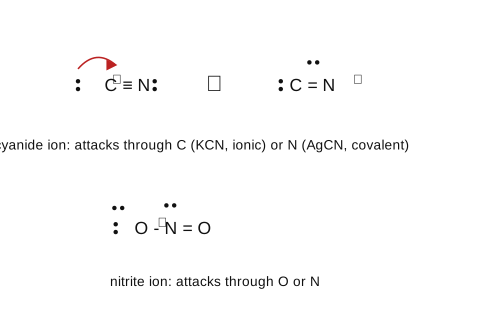
Drawn by us to help you understand the concept clearly, and verified to make sure it's accurate. For exams, practice from your textbook's own diagram.
Worked out. An ambident nucleophile is one capable of attacking through more than one atom (site). Cyanide ion, C(triple bond)N- in resonance with C=N-, can attack an alkyl halide through either its carbon or its nitrogen atom. Potassium cyanide, KCN, is predominantly ionic and supplies a 'naked' cyanide ion in which both atoms are free to donate an electron pair; because the C-C bond that would form is stronger than the C-N bond that would form, attack occurs mainly through the carbon atom, giving an alkyl cyanide (nitrile) as the major product. Silver cyanide, AgCN, by contrast, is mainly covalent (Ag-C(triple bond)N), which ties up the carbon's lone pair in the Ag-C bond and leaves the nitrogen free to donate its electron pair instead, so attack occurs through nitrogen, giving an isocyanide. The nitrite ion, O-N=O in resonance with O=N-O, is a second ambident nucleophile that can attack through either its oxygen or its nitrogen atom: alkyl halides treated with alcoholic silver nitrite (covalent, nitrogen free to attack) give a nitroalkane, while alkyl halides tre …