Chemistry · Ch 10 — Halogen Derivatives
Mechanism of SN reaction
Mechanism of SN reaction
Table 10.3's reactions show that, in a nucleophilic substitution of an alkyl halide, the halogen atom detaches from carbon and a new bond forms between that (electrophilic) carbon and the incoming nucleophile: the covalently bonded halogen is converted into a halide ion, taking the two electrons of the original C-X bond away with it. Because of this, the halogen atom is called the 'leaving group' in the context of this reaction. Two changes therefore happen to the substrate during an SN reaction: heterolysis of the original C-X bond, and formation of a new bond between carbon and the nucleophile using the nucleophile's own electron pair; the sequence and timing of these two changes -- whether they happen together in one step, or one after the other in two steps -- is what is meant by the 'mechanism' of the SN reaction, and it is worked out from studying reaction kinetics. Two such mechanisms are observed: SN2 and SN1. (a) SN2 mechanism: methyl bromide's reaction with hydroxide to give methanol follows second-order kinetics, rate = k[CH3Br][OH-] -- the rate depends on the concentration of BOTH reacting species, which means the reaction happens in a single step, with bond-breaking (C-Br) and bond-forming (C-OH) occurring simultaneously; this is called substitution nucleophilic bimolecular, SN2. Its salient features (Fig. 10.4) are: a single-step mechanism with simultaneous bond breaking/forming; backside attack of the nucleophile (approaching from the side directly opposite the leaving group, to minimise steric and electrostatic repulsion with the leaving group); a transition state in which the carbon is briefly five-coordinate (three sigma bonds in a plane at 120 degrees, plus two partial bonds -- to the nucleophile and to the leaving group -- along a perpendicular axis), with the total negative charge spread (diffused) over the nucleophile and leaving group; and, critically, that when SN2 happens at a chiral carbon, the product's configuration comes out INVERTED relative to the substrate's -- an effect called Walden inversion, pictured as the three untouched groups flipping through the carbon like an umbrella turning inside out. (b) SN1 mechanism: tert-butyl bromide's reaction with hydroxide to give tert-butyl alcohol instead follows first-order kinetics, rate = k[(CH3)3CBr] -- the rate depends only on the substrate's concentration, meaning the nucleophile plays no part in the rate-determining (slow) step; this is called substitution nucleophilic unimolecular, SN1, and it proceeds in two steps (Fig. 10.5): Step I (slow, reversible) is heterolysis of the C-X bond on its own, forming a flat, sp2-hybridised, planar c …
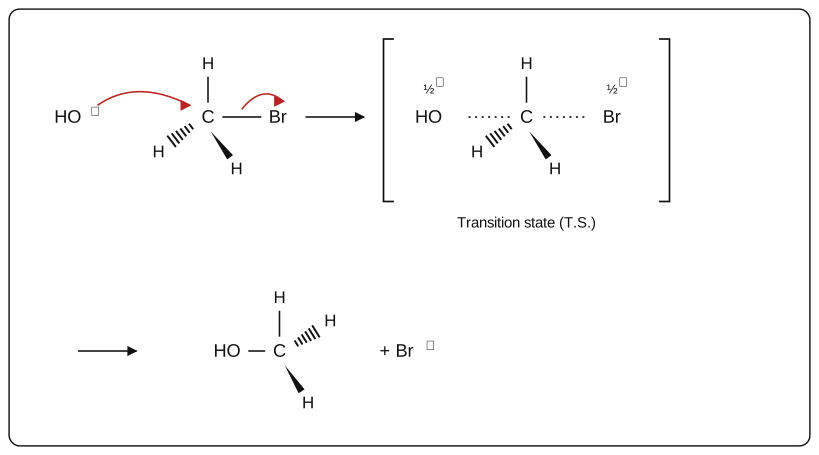
Drawn by us to help you understand the concept clearly, and verified to make sure it's accurate. For exams, practice from your textbook's own diagram.
What this figure shows. Shows the single-step SN2 substitution of methyl bromide by hydroxide ion as three stages left to right. On the left, the incoming hydroxide nucleophile (HO-) approaches the carbon of CH3Br from the side directly opposite (180 degrees from) the C-Br bond -- a 'backside attack'. In the middle, a transition state (T.S., shown inside square brackets) is drawn with the carbon becoming five-coordinate: the three hydrogens are arranged in a flat plane around the central carbon making 120-degree angles with each other, while the partially-formed O...C bond (to the incoming HO-) and the partially-broken C...Br bond lie along a line perpendicular to that plane, one on each side of the carbon; both HO and Br carry a partial negative charge in this state, shown with delta-minus labels, so that the total negative charge is spread out (diffused) across the transition state rather than sitting fully on either group. On the right, the product methanol (CH3OH) is shown with its three hydrogens now pointing to the opposite side from where the bromide has departed -- the hydrogens have flipped through the carbon, like an umbrella turning insi …
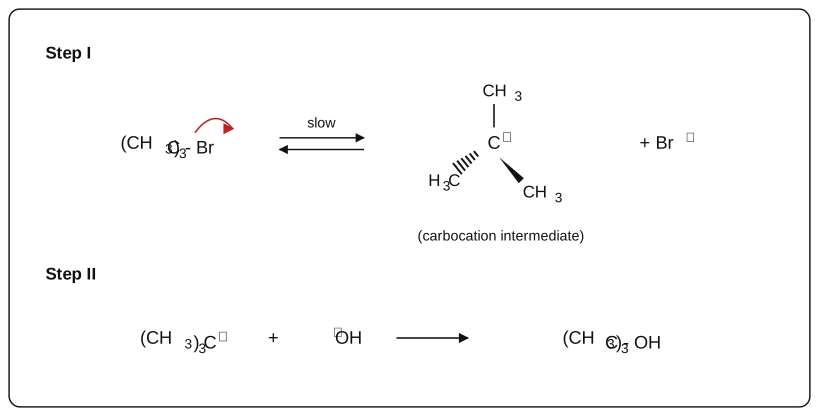
Drawn by us to help you understand the concept clearly, and verified to make sure it's accurate. For exams, practice from your textbook's own diagram.
What this figure shows. Shows the two-step SN1 substitution of tert-butyl bromide by hydroxide ion as two separate steps. Step I (slow): (CH3)3C-Br ionises on its own, without any help from the incoming nucleophile, by heterolysis of the C-Br bond -- the two bonding electrons leave with the departing bromide ion, Br-, and the carbon is left as a flat (planar), sp2-hybridised, positively charged carbocation intermediate, (CH3)3C+, drawn with its three methyl groups splayed out in one plane around the empty p-orbital on the central carbon. Step II (fast): hydroxide ion, OH-, can then attack this planar carbocation from either face (either side of the flat plane, since both faces are equally open), forming the C-OH bond and giving the final product, tert-butyl alcohol, (CH3)3C-OH. Because the carbocation intermediate is planar and can be attacked with equal ease from either side, this …