Chemistry · Ch 10 — Halogen Derivatives
Factors influencing SN1 and SN2 mechanism
Factors influencing SN1 and SN2 mechanism
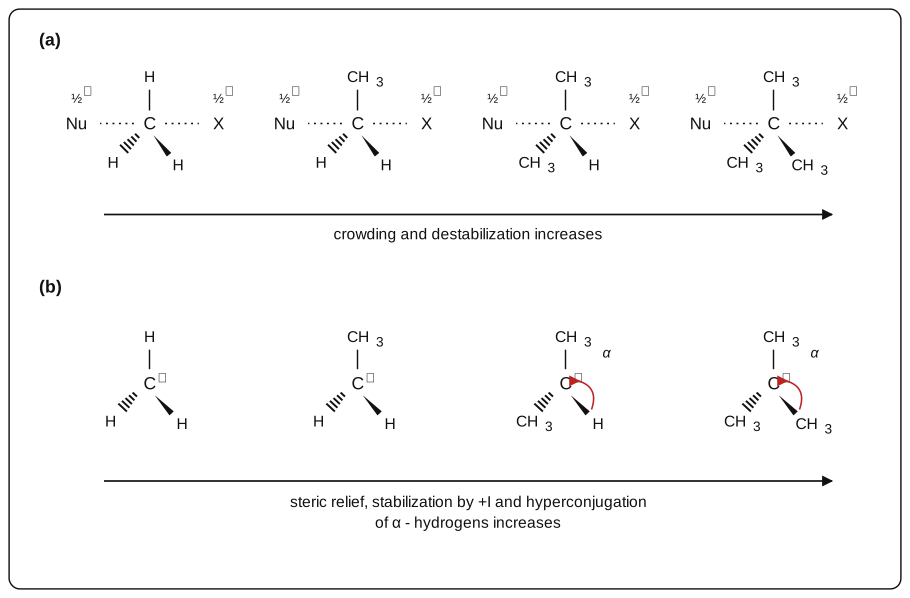
Whether a given alkyl halide reacts by SN1 or by SN2 is controlled by three independent factors. (a) Nature of the substrate: the SN2 transition state is pentacoordinate and therefore crowded (Fig. 10.4), so SN2 is favoured in primary halides and least favoured in tertiary halides, where bulky alkyl groups clash sterically in the crowded T.S. The SN1 mechanism instead goes through a planar carbocation intermediate that has no steric crowding at all -- bulky alkyl groups are easily accommodated around a flat, three-substituent carbon (Fig. 10.5) -- and, further, that carbocation is stabilised by the +I (electron-donating inductive) effect of alkyl substituents and by hyperconjugation from any alpha-hydrogens on those substituents; as a result SN1 is most favoured in tertiary halides and least favoured in primary halides (Fig. 10.6). Worked Problem 10.4 extends this by showing that primary allylic and benzylic halides are exceptions -- unusually SN1-reactive despite being primary -- because their carbocation intermediates are resonance-stabilised. In practice, tertiary alkyl halides undergo nucleophilic substitution by SN1, primary halides follow SN2, and secondary halides can react by either mechanism, or a mixture of both, depending on the exact conditions (Problem 10.5 works through a direct primary-vs-secondary SN2-rate comparison). (b) Nucleophilicity of the reagent: a nucleophile is a species that uses its electron pair to form a bond to carbon, and its nucleophilic character correlates with its strength as a Lewis base; a more powerful nucleophile attacks the substrate faster and favours the SN2 pathway (since the nucleophile IS part of the rate-determining step in SN2), whereas the rate of SN1 is entirely independent of the nucleophile's nature or concentration, because the nucleophile plays no role until after the slow, rate-determining ionisation step is already over. Three rules of thumb for comparing nucleophile strength are given: a negatively charged nucleophile is always a better nucleophile than its own conjugate acid (R-O- beats R-OH); across a period, nucleophilicity falls left to right (H2O is a weaker nucleophile than NH3); and down a group, nucleophilicity rises (I- is a better nucleophile than Cl-). (c) Solvent polarity: SN1 proceeds through ion formation, so a good ionising, polar solvent that can stabilise both the carbocation and the departing anion by solvation speeds it up; solvation of the anion in particular is important, and anions are best solvated by hydrogen-bonding (protic) solvents, so SN1 pro …
Drawn by us to help you understand the concept clearly, and verified to make sure it's accurate. For exams, practice from your textbook's own diagram.
What this figure shows. A two-row comparison across primary, secondary, tertiary, and neopentyl-type substrates. Row (a), SN2 transition states: four drawings, one per substrate class, each showing the same pentacoordinate T.S. geometry as Fig. 10.4 (three groups in a plane, nucleophile and leaving group along the perpendicular axis) but with an increasing number of alkyl (methyl/hydrocarbon) groups crowded around the central carbon as the series goes from primary to secondary to tertiary; a caption arrow reading 'crowding and destabilisation increases' runs beneath the row, and a second arrow reading 'SN2 rate increases' (pointing the opposite way, i.e. towards the least-crowded, primary end) runs beneath the whole figure, showing that SN2 is disfavoured as crowding increases. Row (b), SN1 carbocation intermediates: four drawings of the same substrates' planar (sp2), positively-charged carbocations, with alpha-hydrogens on the neighbouring carbons labelled explicitly on the more substituted examples; a caption arrow reading 'steric relief, stabilisation by +I and hyperconjugation of alpha-hydrogens increases' runs beneath this row (i.e. increases going from primary to tertiary), …
Drawn by us to help you understand the concept clearly, and verified to make sure it's accurate. For exams, practice from your textbook's own diagram.
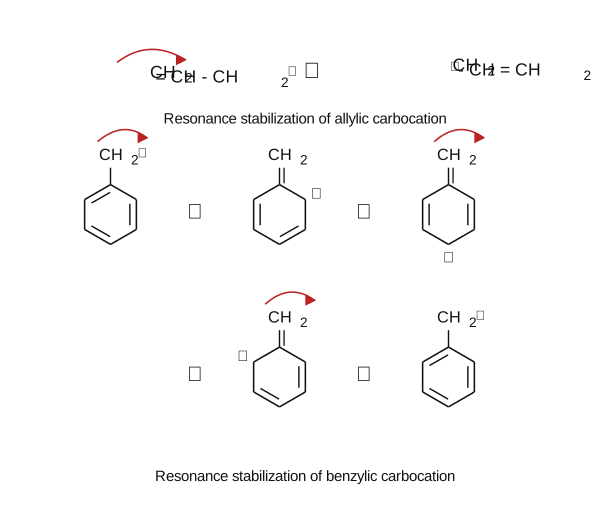
Worked out. Problem: primary allylic and primary benzylic halides show higher reactivity by the SN1 mechanism than other primary alkyl halides -- explain why. Solution: SN1 reaction proceeds through a carbocation intermediate, and the carbocations formed from allylic and benzylic substrates are resonance-stabilised, so SN1 is favoured for them even though they are only primary. For the allylic carbocation, CH2=CH-CH2+ is in resonance with +CH2-CH=CH2 -- the positive charge is delocalised over two terminal carbons through the adjacent double bond. For the benzylic carbocation, the positive charge on the carbon attached to the ring is similarly delocalised into the aromatic ring itself, spreading over several ring positions through a set of resonance structures. In both cases this delocalisation lowers the energy of the carbocation intermediate well below that of an ordinary (non-resonance-stabilised) primary carbocation -- so despite being primary, allylic and benzylic halides react re …
Worked out. Problem: which of 1-chlorobutane (CH3-CH2-CH2-CH2-Cl, primary) and 2-chlorobutane (CH3-CH(Cl)-CH2-CH3, secondary) reacts faster by the SN2 mechanism, and why? Solution: the SN2 mechanism goes through a crowded, pentacoordinate transition state (Fig. 10.4/10.6), so the order of alkyl-halide reactivity towards SN2 is primary > secondary > tertiary, because crowding around the reacting carbon increases from primary to tertiary. 1-Chlorobutane, being the primary halide of this pair, therefore reacts faster by the SN2 mechanism than the seconda …