Physics · Ch 2 — Mechanical Properties of Fluids
Explanation of Formation of Drops and Bubbles
Explanation of Formation of Drops and Bubbles
Free liquid drops, and small bubbles, are always observed to be spherical in shape. This is because, at these small scales, the forces of surface tension dominate completely over gravitational forces, and surface tension always acts to minimise a liquid's total surface area — and, of all possible shapes enclosing a given fixed volume, a sphere is the one with the least possible surface area. A drop or a bubble does not simply collapse in on itself, because the resultant of the external atmospheric-pressure force and the liquid's own surface-tension force is smaller than the (slightly higher) pressure that consequently builds up inside the drop or bubble.
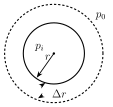
Consider a spherical liquid drop of radius r, with the pressure inside the drop and the pressure of the surrounding atmosphere just outside it; since the drop is spherical (a curved, convex-from-outside surface), is greater than , and the excess pressure inside the drop is .
To find this excess pressure, imagine the drop's radius growing by a very small amount , from r to , small enough that the pressure inside the drop can be taken as essentially unchanged throughout this small growth. The drop's initial surface area is , and its final surface area is ; since is very small, can be neglected next to the other terms, giving . So the increase in the drop's surface area is:
The work done in increasing the drop's surface area by dA is stored as its extra surface energy:
This same work can equally be written as the product of the (excess-pressure) force F that causes the increase in the drop's area, and the displacement through which it acts (the increase in the drop's radius):
where the excess force itself is (excess pressure) × (surface area):
Equating Eqs. (2.20) and (2.21) [using Eq. (2.22) for F]:
This equation gives the excess pressure inside a liquid drop, and is known as Laplace's law of a spherical membrane. …
Drawn by us to help you understand the concept clearly, and verified to make sure it's accurate. For exams, practice from your textbook's own diagram.
What this figure shows. A spherical liquid drop of radius r is shown, with marking the pressure inside the drop and marking the pressure of the surrounding atmosphere just outside it; because the drop's own surface tension always acts to minimise its surface area, the drop is slightly 'over-pressurised' inside relative to outside, i.e. , and the excess pressure is exactly what section 2.4.6 goes on to derive. This is the starting geometry for that derivation: the radius is imagined to grow by a small amount (so the pressure inside stays nearly constant), and the resulting small increase in the drop's surface area and surface energy is equated to the work done by the net outward force from the exces …