Physics · Ch 2 — Mechanical Properties of Fluids
Surface Tension and Surface Energy
Surface Tension and Surface Energy
a) Surface tension. As just seen, the free surface of a liquid behaves like a stretched membrane, and every molecule within its surface film experiences a stretching force. Imagine an imaginary straight line PQ, of length L, drawn lying within the liquid's free surface. All the molecules lying along this line experience equal and opposite forces, tangential to the surface, as if the liquid on either side of the line were trying to tear apart from the liquid on the other side, purely due to the cohesive forces of the molecules on each side.
Surface tension T is defined as this tangential force acting per unit length, on either side of such an imaginary line drawn on a liquid's free surface:
The SI unit of surface tension is N/m, and its dimensional formula is (equivalently, surface tension can be expressed as an energy per unit area, giving the equivalent SI unit J/m² — see part (b) below). Table 2.1 lists the surface tension of a few common liquids: mercury, with its very strong metallic cohesive bonds, has by far the highest surface tension of the liquids listed, while a soap solution — whose whole purpose is to lower water's natural surface tension — has the lowest.
Liquid | S.T. (N/m) | S.T. (dyne/cm)
Water | 0.0727 | 72.7
Mercury | 0.4355 | 435.5
Soap solution | 0.025 | 25 …
b) Surface energy. Since a molecule inside the bulk of a liquid (like molecule A of section 2.4.1) experiences zero net cohesive force, while a molecule in the surface film (like B or C) experiences a net inward pull, work must be done against this inward pull whenever a molecule is brought up from inside the liquid into the surface film. So surface-film molecules possess extra potential energy compared to molecules in the bulk — this extra energy is called the surface energy of the liquid. Because any physical system always tends toward a state of minimum potential energy, a liquid's surface correspondingly always tries to minimise its own total surface area, and energy must always be supplied to increase a liquid's surface area.
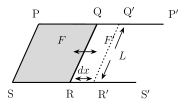
This relationship between surface tension and surface energy can be derived quantitatively using a simple experiment. Take a rigid, C-shaped wire frame, labelled , fitted with one movable straight arm QR that can slide freely along the frame's two side-arms. Dip the frame in soap solution and withdraw it: a rectangular film of soap solution forms within the boundary PQRS. Every arm of the frame feels an inward pull from this film; in particular, if the length of the movable arm QR is L, and — because the film has two surfaces, an upper and a lower one — the surface tension acts along a total length on this arm, the inward force F on QR is:
Now imagine applying an external force , equal in magnitude and opposite in direction to F, to the arm QR, isothermally (gradually, and at constant temperature), so that it pulls the arm outward and increases the film's area; suppose this moves QR through a small distance dx, to a new position . The work done against F (the film's own inward pull) in this process is:
But is exactly the increase in the total area of the film's two surfaces (upper plus lower) — so:
…

Drawn by us to help you understand the concept clearly, and verified to make sure it's accurate. For exams, practice from your textbook's own diagram.
What this figure shows. An imaginary straight line PQ of length L is drawn lying within a liquid's free surface, with force arrows labelled F drawn along the surface on both sides of the line, pointing directly away from PQ and perpendicular to it (i.e. tangential to the liquid surface). This represents the equal-and-opposite pulling force that the molecules on either side of the line exert on each other along the surface, as if the two sides were trying to tear apart along PQ under their mutual cohesive attraction. This is the exact geometry that defines surface tension, T = F/L, as the force per unit length acting across any such ima …
Drawn by us to help you understand the concept clearly, and verified to make sure it's accurate. For exams, practice from your textbook's own diagram.
What this figure shows. A C-shaped (or U-shaped) rigid wire frame, labelled with corners P′, P, S, S′, is shown fitted with one movable straight arm QR that can slide freely along the two parallel side-arms of the frame. The frame has been dipped in soap solution and withdrawn, so that a rectangular soap film now fills the region bounded by P, Q, R and S. An external force F′, equal and opposite to the film's own inward pull F on the movable arm, is shown being applied to arm QR, pulling it outward through a small distance dx to a new position Q′R′ and thereby increasing the film's area. Because the soap film has two surfaces (front and back), the effective length over which surface tension acts on the arm QR is 2L (not just L), so the inward force is F = T(2L); the work done in pulling the arm out by dx is then dw = F′dx = T(2L)dx = T(dA), where dA = 2L·dx is the resulting increase in the total area of both of the film' …