Physics · Ch 2 — Mechanical Properties of Fluids
Angle of Contact
Angle of Contact
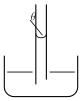
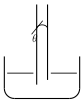
When a liquid's surface comes into contact with a solid surface (for example, the wall of a narrow tube dipped into the liquid), it forms a meniscus — a curved surface that can be either convex (bulging upward, as with mercury against glass) or concave (dipping downward like a bowl, as with water against glass). The angle of contact θ, between a given liquid and a given solid surface, is defined as the angle, measured within the liquid, between the tangent drawn to the liquid's free surface and the tangent drawn to the solid's surface, both taken at their common point of contact. (In practice, when reading the level of water in a narrow capillary, one reads the tangent to the meniscus from inside the water; when reading the level of mercury, one reads the tangent to the meniscus from just above the mercury column.)
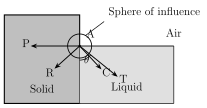
i) Concave meniscus — acute angle of contact. Consider a molecule A on a liquid's surface very close to a vertical container wall — kerosene in a glass bottle, say. Molecule A experiences both a net adhesive force , drawn purely horizontal because the wall is vertical, and a net cohesive force , directed into the liquid at very nearly 45° to the two surfaces. If the magnitude of the adhesive force is large enough, the resultant of these two forces is directed into the solid wall itself. For the liquid surface to remain in stable equilibrium, however, the net force acting on every surface molecule must be exactly normal (perpendicular) to the liquid surface everywhere — so, for to end up normal to the tangent AT drawn to the surface, the liquid must actually pile up higher against the solid wall, which is exactly what produces a concave meniscus. Such a liquid is said to wet the solid surface.
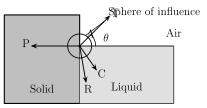
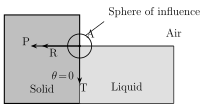
ii) Convex meniscus — obtuse angle of contact. Now consider a molecule A on a liquid's surface near a vertical wall for a liquid like mercury in a glass bottle. Again the net adhesive force is horizontal, but here the magnitude of the cohesive force is so large that the resultant is instead directed into the liquid itself. By the same equilibrium requirement, the liquid must creep away from (downward against) the solid boundary so that AR again ends up normal to the surface — this produces a convex meniscus, and such a liquid is said not to wet that solid surface.
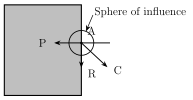
iii) Zero angle of contact. For a liquid that completely wets a solid — pure water on very clean glass, for instance — the number of liquid molecules actually near the contact region is so small that the cohesive force is essentially negligible, , and the net adhesive force is itself the whole resultant force, . In this limiting case the tangent AT runs flush along the wall, inside the liquid, and the angle of contact comes out essentially zero.
iv) Angle of contact = 90° and the acute/obtuse condition. For a hypothetical liquid whose angle of contact with a given container happens to be exactly 90°, the net cohesive force sits at exactly 45° to both surfaces and the resultant works out to be exactly vertical, running along the solid surface. For this special case to hold, , where AC is the magnitude of the net cohesive force. From this boundary condition, the general rule follows directly: the angle of contact is acute (giving a concave meniscus) whenever , and obtuse (giving a convex meniscus) whenever .
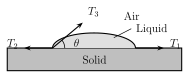
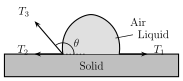
b) Shape of liquid drops on a solid surface. The very same competition of forces decides whether a small liquid drop placed on a flat solid surface spreads out or beads up. Let θ be the angle of contact for a given solid-liquid pair, and let be the force due to surface tension at the liquid-solid interface, the force due to surface tension at the air-solid interface, and the force due to surface tension at the air-liquid interface — each acting tangentially along its own interface. For the drop's edge to be in equilibrium:
…
Drawn by us to help you understand the concept clearly, and verified to make sure it's accurate. For exams, practice from your textbook's own diagram.
What this figure shows. Two-part figure showing a narrow tube dipped into a liquid: (a) concave meniscus — for a liquid that partially or completely wets the solid (e.g. water in a glass tube), the liquid surface curves upward where it meets the tube's inner wall, dipping down in the middle, giving the meniscus a concave (bowl-like, seen from above) shape; (b) convex meniscus — for a liquid that does not wet the solid (e.g. mercury in a glass tube), the liquid surface instead bulges upward in the middle and curves downward at the walls, giving a convex (dome-like) shape. Together these establish the two meniscus shapes that the rest of section 2.4.3 exp …
Drawn by us to help you understand the concept clearly, and verified to make sure it's accurate. For exams, practice from your textbook's own diagram.
What this figure shows. The same capillary-in-vessel arrangement as part (a), but for a liquid that does NOT wet the solid (mercury in glass): the meniscus bulges upward (convex), and the angle of contact θ — measured within the liquid between the wall and …
Drawn by us to help you understand the concept clearly, and verified to make sure it's accurate. For exams, practice from your textbook's own diagram.
What this figure shows. Four-part figure, each showing a molecule A on a liquid's surface right next to a vertical container wall, subject to a net adhesive force AP (always horizontal here, since the wall is vertical) and a net cohesive force AC (directed into the bulk of the liquid at roughly 45° to the surfaces): (a) acute angle of contact (e.g. kerosene in glass) — AP is large enough that the resultant AR points into the solid wall, so for the equilibrium condition (AR normal to the liquid surface) to hold, the liquid must pile up against the wall, producing a concave meniscus; (b) obtuse angle of contact (e.g. mercury in glass) — AC dominates instead, so AR points into the liquid, and the liquid creeps away from the wall, producing a convex meniscus; (c) zero angle of contact (e.g. pure water on clean glass) — AC is negligible, so the resultant AR is simply the adhesive force AP itself, and the tangent to the liquid surface runs flush along the wall; (d) angle of contact exactly 90° (a hypothetical liquid) — AC sits at exactly 45° to both surfaces and the resultant AR is exactly vertical along the wall, the …
Drawn by us to help you understand the concept clearly, and verified to make sure it's accurate. For exams, practice from your textbook's own diagram.
What this figure shows. For mercury against glass, the cohesive force AC on the wall molecule A is far stronger than the adhesive pull AP into the solid, so the resultant AR points down into the LIQUID. The surface near the wall curves so that AR stays normal to it, making t …
Drawn by us to help you understand the concept clearly, and verified to make sure it's accurate. For exams, practice from your textbook's own diagram.
What this figure shows. For a liquid that perfectly wets the solid (highly pure water on clean glass) the cohesive force is negligible: the net adhesive force AP is itself the resultant AR, directed into the solid, and the tangent AT lies along the wall within the …
Drawn by us to help you understand the concept clearly, and verified to make sure it's accurate. For exams, practice from your textbook's own diagram.
What this figure shows. The hypothetical 90° case: the net cohesive force AC lies exactly at 45° to the surfaces, so the resultant AR of AP and AC is exactly vertical (along the solid wall), and the liquid surface meets the wall at a right angle. This happens when AP = AC/√2 — larger …
Liquid - solid in contact | Angle of contact
Pure water and clean glass | 0°
Chloroform with clean glass | 0°
Organic liquids with clean glass | 0°
Ether with clean glass | 16°
Kerosene with clean glass | 26° …
Drawn by us to help you understand the concept clearly, and verified to make sure it's accurate. For exams, practice from your textbook's own diagram.
What this figure shows. Two-part figure showing a small liquid drop resting on a flat horizontal solid surface, with three surface-tension force vectors marked at the point where the liquid, solid and air surfaces all meet: T1 acting along the liquid-solid interface, T2 acting along the air-solid interface (pulling the contact line outward, away from the drop), and T3 acting along the air-liquid interface (pulling the drop's own surface inward, at the angle of contact θ to the solid surface), with the equilibrium condition T2 = T1 + T3·cosθ: (a) acute angle of contact — the drop is drawn as a low, flattened dome (spreading fairly well over the surface), consistent with T2 > T1 and (T2 − T1) < T3 giving a positive cosθ and a small, acute θ; (b) obtuse angle of contact — the drop is drawn beading up into a much rounder, higher dom …
Drawn by us to help you understand the concept clearly, and verified to make sure it's accurate. For exams, practice from your textbook's own diagram.
What this figure shows. A mercury-like drop on a surface it does not wet: the solid–air tension T₂ is smaller than the liquid–solid tension T₁, so equilibrium (T₂ = T₁ + T₃ cos θ) requires cos θ negative — the drop stands tall with an obtuse angle of co …