Physics · Ch 2 — Mechanical Properties of Fluids
Molecular Theory of Surface Tension
Molecular Theory of Surface Tension
To understand surface tension, we first need a small set of terms from the molecular theory of liquids that describe how molecules behave near a liquid's surface.
a) Intermolecular force. Matter is made up of molecules, and any two molecules attract each other with a force called the intermolecular force. There are two kinds: (i) cohesive force, the force of attraction between molecules of the same substance (e.g. between two water molecules) — this force is strongest in solids and weakest in gases, which is exactly why solids hold a definite shape while gases do not, and it is also why small droplets of a liquid coalesce together into one larger drop; and (ii) adhesive force, the force of attraction between molecules of two different substances (e.g. between a glass molecule and a water molecule).
b) Range of molecular force. The maximum distance from a molecule out to which its molecular force remains effective is called the range of molecular force. In solids and liquids, intermolecular forces are effective only up to a distance of the order of a few nanometres ( m) — they are therefore classified as short-range forces.
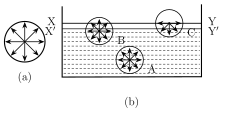
c) Sphere of influence. An imaginary sphere, centred on a given molecule, with radius equal to the range of molecular force, is called that molecule's sphere of influence. The intermolecular force due to (or on) a molecule is effective only for other molecules that lie within this sphere.
d) Surface film. The thin layer at the surface of a liquid, of thickness exactly equal to the range of intermolecular force, is called the surface film.
e) Free surface of a liquid. The free surface is the surface of a liquid that experiences no shear stress — for example, the interface between liquid water and the air directly above it.
f) Surface tension on the basis of molecular theory. Consider a liquid whose free surface is XY, and an inner boundary drawn parallel to XY at a depth exactly equal to the range of molecular force, so that the thin region between XY and is the surface film. Now consider three molecules: A, lying deep inside the liquid, well below ; B, lying within the surface film itself, between XY and ; and C, lying exactly on the free surface XY.
Molecule A, being deep inside the liquid, has its entire sphere of influence lying completely within the liquid — so it is pulled equally by cohesive forces from every direction, and the net cohesive force on A is exactly zero.
Molecule B lies within the surface film, so a larger part of its sphere of influence is inside the liquid and only a smaller part extends into the air above. As a result, B feels a strong downward (inward) cohesive pull from the liquid molecules that dominate its sphere of influence, only weakly opposed by a comparatively weak adhesive force from the far sparser air molecules above it — so molecule B is, on balance, pulled inward, deeper into the liquid.
Molecule C, lying exactly on the free surface, has exactly half its sphere of influence in the liquid and half in the air above. But because air is far less dense than the liquid, the number of liquid molecules within C's sphere of influence (in the lower half) is much greater than the number of air molecules within it (in the upper half). So even for C, the cohesive pull toward the liquid dominates over the weak adhesive pull toward the air, and C too is, on balance, pulled inward. …
Drawn by us to help you understand the concept clearly, and verified to make sure it's accurate. For exams, practice from your textbook's own diagram.
What this figure shows. Two-part figure: (a) shows a single molecule at the centre of an imaginary sphere whose radius equals the (short) range of molecular force — its sphere of influence, within which intermolecular attraction on that molecule is effective; (b) shows a liquid's free surface XY and a second, parallel boundary line X′Y′ drawn at a depth below XY exactly equal to the molecular range, so that the thin layer between XY and X′Y′ is the surface film. Three molecules are marked with their own spheres of influence drawn around them: molecule A, deep inside the liquid well below X′Y′, whose entire sphere of influence lies within the liquid; molecule B, inside the surface film between XY and X′Y′, whose sphere of influence is mostly within the liquid but partly extends into the air above; and molecule C, sitting exactly on the free surface XY itself, whose sphere of influence is split roughly half in the liquid and half in the …