Physics · Ch 2 — Mechanical Properties of Fluids
Excess Pressure Across the Free Surface of a Liquid
Excess Pressure Across the Free Surface of a Liquid
Every molecule sitting on a liquid's surface experiences a force due to surface tension that is tangential to the (static) liquid surface at that point; the direction of the net, resultant surface-tension force on any such molecule depends on the shape — plane, convex, or concave — of the liquid surface there, and this net force in turn contributes to the pressure recorded just below the surface.
Consider a molecule A just above a liquid's surface, and a molecule B just below it, inside the liquid — the small vertical level difference between A and B is negligible, so it contributes nothing to any pressure difference between them, and in every case the pressure at A itself is simply the atmospheric pressure. Let denote the downward force on a surface molecule due to atmospheric pressure, and the net force on a molecule (like B) due to surface tension.
a) Plane liquid surface. For a flat, plane free surface, the surface-tension forces pulling on molecule B from every direction around it cancel out exactly, so the resultant force on B is zero. The atmospheric force alone then decides the pressure at B, and the pressure at A and at B come out equal.
b) Convex liquid surface. For a surface that bulges upward (convex, as seen from above), the resultant surface-tension force on molecule B points vertically downward, adding directly to the downward atmospheric force . So the net downward force — and hence the pressure — at B, which lies on the convex (inner) side of the surface, works out greater than at A, on the concave (outer) side.
c) Concave liquid surface. For a surface that dips downward, like a meniscus (concave as seen from above), the resultant surface-tension force on molecule B points vertically upward, opposing the downward atmospheric force . So the net downward force responsible for the pressure at B is now less than alone would give — this develops a lower pressure at B than the pressure just outside on the far side. …

Drawn by us to help you understand the concept clearly, and verified to make sure it's accurate. For exams, practice from your textbook's own diagram.
What this figure shows. Three-part figure, each showing a liquid surface of a different shape with a molecule A marked just above the surface (in air) and a molecule B marked just below it (inside the liquid), the level difference between A and B taken as essentially zero: (a) plane liquid surface — a flat horizontal surface, with the net surface-tension force on B equal to zero, so pressure at A and pressure at B are the same, both equal to atmospheric pressure; (b) convex liquid surface — the surface bulges upward (dome-shaped, as seen from above), with the net surface-tension force on B pointing vertically downward, adding to the downward atmospheric force, so B (on the convex/inside) experiences greater pressure than A (on the concave/outside); (c) concave liquid surface — the surface dips downward like a meniscus (bowl-shaped, as seen from above), with the net surface-tension force on B pointing vertically upward, opposing the downward atmospheric force, so B (on the concave/inside) experiences less pressure than the full atmospheric force alone would give, while still …
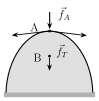
Drawn by us to help you understand the concept clearly, and verified to make sure it's accurate. For exams, practice from your textbook's own diagram.
What this figure shows. An upper-convex liquid surface: the surface-tension resultant f_T on molecule B just below the surface points vertically DOWN into the liquid, adding to the atmospheric push f_A on A. The pressure at B — on the concave (inner) side — therefore …
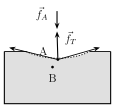
Drawn by us to help you understand the concept clearly, and verified to make sure it's accurate. For exams, practice from your textbook's own diagram.
What this figure shows. An upper-concave surface (the meniscus of a wetting liquid): the surface-tension resultant f_T on B points UP, opposing the atmospheric force f_A, so the net downward force at B is reduced. The pressure inside the liquid at B is then LESS than the atmospheric pressure — …