Physics · Ch 5 — Oscillations
Magnet Vibrating in Uniform Magnetic Field
Magnet Vibrating in Uniform Magnetic Field
As a concrete and important application of angular S.H.M. (section 5.13), consider a bar magnet of magnetic dipole moment , freely suspended (e.g. on a fine, torsion-free thread) in a uniform external magnetic field B (Fig. 5.12). In equilibrium, the magnet's axis aligns itself parallel to the field direction. If it is now given a small angular displacement (about an axis through its centre, perpendicular both to the magnet itself and to the field), and then released, it performs angular oscillations about this equilibrium orientation.
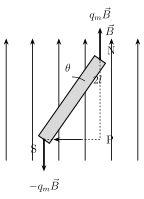
Drawn by us to help you understand the concept clearly, and verified to make sure it's accurate. For exams, practice from your textbook's own diagram.
What this figure shows. A bar magnet (poles N and S, length 2l, pole strength qm) suspended in a uniform magnetic field B. When displaced by a small angle θ from the field direction, the field exerts a restoring torque τ = -μB sin θ ≈ -μBθ (for small θ) that tends to align it with the field — so the ma …
The magnitude of the restoring torque acting on the displaced magnet is
(this is the standard expression for the torque on a magnetic dipole in a field, from the magnetism chapter). For SMALL , using ,
and, since for a CLOCKWISE angular displacement the restoring torque acts in the ANTICLOCKWISE direction (and vice versa), this is properly written with a minus sign to show it opposes the displacement:
Comparing directly with the general angular-S.H.M. torque law (Eq. 5.31) from section 5.13, we identify the restoring-torque-per-unit-angular-displacement constant here as . Substituting into the general angular-S.H.M. differential equation, becomes
Since , B and I are all constants, this equation shows the angular acceleration is directly proportional to the angular displacement and opposite in direction to it -- exactly the defining condition of angular S.H.M. -- confirming that the freely suspended magnet does indeed perform angular S.H.M. for small displacements from its equilibrium orientation.
Applying the general period formula from section 5.13, with , gives the period of the magnet's vibration:
…