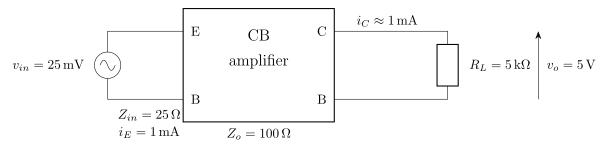
Q.The idea of amplification is clearly understood in the example illustrated in figure 3.1.2a. Let the microphone convert audio frequency sound into electrical signal of 25 mV and is connected to CB amplifier having input impedance of 25 and output impedance of 5 k. Find the voltage amplification (Av).
[!TLDR]
The CB amplifier passes the emitter current almost unchanged into a large collector load, turning a 25 mV microphone signal into a 5 V output — a voltage gain of 200.
A common base amplifier is a good voltage amplifier because its input (emitter-base) side has a very low impedance while its output (collector-base) side has a very high impedance. The signal current established in the low-impedance input is delivered almost entirely to the high-impedance output, so the voltage is stepped up even though the current gain is slightly less than 1 (there is voltage amplification but no current amplification, since ).
Given: input signal , input impedance , collector load .
Step 1 — input (emitter) current:
Step 2 — output voltage. In a CB stage , so the same 1 mA flows through the load:
Step 3 — voltage amplification:
The weak microphone signal is amplified 200 times, a classic Karnataka 2nd PUC Electronics illustration of how a CB amplifier gives voltage amplification without current amplification.
[!ANSWER]
Voltage amplification .
Unlock everything free for 14 days
- Full step-by-step solutions
- Concept-first explanations
- Methods, shortcuts & mistakes
- PYQ mapping + timed mock tests
Full access for 14 days. No credit card required.