Mathematics · Ch 3 — Trigonometric Functions
Polar Co-ordinates
Polar Co-ordinates
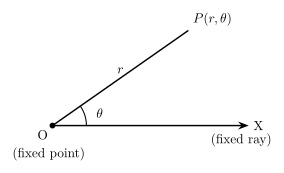
Fix a point in a plane, called the pole, and a fixed ray starting at , called the polar axis. For any point in the plane other than , let (the length of the segment joining and ) and let (the angle the ray makes with the polar axis ). The ordered pair completely determines the position of and is called its polar co-ordinates: is the radius vector and is the vectorial angle of .
Drawn by us to help you understand the concept clearly, and verified to make sure it's accurate. For exams, practice from your textbook's own diagram.
What this figure shows. Shows the fixed pole and the fixed polar ray (the polar axis) in a plane, with an arbitrary point marked away from the pole. A line segment joins to , labelled for its length , and the angle is marked at between the ray and the segment , giving the ordered pair that are t …
…