Mathematics · Ch 3 — Trigonometric Functions
Relation between the Cartesian and the Polar Co-ordinates
Relation between the Cartesian and the Polar Co-ordinates
To connect polar co-ordinates to the familiar Cartesian system, take the polar axis as the X-axis and the line through perpendicular to as the Y-axis, with the pole as the origin. Let be any point other than the origin, with Cartesian co-ordinates and polar co-ordinates . By the definition of the sine and cosine of an angle applied to the right triangle formed by dropping a perpendicular from to the X-axis,
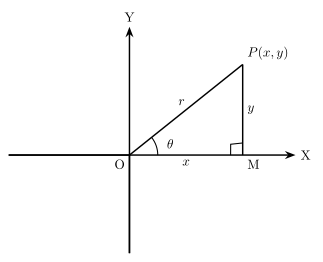
Drawn by us to help you understand the concept clearly, and verified to make sure it's accurate. For exams, practice from your textbook's own diagram.
What this figure shows. Shows the same pole now doubling as the Cartesian origin, with serving as the X-axis and the perpendicular line through as the Y-axis. Point has Cartesian co-ordinates and polar co-ordinates ; a foot of perpendicular is dropped from onto the X-axis, so the right triangle visually justifies and by definiti …
and , so
This is the relation between Cartesian and polar co-ordinates: given these formulas give directly; given , one first finds and then solves , simultaneously for in , taking care to pick the value of in the correct quadrant (matching both the sign of and the sign of , not just one of them).
Ex.(1) Find the Cartesian co-ordinates of the point whose polar co-ordinates are . Here , . ; . The required Cartesian co-ordinates are . …