The Cosine Rule. In △ABC: (i) a2=b2+c2−2bccosA; (ii) b2=c2+a2−2cacosB; (iii) c2=a2+b2−2abcosC.
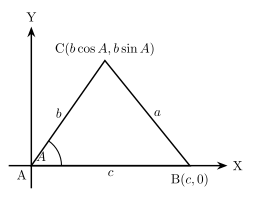
Proof. Take A as the origin, the X-axis along AB, and the perpendicular to AB through A as the Y-axis. Then the co-ordinates of A, B, C are (0,0), (c,0), (bcosA,bsinA) respectively
Figure 3.5Fig. 3.5 — Cosine Rule co-ordinate set-up: A at the origin, B(c, 0) on the X-axis, C(b cos A, b sin A)
ⓘDrawn by us to help you understand the concept clearly, and verified to make sure it's accurate. For exams, practice from your textbook's own diagram.
What this figure shows. Shows △ABC placed on a co-ordinate frame with vertex A at the origin (0,0) and side AB running along the X-axis so that B sits at (c,0); vertex C is plotted at (bcosA,bsinA) using its distance b=AC and the angle A at the origin, letting the distance formula for BC2 generate the cosine-rule id …
(the co-ordinates of C follow because AC=b and the angle at A between AC and the X-axis is A). By the distance formula, a2=BC2=(c−bcosA)2+(0−bsinA)2=c2−2bccosA+b2cos2A+b2sin2A=c2+b2(cos2A+sin2A)−2bccosA=b2+c2−2bccosA. So a2=b2+c2−2bccosA. Placing the origin at B or C in turn and repeating the same argument gives the other two forms, b2=c2+a2−2cacosB and c2=a2+b2−2abcosC. ■
Remark (cosine-solved form). The Cosine Rule can equivalently be written to solve directly for each angle: cosA=2bcb2+c2−a2, cosB=2cac2+a2−b2, cosC=2aba2+b2−c2.
Ex.(5) In △ABC, if a=2, b=3, c=4 then prove that the triangle is obtuse angled. The angle opposite the largest side is the largest angle, so here C (opposite side AB=c=4, the largest side) is the largest angle; we check whether C is obtuse. cosC=2aba2+b2−c2=2(2)(3)4+9−16=24−3=−81. Since cosC is negative, C is obtuse, so △ABC is an obtuse-angled triangle. …