Mathematics · Ch 3 — Trigonometric Functions
The Projection Rule
The Projection Rule
The Projection Rule. In : (i) ; (ii) ; (iii) .
Proof (of statement (i), considering all cases). Let the altitude from meet line at . is the projection of on , and is the projection of on .
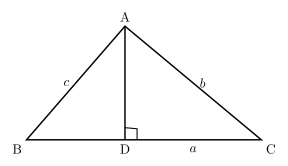
Case (i): and both acute. Then lies between and .
Drawn by us to help you understand the concept clearly, and verified to make sure it's accurate. For exams, practice from your textbook's own diagram.
What this figure shows. Shows with the altitude from vertex meeting side at foot , where both base angles and are acute so falls strictly between and . The two projections and visibly add up along the base to the full length , which is the identity the projection rule proof esta …
Projection of on = ; projection of on = . From the figure, .
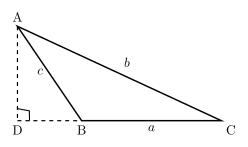
Case (ii): obtuse. Then falls outside segment , beyond .
Drawn by us to help you understand the concept clearly, and verified to make sure it's accurate. For exams, practice from your textbook's own diagram.
What this figure shows. Shows redrawn for the case where angle is obtuse, so the foot of the altitude from falls outside segment , beyond vertex . This makes the projection of onto line equal to (using ), and the figure shows rather than a sum, which the proof uses to recover the same identity $a = b\cos C + …
Projection of on = ; projection of on is still . From the figure, .
Case (iii): right angle. Here coincides with . R.H.S. L.H.S.
In every case, . The cases where is obtuse or a right angle are handled symmetrically. By the same argument applied to the other two vertices, and .
Ex.(8) In , prove that . L.H.S. ; by the Projection Rule each bracket is one full side: R.H.S.
Ex.(9) In , prove that . By the Projection Rule, and , so and . L.H.S. (using ) R.H.S. …