Skip to content

Mathematics · Ch 3 — Trigonometric Functions

The Sine Rule

3.2.4

The Sine Rule

The Sine Rule. In △ABC\triangle ABC,

asin⁡A=bsin⁡B=csin⁡C=2R,\frac{a}{\sin A}=\frac{b}{\sin B}=\frac{c}{\sin C}=2R,

where RR is the circumradius (the radius of the circle passing through AA, BB, CC).

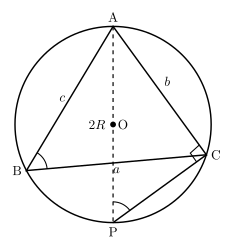
Figure 3.3bSine Rule — triangle ABC inscribed in its circumcircle; diameter AP = 2R gives the common ratio value
Fig. 3.3b — Sine Rule — triangle ABC inscribed in its circumcircle; diameter AP = 2R gives the common ratio value

Drawn by us to help you understand the concept clearly, and verified to make sure it's accurate. For exams, practice from your textbook's own diagram.

What this figure shows. Triangle ABCABC inscribed in its circumcircle (centre OO), with APAP a diameter (=2R=2R). Since ∠ACP\angle ACP stands in a semicircle it is a right angle, and ∠APC=∠ABC\angle APC=\angle ABC (angles in the same segment on chord ACAC). From right triangle ACPACP, $b=AC=2R\sin(\angle A …

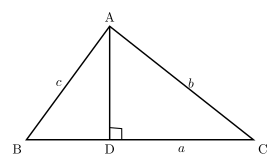
Proof (first part — the three ratios are equal). Draw AD⊥BCAD\perp BC.

Figure 3.3Fig. 3.3 — Triangle ABC with altitude AD (the Sine Rule area argument: AD = b sin C)
Fig. 3.3 — Fig. 3.3 — Triangle ABC with altitude AD (the Sine Rule area argument: AD = b sin C)

Drawn by us to help you understand the concept clearly, and verified to make sure it's accurate. For exams, practice from your textbook's own diagram.

What this figure shows. Triangle ABCABC with the perpendicular (altitude) ADAD dropped from AA onto side BCBC, meeting it at DD (right angle at DD). In right triangle ADCADC, AD=bsin⁡CAD=b\sin C, so the area is 12 a bsin⁡C\tfrac12\,a\,b\sin C — the key step in showing the thre …

In right triangle ADCADC, AD=bsin⁡CAD=b\sin C. So the area A(△ABC)=12⋅BC⋅AD=12⋅a⋅bsin⁡CA(\triangle ABC)=\dfrac12\cdot BC\cdot AD=\dfrac12\cdot a\cdot b\sin C, i.e. 2 A(△ABC)=absin⁡C2\,A(\triangle ABC)=ab\sin C. By dropping perpendiculars from the other two vertices in the same way, 2 A(△ABC)=acsin⁡B=bcsin⁡A2\,A(\triangle ABC)=ac\sin B=bc\sin A as well. So bcsin⁡A=acsin⁡B=absin⁡Cbc\sin A=ac\sin B=ab\sin C; dividing throughout by abcabc: sin⁡Aa=sin⁡Bb=sin⁡Cc\dfrac{\sin A}{a}=\dfrac{\sin B}{b}=\dfrac{\sin C}{c}, i.e. asin⁡A=bsin⁡B=csin⁡C\dfrac{a}{\sin A}=\dfrac{b}{\sin B}=\dfrac{c}{\sin C}. — (1)

Proof (second part — the common ratio is 2R2R). Since the three angles of a triangle sum to 180∘180^\circ, at least one of them is not a right angle; suppose ∠A\angle A is not a right angle. Draw the diameter through AA, meeting the circumcircle again at PP; then AP=2RAP=2R and △ACP\triangle ACP is right-angled at CC (angle in a semicircle). Since ∠ABC\angle ABC and ∠APC\angle APC are angles inscribed in the same arc ACAC, m∠ABC=m∠APCm\angle ABC=m\angle APC, so sin⁡B=sin⁡P=bAP=b2R\sin B=\sin P=\dfrac{b}{AP}=\dfrac{b}{2R}, i.e. bsin⁡B=2R\dfrac{b}{\sin B}=2R. — (2). Combining (1) and (2): asin⁡A=bsin⁡B=csin⁡C=2R\dfrac{a}{\sin A}=\dfrac{b}{\sin B}=\dfrac{c}{\sin C}=2R. ■\blacksquare

Different equivalent forms of the Sine Rule (all standard, all worth recognising): (i) asin⁡A=bsin⁡B=csin⁡C=2R\dfrac{a}{\sin A}=\dfrac{b}{\sin B}=\dfrac{c}{\sin C}=2R; (ii) a=2Rsin⁡A, b=2Rsin⁡B, c=2Rsin⁡Ca=2R\sin A,\ b=2R\sin B,\ c=2R\sin C; (iii) sin⁡Aa=sin⁡Bb=sin⁡Cc=k\dfrac{\sin A}{a}=\dfrac{\sin B}{b}=\dfrac{\sin C}{c}=k (some constant k=1/2Rk=1/2R); (iv) bsin⁡A=asin⁡B, csin⁡B=bsin⁡C, csin⁡A=asin⁡Cb\sin A=a\sin B,\ c\sin B=b\sin C,\ c\sin A=a\sin C; (v) ab=sin⁡Asin⁡B, bc=sin⁡Bsin⁡C\dfrac{a}{b}=\dfrac{\sin A}{\sin B},\ \dfrac{b}{c}=\dfrac{\sin B}{\sin C}.

Ex.(1) In △ABC\triangle ABC if A=30∘A=30^\circ, B=60∘B=60^\circ then find the ratio of its sides. Since A+B+C=180∘A+B+C=180^\circ, C=90∘C=90^\circ. By the Sine Rule, asin⁡30∘=bsin⁡60∘=csin⁡90∘\dfrac{a}{\sin30^\circ}=\dfrac{b}{\sin60^\circ}=\dfrac{c}{\sin90^\circ}, i.e. a1/2=b3/2=c1\dfrac{a}{1/2}=\dfrac{b}{\sqrt3/2}=\dfrac{c}{1}. So a:b:c=12:32:1=1:3:2a:b:c=\dfrac12:\dfrac{\sqrt3}{2}:1=1:\sqrt3:2.

Ex.(2) In △ABC\triangle ABC if a=2a=2, b=3b=\sqrt3 and sin⁡A=23\sin A=\dfrac{2}{\sqrt3} then find BB. By the Sine Rule, asin⁡A=bsin⁡B  ⟹  22/3=3sin⁡B  ⟹  3=3sin⁡B  ⟹  sin⁡B=1  ⟹  B=π2=90∘\dfrac{a}{\sin A}=\dfrac{b}{\sin B}\implies\dfrac{2}{2/\sqrt3}=\dfrac{\sqrt3}{\sin B}\implies\sqrt3=\dfrac{\sqrt3}{\sin B}\implies\sin B=1\implies B=\dfrac{\pi}{2}=90^\circ. …