Q.State and explain Lenz's law in the light of principle of conservation of energy.
Concept understanding — Lenz's Law
Statement. Lenz's law, formulated by the German physicist Heinrich Lenz, gives the DIRECTION of an induced current (which Faraday's laws alone do not specify): the direction of the induced current is always such that it opposes the cause responsible for its production. If a changing flux is the cause and an induced current the effect, the induced current always acts, through the magnetic field it itself creates, to oppose that very flux change.
In the emf formula. Incorporating Lenz's law into Faraday's law supplies the standard minus sign, ε=−d(NΦB)/dt -- not a mathematical formality, but a literal encoding of the physical statement that the induced emf's polarity always opposes the flux change producing it.
Application technique. To find a direction: (i) determine whether the relevant flux is increasing or decreasing; (ii) the induced current flows in whichever sense creates its OWN magnetic field that opposes that particular change (reinforcing a decreasing flux, or counteracting an increasing one); (iii) apply the right-hand rule to that self-field to read off the current's actual direction around the loop. Equivalently, for a magnet approaching/receding a coil, the coil's near end becomes whichever pole (N or S) repels an approaching magnet or attracts a receding one.
Proof from energy conservation. If a magnet is moved towards/away from a coil, Lenz's law says the induced current opposes this motion, so external work must be done against a resisting force -- this work converts to electrical, then thermal, energy, consistent with energy conservation. If (hypothetically) the induced current instead HELPED the motion, a magnet nudged towards a coil would accelerate in with no external energy input -- a perpetual motion machine, which is never observed; since this contradiction is impossible, Lenz's law must hold, proving it is a direct consequence of energy conservation rather than an independent postulate.
[!TLDR] Lenz's law: the induced current always flows so as to oppose the change in flux that produces it. This follows from energy conservation -- an induced current that instead REINFORCED the change would let flux and current amplify each other without bound, generating heat from nothing (a perpetual-motion machine). [!ANSWER] Induced current opposes the flux change that causes it; any other direction would violate energy conservation.
Lenz's law states that the direction of the induced current in a circuit is always such that the magnetic field it produces opposes the very change in magnetic flux that induced it -- equivalently, 'every effect of induction acts in opposition to the cause that produces it.'
This direction is not an independent, arbitrary rule -- it is forced on us by energy conservation. Consider the two ways a current can be induced: (i) a conductor moving through a field, where the induced current always experiences a magnetic force opposing its own motion, so external work must be done to sustain the motion; and (ii) a stationary circuit in a changing field, where the induced current's own magnetic field always opposes the change in the external flux (opposite to it while increasing, same direction while decreasing). Now suppose, hypothetically, that the induced current instead flowed in the OPPOSITE sense in either case -- reinforcing rather than opposing the change. Then the induced current would strengthen the very flux change that produces it, which would strengthen the current further, and so on without limit: the circuit's resistance would dissipate ever-growing amounts of heat with no energy being supplied from anywhere -- a perpetual motion machine, flatly forbidden by the law of conservation of energy. Since this cannot happen, the induced current must instead oppose the change producing it, which is exactly Lenz's law. [!ANSWER] Induced current opposes the flux change that causes it; any other direction would violate energy conservation.
State Lenz's law, then argue by contradiction that if it were reversed, an unopposed current would grow without bound (violating energy conservation), considering both the moving-conductor and changing-field cases.
Explaining Lenz's law only qualitatively (direction rule) without explicitly connecting it to energy conservation via the 'perpetual motion machine' contradiction, which is specifically what this question asks for.
Showing the 12 most recent of 26 on this concept.
- CBSE 2026Set V11 markQ.Lenz's law gives the __________ of induced emf. Fill in the blank choosing the appropriate answer from the bracket: (photons, diffraction, polarity, monopoles, greater than unity, less than unity)
›Reveal solutionSolution
direction (polarity)
✓Final answerdirection (polarity)
Lenz's law states that the induced emf (and hence the induced current) is directed so as to oppose the change in magnetic flux that produces it. Thus Lenz's law gives the direction (polarity/sense) of the induced emf; it is a consequence of the conservation of energy.
- CBSE 2026Set ANNUAL1 markQ.Lenz's law obeys the conservation law of ______.
›Reveal solutionSolution
Lenz's law says the induced effects always oppose the cause producing them, which is required so that work must be done against the induced opposition - i.e. energy is conserved, never created for free.
If the induced current instead aided the change in flux (rather than opposing it), the change would accelerate itself, and the system could generate energy from nothing, violating the law of conservation of energy. Because the induced current opposes the very change that produces it (Lenz's law), external work must always be done to drive the change, and that work is what gets converted into electrical energy. This is why Lenz's law is a direct consequence of conservation of energy.
✓Final answerconservation of energy.
- CBSE 2026Set ANNUAL1 markQ.Which law determines the direction of an induced current?
›Reveal solutionSolution
Lenz's law gives the direction of induced current: it always opposes the very change that causes it (a statement of energy conservation).
Faraday's law gives the MAGNITUDE of the induced emf (emf = -dphi/dt), but it is Lenz's law that fixes its DIRECTION. Lenz's law states that the direction of the induced current is always such as to OPPOSE the change in magnetic flux that induces it - for example, if flux through a loop is increasing, the induced current flows so as to create its own magnetic field opposing that increase. This is ultimately a consequence of the law of conservation of energy: if the induced current instead aided the change, flux (and hence energy) would build up without any external work being done, which is impossible.
✓Final answerLenz's law.
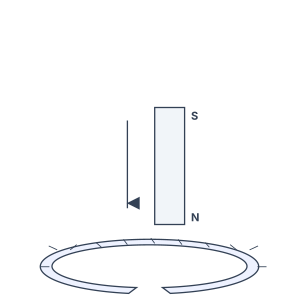
- CBSE 2025Set 55/6/11 markMCQQ.A vertically held bar magnet is dropped along the axis of a copper ring having a cut as shown in the diagram. The acceleration of the falling magnet is: (A) zero (B) less than g (C) g (D) greater than g
›Reveal solutionSolution
Figure — 55/6/1 Q7 Because the copper ring has a cut (it is not a closed loop), no induced current can flow. Without induced current, there is no magnetic braking force, so the magnet falls with acceleration g.
The key idea here is Lenz’s law and what it requires. Lenz’s law says that an induced current flows in a direction that opposes the change causing it. That opposition creates a retarding force on a moving magnet — but only if the current can actually flow. A cut in the ring breaks the conducting path, so no current circulates. No current means no opposing magnetic field, and therefore no upward force on the falling magnet.
Many students memorise that a magnet falling through a copper ring slows down, but they forget the ring must be a closed loop. An open ring is just a curved piece of metal — it cannot sustain a current.
Let’s walk through it step by step.
-
What happens when a magnet moves near a conductor?
A changing magnetic flux through a conducting loop induces an emf (Faraday’s law). If the loop is closed, this emf drives a current. That current produces its own magnetic field, which opposes the motion of the magnet (Lenz’s law). The result is a retarding force, so the magnet falls with acceleration less than g.
-
What is different here?
The copper ring has a cut — it is not a closed loop. An emf is still induced across the gap (a potential difference appears), but without a complete conducting path, no current can flow.
Watch outA common mistake is to think that an induced emf automatically means a retarding force. It does not. Without current, there is no magnetic field from the ring, and therefore no force on the magnet.
-
What forces act on the magnet?
Only two forces: gravity downward (mg) and possibly a magnetic force from the ring. Since no current flows, the magnetic force is zero. The net force is just mg, so by Newton’s second law, the acceleration is g.
-
What if the ring were closed?
Then the induced current would create an upward magnetic force, reducing the net downward force. The acceleration would be less than g — that’s option (B). But here the ring is open, so that doesn’t happen.
TipThink of it this way: a cut ring behaves like a broken circuit. An emf appears across the break, but no electrons complete the loop. No loop current = no opposing field = free fall.
✓Final answerThe acceleration of the falling magnet is g, so the correct option is (C).
-
- CBSE 2025Set ANNUAL1 markMCQQ."The polarity of induced emf is such that it tends to produce a current in a direction which opposes the change in magnetic flux that produces it" - This law is based on conservation of which physical quantity?(a) Mass(b) Charge(c) Energy(d) Momentum
›Reveal solutionSolution
Lenz's law is a statement of the law of conservation of energy applied to electromagnetic induction.
Lenz's law says the induced current opposes the change in flux that produces it. If the induced current instead aided the change, the flux (and hence the current and the force on the source) would grow without any external work being done — creating energy from nothing. Because the induced current opposes the change, external work must be done against this opposition to sustain the change, and this work is exactly the electrical energy delivered. This is why Lenz's law is a direct consequence of conservation of energy.
✓Final answer(c) Energy
- CBSE 2025Set IMPROVEMENT1 markQ.
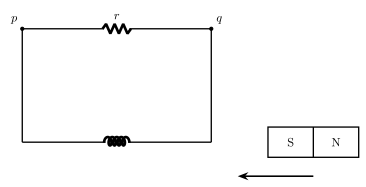 What will be the direction of the induced current in the situation shown in the following figure?
›Reveal solutionSolution
Using Lenz's law, the induced current opposes the approaching magnet by making the near face of the coil repel it.
In the figure, the bar magnet's S-pole faces the coil and the magnet is moving towards the coil, so the magnetic flux linked with the coil (directed towards the approaching S-pole) is increasing. By Faraday's law, an emf is induced in the coil, and by Lenz's law the induced current must flow in a direction that opposes this increase in flux — i.e. it must oppose the relative approach of the magnet and the coil.
This means the induced current must make the face of the coil nearer the magnet behave like an S-pole as well, since like poles (S facing S) repel each other, opposing the magnet's approach (equivalently, this can be seen as the induced current creating a magnetic moment that opposes the increasing flux through the coil, consistent with the negative sign in ε=−dtdϕ).
Applying the right-hand (curled-fingers) rule for the coil so that its near face acts as an S-pole (field lines entering that face, i.e. pointing from p-end towards q-end inside the winding as drawn), the induced conventional current flows from q to p within the coil (i.e., from p to q through the external resistor r).
✓Final answerThe induced current opposes the approaching S-pole (coil's near face becomes an S-pole too), flowing from q to p through the coil, by Lenz's law.
- CBSE 2025Set D1 markMCQQ.Which of the following laws is based on the principle of energy-conservation? (A) Ampere's law (B) Faraday's law of electrolysis (C) Lenz's law (D) None of these
›Reveal solutionSolution
Lenz's law fixes the direction of the induced current so it opposes the flux change; this opposition is exactly what energy conservation demands.
Lenz's law states that the induced e.m.f./current always opposes the change in magnetic flux that produces it. If the induced current instead aided the change, the flux would grow without any external work, creating energy from nothing — a violation of the conservation of energy.
Because the induced current opposes the motion, external work must be done to maintain the change, and this work reappears as the electrical energy of the induced current. Hence Lenz's law is a statement of energy conservation applied to electromagnetic induction.
✓Final answer(C) Lenz's law.
- CBSE 2025Set ANNUAL1 markMCQQ.Lenz's law is based on conservation of physical quantity(a) momentum(b) angular momentum(c) energy(d) charge
›Reveal solutionSolution
Lenz's law fixes the direction of induced current so that it opposes its own cause; if it did not, the induced current would help the change along and energy could be created from nothing, violating energy conservation.
Lenz's law states that the direction of an induced EMF (and induced current) is always such as to oppose the change in magnetic flux that produces it. If the induced current instead aided the change, the flux (and hence the current) would keep increasing without any external work being done — creating energy from nothing. Since this is forbidden, the opposing direction given by Lenz's law is exactly what conservation of energy requires: work must be done against the induced effects to change the flux, and that work is converted into electrical energy.
✓Final answer(c) energy.
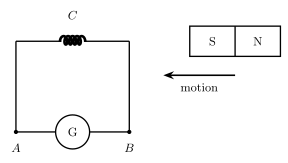
- CBSE 2025Set ANNUAL1 markQ.A magnet is brought towards a coil as shown in the adjoining figure. In which direction will the induced current be?
›Reveal solutionSolution
The approaching south pole increases the flux linked with the coil; by Lenz's law the induced current opposes this by making the near face of the coil itself a south pole, repelling the magnet.
As the bar magnet's S pole moves toward the coil, the magnetic flux (directed into the S pole's field lines, i.e. towards the magnet) through the coil increases. By Lenz's law, the induced current must flow in a direction that opposes this increase — i.e. it must create a magnetic field that repels the approaching magnet. Since the approaching pole is South, the coil's near face must become a South pole too (like poles repel), so as to push back against the magnet's motion and oppose the flux increase.
Using the right-hand (or clock) rule for a solenoid: to make the face nearer the magnet a South pole (field lines entering that face), the induced current, viewed from the magnet's side, flows clockwise.
✓Final answerThe induced current flows so as to make the coil's near end a South pole (repelling the approaching magnet) — i.e. clockwise as viewed from the magnet's side — in accordance with Lenz's law.
- CBSE 2025Set ANNUAL1 markMCQQ.Which of the following gives the polarity of the induced emf?(i) Biot-Savart Law(ii) Lenz's Law(iii) Ampere's circuital Law(iv) Fleming's right-hand Rule
›Reveal solutionSolution
Lenz's law gives the direction (polarity) of an induced emf: it always opposes the change in flux that produces it.
Faraday's law gives the magnitude of the induced emf, ∣ε∣=NdtdΦB, but by itself does not fix its sign/direction. Lenz's law supplies that: the induced current flows in the direction such that the magnetic field it creates opposes the change in flux causing it — this is expressed by the minus sign in ε=−NdtdΦB, and is a consequence of the conservation of energy.
Biot–Savart law and Ampere's circuital law relate currents to the magnetic fields they produce (not induced emf), and Fleming's right-hand rule is only a mnemonic for motional emf direction, not the general law. Lenz's law is the general statement of polarity for any induced emf.
✓Final answer(ii) Lenz's Law — the induced emf always opposes the change in flux producing it.
- CBSE 2025Set ANNUAL1 markQ.Which principle is obeyed by Lenz's law?
›Reveal solutionSolution
The induced current always opposes the change that produces it, which is exactly what conservation of energy demands.
Lenz's law states that the direction of an induced emf/current is such that it opposes the change in magnetic flux that produces it. If it instead aided the change, the induced current would reinforce the flux change, drawing more current, more force, indefinitely — creating energy from nothing. Because the induced effect always opposes the cause, external work must be done against this opposition to sustain the change, and that work is what converts to electrical energy. This is precisely the requirement of the principle of conservation of energy.
✓Final answerLenz's law is a consequence of (obeys) the principle of conservation of energy.
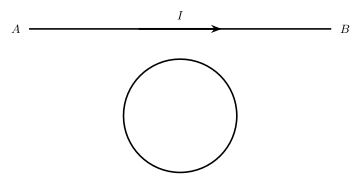
- CBSE 2025Set ANNUAL1 markMCQQ.A current starts flowing from A to B as shown in the figure : The direction of the induced current in the loop is :(a) Clockwise(b) Anticlockwise(c) No current is induced(d) Dependent on the radius of the loop
›Reveal solutionSolution
As the current in the straight wire builds up, the into-the-page flux it creates through the nearby loop increases; by Lenz's law the induced current opposes this increase, so it flows anticlockwise.
The current in the straight wire flows from A (left) to B (right). Using the right-hand thumb rule, at the location of the loop (just below the wire) this current produces a magnetic field directed into the page.
As the current in the wire starts flowing (i.e. grows from zero), the flux through the loop, directed into the page, is increasing with time.
By Lenz's law, the induced current in the loop must oppose this increase, i.e. it must create its own magnetic field out of the page inside the loop.
Applying the right-hand rule to the loop itself: to produce a field out of the page, the induced current must flow anticlockwise (as viewed from the side the field emerges towards).
✓Final answer(b) The induced current in the loop flows anticlockwise, opposing the increasing into-the-page flux from the growing current in wire AB (Lenz's law).
🎓Unlock everything free for 14 days
- ✓Full step-by-step solutions
- ✓Concept-first explanations
- ✓Methods, shortcuts & mistakes
- ✓PYQ mapping + timed mock tests
Full access for 14 days. No credit card required.