Physics · Ch 10 — Magnetic Fields due to Electric Current
Axial Magnetic Field Produced by Current in a Circular Loop
Axial Magnetic Field Produced by Current in a Circular Loop
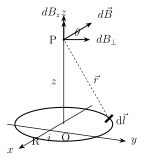
Section 10.12 found the field only at the CENTRE of a circular current loop. This section generalises that result to any point P on the loop's AXIS -- the straight line through the centre of the loop, perpendicular to the plane of the loop -- at an arbitrary distance from the centre (Fig. 10.19).
Set up coordinates so the circular loop, of radius , carrying steady current , lies in the - plane, centred at the origin , with the point P on the axis at distance from . For a current element anywhere on the loop, the distance to P is -- the SAME for every element, by the loop's circular symmetry, exactly as it was constant for every element of a circular arc in the previous section. Because (lying in the - plane, tangent to the loop) is always exactly perpendicular to (which points from the element out to P, lying in a - plane containing the axis), the Biot-Savart law gives a differential field of magnitude
This differential field is NOT directed purely along the axis, however -- it has both an axial () component and a component perpendicular to the axis. Crucially, by the loop's symmetry, the perpendicular component due to any one current element is EXACTLY CANCELLED by the perpendicular component due to the current element diametrically OPPOSITE it on the loop -- so when the contributions of every element are summed over the full loop, all the perpendicular components cancel out completely, leaving only the AXIAL components to add up.
Using the geometry of Fig. 10.19, (where is the angle between and the plane of the loop), so , and integrating this axial component over the entire loop (a simple integral, since itself is the SAME for every element, by symmetry) gives
for a single-turn loop, or, for a coil of turns, …
Drawn by us to help you understand the concept clearly, and verified to make sure it's accurate. For exams, practice from your textbook's own diagram.
What this figure shows. A circular current loop of radius R lies flat in the x-y plane, centred at the origin O, carrying a steady current I. A point P is marked on the z axis (the axis passing through O, perpendicular to the loop's plane), at a distance z from the centre O. A representative current element is marked at one point on the circumference of the loop (lying in the x-y plane), joined to P by a vector of length ; the resulting differential field at P is shown resolved into its component ALONG the z axis and its component perpendicular to the z axis, with the figure geometry making clear that where is the angle between and the loop's plane -- this resolution is exactly what lets the perpendicular components cancel …
Worked out. A closely-wound coil of 1000 turns has a radius of 1 m (R = 100 cm), and a current of 10 A passes through it; the magnitude of the magnetic field at the coil's centre is required. Using the centre-of-loop formula for N turns, , this evaluates to T -- illustrating that even a modest current, when passed through many turns of a reasonably large coil, produces a field of a few milliteslas at the centre, considerably stronger than the Earth's own field of about 0.36 …