Physics · Ch 10 — Magnetic Fields due to Electric Current
Magnetic Lines for a Current Loop
Magnetic Lines for a Current Loop
Building directly on the on-axis field formula of Section 10.13, this section examines the overall SHAPE of the magnetic field lines produced by a circular current loop, and shows that -- viewed from a sufficient distance -- a current loop behaves, in every important respect, exactly like a MAGNETIC DIPOLE, in close analogy with the electric dipole studied in electrostatics.
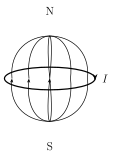
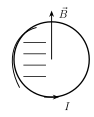
Qualitatively, the field lines of a circular current loop (Fig. 10.20) pass through the loop's own interior in a direction roughly parallel to the axis, then spread out, curve around, and close back up on the far side -- a pattern immediately recognisable as very similar to the familiar field-line pattern of a short bar magnet. Applying the right-hand thumb rule to the loop as a whole (curl the fingers along the sense of current circulation; the outstretched thumb then gives the field direction through the loop's centre, Fig. 10.21) lets one face of the loop be identified as an effective "north pole," and the opposite face as an effective "south pole" -- even though, physically, there is no actual magnetic material or separated pole anywhere in sight, only a circulating current.
This "effective dipole" behaviour can be made precise by DEFINING a magnetic moment for the loop as the vector , where is a vector of magnitude equal to the loop's enclosed area, directed along the loop's normal (exactly the definition of the magnetic dipole moment already met in Section 10.8, here written with the alternative common symbol rather than ). Substituting into the on-axis field formula of Section 10.13, and specialising to the case of large axial distance, (so that becomes negligible compared to in the denominator, ), gives
…
Drawn by us to help you understand the concept clearly, and verified to make sure it's accurate. For exams, practice from your textbook's own diagram.
What this figure shows. A circular current-carrying loop is shown lying flat, with a full pattern of magnetic field lines drawn threading through and around it: lines pass straight through the centre of the loop (roughly parallel to its axis, close to the loop), then curve outward and around on either side of the loop, closing up into large loops that return from the far side, in a pattern that closely resembles the familiar field-line pattern of a short bar magnet (dense and roughly parallel lines threading straight through the 'poles', flaring out a …
Drawn by us to help you understand the concept clearly, and verified to make sure it's accurate. For exams, practice from your textbook's own diagram.
What this figure shows. A circular current loop is shown with a right hand curled around its circumference, the curled fingers following the SENSE of the current flow around the loop (the direction charges actually move around the ring), and the extended right-hand thumb pointing straight through the centre of the loop, ALONG its axis -- this thumb direction is the direction of the magnetic field (and of the magnetic moment ) on the axis of the loop, and by convention marks the face the thumb points out of as the lo …