Physics · Ch 10 — Magnetic Fields due to Electric Current
Force of Attraction between two Long Parallel Wires
Force of Attraction between two Long Parallel Wires
The two-wire demonstration that opened this chapter (Fig. 10.1, Section 10.1) showed QUALITATIVELY that current-carrying wires exert forces on one another -- attractive for parallel currents, repulsive for antiparallel ones -- but left the underlying mechanism and the exact magnitude of the force unexplained. With the tools of the intervening sections now in hand -- the Biot-Savart-law field of a long straight wire (Section 10.10.1) and the force on a current-carrying wire in a magnetic field (Section 10.5.1) -- that force can now be derived precisely.
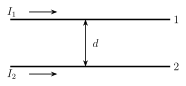
Consider two long, straight, parallel wires, separated by a perpendicular distance , carrying currents and respectively (Fig. 10.17). The magnetic field produced by wire 1, AT THE LOCATION of wire 2, is, directly from Section 10.10.1,
directed (by the right-hand rule) into the plane of the paper if the currents are drawn in the plane, circling around wire 1. Wire 2, carrying current , now sits in this field produced by wire 1, and so experiences a force given directly by the straight-wire force law of Section 10.5.1: for a segment of wire 2 of length ,
directed, by applying the Lorentz force law with this specific field's direction, TOWARDS wire 1 -- i.e. attractive, for the case where both currents flow in the same direction (as drawn). Dividing through by gives the FORCE PER UNIT LENGTH between the two wires,
attractive whenever and flow in the SAME direction (parallel currents), and, by an identical calculation (only the direction of the resulting force flips), repulsive whenever they flow in OPPOSITE directions (antiparallel currents) -- precisely reproducing, now with an exact formula attached, the qualitative Fig. 10.1 demonstration from the very start of the chapter: parallel currents attract, antiparallel currents repel. …
Drawn by us to help you understand the concept clearly, and verified to make sure it's accurate. For exams, practice from your textbook's own diagram.
What this figure shows. Two long straight wires are drawn parallel to each other, separated by a fixed perpendicular distance d, each carrying its own current -- in the first wire and in the second, both drawn in the SAME direction along their lengths (illustrating the attractive case worked out in the surrounding text). The figure establishes the basic geometry (two parallel lines, separation d, both currents labelled) that the force-per-unit-length formula is derived for, with the direction of the resulting mutual force (towards each other, i.e. attractive, for this same-direction case) implied by applying the …