Physics · Ch 10 — Magnetic Fields due to Electric Current
Magnetic Field Produced by a Current in a Circular Arc of a Wire
Magnetic Field Produced by a Current in a Circular Arc of a Wire
Having worked out the field of a straight wire (Section 10.10.1), the next natural shape to consider is a CIRCULAR arc of wire -- and, as a special case, a complete circular loop, which turns out to be considerably simpler to handle than the straight-wire case, on account of a special geometric fact unique to circles.
Consider a circular arc of a wire, of radius , centred at a point , subtending an angle (measured in RADIANS) at that centre, and carrying a steady current (Fig. 10.18). Take a current element anywhere along this arc. Because every point on a circle is, by the very definition of a circle, always exactly the SAME distance from the centre, and because the tangent direction to a circle at any point is always exactly PERPENDICULAR to the radius drawn to that point, the current element (which points along the local tangent direction of the wire) is ALWAYS perpendicular to the radius vector drawn from that element to the centre -- for EVERY element along the arc, without exception. This means the angle between and in the Biot-Savart law is always exactly , so throughout, and moreover itself stays constant (equal to the arc's own radius) as the integration proceeds along the arc. Both of these simplifications together mean the general Biot-Savart integral collapses to something very simple:
(using , the standard relation between arc length, radius, and the SUBTENDED ANGLE in radians), directed, throughout the arc, into (or out of) the plane of the page according to the right-hand rule applied to the current's direction of flow.
As an important special case, letting the arc become a COMPLETE circle -- that is, radians, the full angle around a circle -- gives the field at the CENTRE of a full circular current loop of radius , carrying current : …
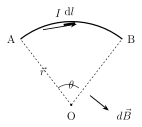
Drawn by us to help you understand the concept clearly, and verified to make sure it's accurate. For exams, practice from your textbook's own diagram.
What this figure shows. A circular arc of wire AB, part of a circle of radius r centred at point O, carries a current I flowing along the arc from A to B. A representative differential length element is marked at some point along the arc, together with the radius vector drawn from that element straight to the centre O -- explicitly drawn (and labelled) as being PERPENDICULAR to at every point along the arc, which is the key geometric fact (unique to a circular shape) that makes the Biot-Savart integration for the field at the centre O particularly simple, since $\sin\theta=\ …
Worked out. A wire consists of three sections joined together: a straight section (i), a semicircular section (ii) of radius R, and another straight section (iii), forming a path that passes near a point O (the centre of the semicircle), and the field at O due to each of the three sections individually, and their total, is required. For sections (i) and (iii), the current-length element is found to be exactly PARALLEL (angle ) or ANTI-PARALLEL (angle ) to the radius vector drawn to O for every point on those straight sections, so and each contributes ZERO field at O. For section (ii), the semicircular arc, is always PERPENDICULAR to (as in the general circular-arc case above), giving, via the arc-field formula with (a semicircle, i.e. half of ), . Since sections (i) and (iii) contribute zero, the TOTAL field at O is simply this same value, $B_{total}=0+\frac{\ …