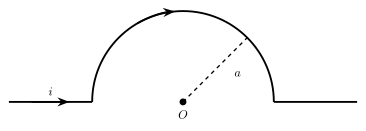
Q.A conductor has 3 segments: two straight segments, each of length L, and a semicircular segment of radius R, joined so that the semicircle's centre is at point P, carrying a current I (the magnetic field at P is directed into the plane of the paper). What is the magnetic field B at point P? [The four printed answer options for this item are badly garbled in the source scan -- the visible fragments read like repeated/duplicated mu_0 I / (4R)-type expressions with no clean, distinct (A)-(D) set recoverable, and the exact geometry of how the two straight segments meet the arc (whether their current elements are collinear with P) is only fully fixed by the printed figure.]
Concept understanding — Magnetic Field at the Centre of a Circular Current Loop
Applying the Biot-Savart law to a circular arc of wire exploits a special geometric fact unique to circles: every current element along the arc is always exactly perpendicular to the radius vector drawn to the centre, and every element is the same fixed distance from the centre. This simplifies the Biot-Savart integral for the field at the centre O of an arc of radius r subtending angle (in radians) to .
As the special case of a COMPLETE circular loop (), this gives the widely-used result for the field at the centre of a full circular current loop of radius r carrying current I: , or for N turns. This centre-of-loop formula is one of the most frequently used results in the whole chapter, and is also correctly recovered as the special case z=0 of the more general on-axis field formula for a circular loop.
Unlock everything free for 14 days
- Full step-by-step solutions
- Concept-first explanations
- Methods, shortcuts & mistakes
- PYQ mapping + timed mock tests
Full access for 14 days. No credit card required.