Physics · Ch 10 — Magnetic Fields due to Electric Current
Cyclotron Motion
Cyclotron Motion
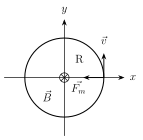
A key structural consequence of Section 10.2 is that the magnetic force on a moving charge is always perpendicular to its velocity, and always has a constant magnitude for a fixed speed and field strength. This is exactly the condition needed to produce UNIFORM CIRCULAR MOTION -- a net force of constant magnitude, always directed towards a fixed centre, is precisely what is needed to keep a particle moving in a circle at constant speed (a fact already familiar from the study of circular motion). Consider, then, a charged particle of charge moving with speed in a region where a uniform magnetic field is directed perpendicular to the plane of the particle's motion (Fig. 10.5). The magnetic force on the particle, (since here, so ), acts at every instant towards the centre of a circle of some radius , and this force supplies EXACTLY the centripetal force needed to sustain that circular motion:
Rearranging this single equation gives two equally important results. First, solving for :
Second, rewriting it in terms of the particle's momentum :
This last relation, , is known as the cyclotron formula, and it is the mathematical foundation of the cyclotron accelerator discussed in the next subsection: it says that a charged particle of a given momentum, moving perpendicular to a given magnetic field, traces out a circular arc of a radius fixed entirely by that momentum, charge and field -- and, conversely, that measuring the radius of the circular path lets you determine the particle's momentum (or, if the momentum is known, its charge-to-mass ratio) directly. …
Drawn by us to help you understand the concept clearly, and verified to make sure it's accurate. For exams, practice from your textbook's own diagram.
What this figure shows. A uniform magnetic field is directed perpendicular to the plane of the page (into the page, i.e. parallel to the negative z axis, with x and y axes drawn in the plane of the page). A particle of charge q, moving with speed v, is shown at one point of a circular path of radius R that it traces out in the xy plane; a force arrow is drawn pointing from the particle's position radially INWARD, towards the centre of the circle -- illustrating that the magnetic force provides the centripetal force that curves the particle's straight-line motion into a circle, with R marked a …